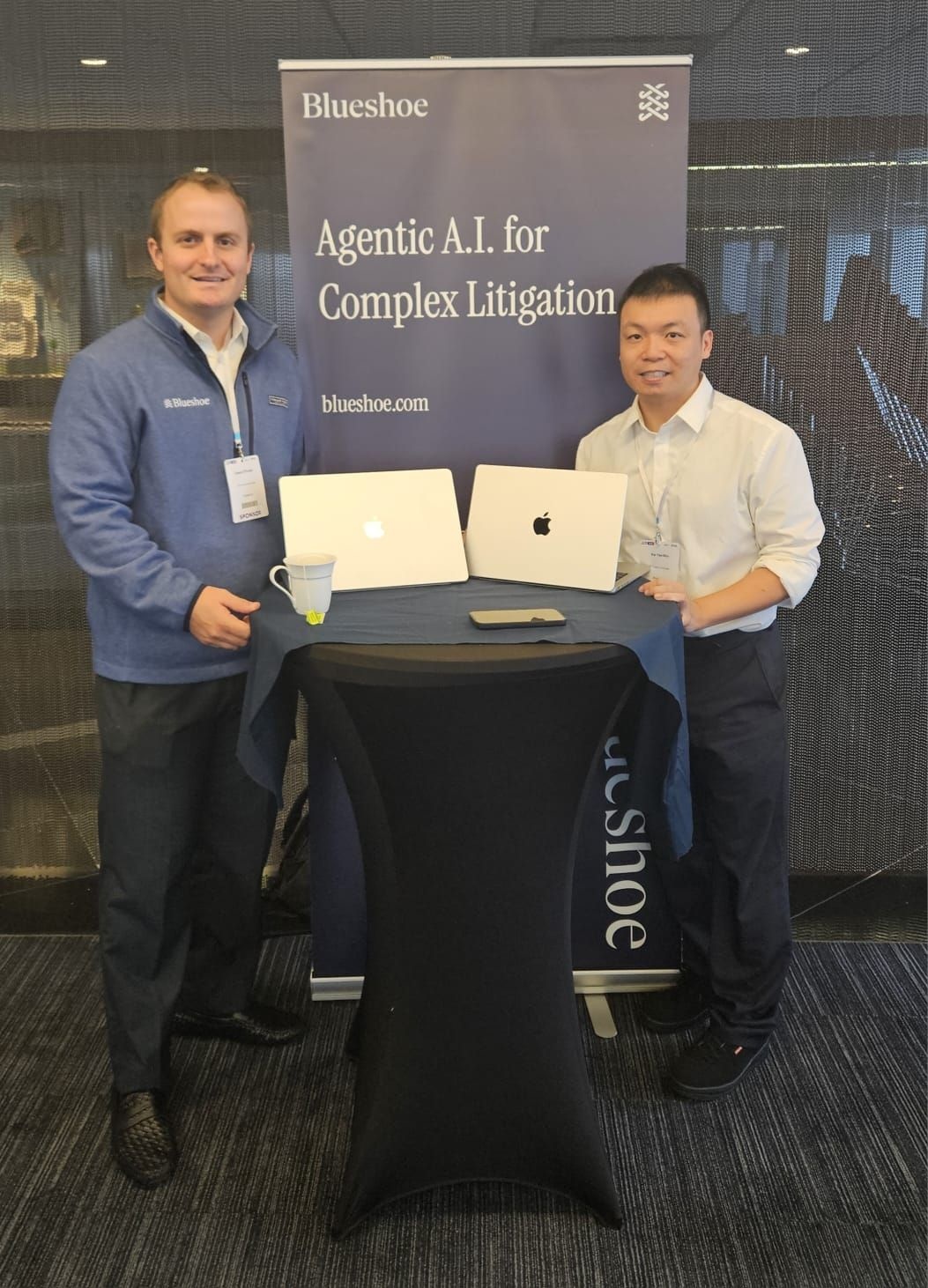
At a conference in Boston, Casey O'Grady kept hearing a perfectly reasonable question: what does your tool do? He had come to Future Lawyer USA with his co-founder, Kai Yee Wan. Behind them stood a Blueshoe banner advertising agentic AI for complex litigation. In front of them sat two open laptops, a paper cup and the familiar problem of explaining a young company in one breath.
O'Grady's answer was becoming difficult to contain. Drafting could turn into litigation strategy. Intake could become a synthesis of facts. Research could lead into reasoning. Once a lawyer began working with AI, the task had a habit of wandering beyond its original job description. The tidy product category was losing an argument with the work itself.
That observation helps explain the changing shape of Blueshoe. Its early public pitch concerned the legal back office. Later came research and reasoning. Today, O'Grady and Yee Wan are building around consumer legal services and plaintiff representation. They have moved from helping the profession manage its work toward helping a person reach the profession in the first place.
For O'Grady, the distance between those two things has become the subject. A person can ask a question in seconds. Finding someone qualified to act on it is a separate journey, with its own delays, repeated explanations and unfamiliar vocabulary. He wants more of that journey to happen inside a single conversation.
A runner with a philosophy prize
Long before the conference banner, there was a track. O'Grady grew up in Phoenix and graduated from Brophy College Preparatory in 2007. His high-school running record included 52 seconds for 400 metres and two minutes for 800. He helped his team win a regional track title and belonged to the school's 2006 football state championship team.
Rice listed him as a middle-distance runner. Its freshman biography also recorded a National Merit scholarship and membership in the National Honor Society. These are pleasantly concrete details in a profession where biographies often hurry straight to the prestigious degree. Here, there is a young person with both race times and classroom credentials, before anyone has asked him to explain a business model.
At Rice, he studied philosophy and mathematics. In the 2010-2011 academic year, he received the James Street Fulton Prize for Excellence in Philosophy. The department awards it to a graduating senior for achievement and motivation in the field. The prize includes a book and $250, a sum unlikely to alter anyone's financial destiny but quite capable of making a graduation week better.
Harvard Law followed. His professional route then took several turns: a legal internship at the Arizona Attorney General's Office, an associate role at Osborn Maledon, investment banking at Lazard, and strategy consulting at Altman Solon. The last of those lasted from 2020 to 2024. Each role placed him inside a different professional system, with its own documents, incentives and ways of deciding what mattered.
That sequence supplies useful context for his eventual company. He had experience with legal practice and with the commercial machinery surrounding professional work. His founder biography also records advising Fortune 500 companies on AI adoption. By the time he began Blueshoe, the technology was something he had already helped other organizations consider.
Two laptops and a moving target
O'Grady and Yee Wan met in Cambridge, Massachusetts. O'Grady says Blueshoe began in a coffee shop halfway between Charlestown and Cambridge. The location is modest; the partnership was deliberately broad. A lawyer with consulting experience and an engineer could bring different questions to the same pile of paperwork.
Yee Wan's background includes research at MIT's Computer Science and Artificial Intelligence Laboratory, embedded software work on Google's Chrome and Nest teams, and teaching computer science at Northeastern. He became Blueshoe's CTO. O'Grady became CEO. Their company joined Y Combinator's Spring 2025 batch, taking the idea from the Boston area to San Francisco.
The move involved a family as well as a company. In his launch announcement, O'Grady thanked his wife, Eileen Ong, for backing the adventure. Her own public congratulations described the risk and doubt involved in making a path of his own. Beneath the familiar accelerator announcement was an ordinary domestic fact: a startup move changes the lives of people whose names never appear in the pitch deck.
The early offering concentrated on invoices, compliance and the financial organization of law firms. By September 2025, Blueshoe was announcing a platform for legal research and reasoning. It opened pilot access to individuals at Harvard, Yale and Columbia law schools. O'Grady described the aim as helping users work with the structure of legal thought, rather than stopping at the retrieval of relevant material.
This is where the conference question becomes revealing. A research product can find something. A lawyer still has to connect it to facts, decide whether it helps and consider what the other side will say. A case keeps generating new tasks. O'Grady's account of the Boston conversations suggests he was thinking about how software could keep pace with that progression.
- 2025The back officeBilling and operations
- SEPT 2025The legal argumentResearch and reasoning
- JUNE 2026The clientConsumer and plaintiff services
The case should remember
Blueshoe's case-builder project makes the current direction tangible. A person describes what happened through an AI assistant. The project helps organize the account into a case file, capturing facts, jurisdiction, relevant dates and evidence. The materials can develop as documents and updates arrive.
The file is portable and human-readable. Someone can take it to another attorney. Engaging a Blueshoe lawyer remains a decision made by the person in the app. Those details matter because they give the early organizing work a purpose even before the person chooses representation.
There is a quiet ambition in a file that travels well. Professional services routinely ask customers to translate a messy event into an orderly submission. The person knows the event from the inside; the professional needs a chronology, documents and answers to specific questions. A system that helps with that translation can reduce the distance between the account someone gives and the account a lawyer can use.
“We think it should start with a conversation.”
Casey O'Grady, on legal intake
For O'Grady, this is a way of designing the beginning of a matter. His explanation of case-builder puts the emphasis on avoiding forms and phone tag. An attorney should receive an organized matter rather than begin with a cold call and reconstruct everything afterward.
Good continuity is easy to overlook in a demonstration. The striking moment is usually an answer appearing on a screen. The less theatrical question arrives later: can the next person see what has already happened? Legal work takes place over time. Remembering the conversation, and making it useful to someone else, is part of the service.
Someone has to check the work
O'Grady's interest in the mechanics of a firm also appears in his scholarship. In 2025, he and Catherine Gage O'Grady co-authored an article in the Georgetown Journal of Legal Ethics on AI agents as ethics counsel. It considers how specialized agents could support ethical decision-making inside legal workflows.
The proposal includes accountability, supervision and systematic guidance. It also examines human decision-making biases. That last element gives the paper an interesting balance: the professional environment already has fallible people in it. Introducing software requires attention to both kinds of error and to the responsibilities of the people overseeing the work.
The article treats ethical guidance as an activity that can be built into a working process. A reminder has to arrive when a decision is being made. A concern has to reach someone who can act on it. Those are practical design questions for a founder who wants AI to carry more of a firm's operational burden.
They also keep the company story grounded. More output creates more work to inspect. Faster handling makes supervision consequential. O'Grady's paper offers a way to think about those obligations alongside the technology, while his business asks how that technology might change the delivery of legal services.
The lawyer joins the conversation
In June 2026, O'Grady announced Blueshoe's launch as a consumer and plaintiff law firm. His explanation was direct: “Lawyers are how people protect their rights.” The ambition extends from everyday questions to litigation, with technology supporting the operation around the attorney.
Employment is one area he has singled out. His account begins with decisions people make about contracts, compensation and their working lives, often without counsel. He wants legal expertise paired with better information and context. The customer in that picture is someone trying to understand a consequential document, rather than a legal department shopping for another subscription.
Blueshoe's current structure brings a technology company together with a separate legal-services entity. Attorneys provide the legal service. The platform provides ways to begin, organize and continue the matter. That distinction gives the ambition its working form: the person asking the question needs a path to someone who can take professional responsibility for helping.
O'Grady has also described a more personal attraction to AI. He says it has made work more enjoyable by reducing the time he spends wrestling with presentation details and letting him move more directly from an idea to something usable. For a former consultant, the PowerPoint slide is a suitably small antagonist. It can consume an afternoon without ever becoming interesting.
The larger ambition is to build a national firm with his co-founder. The route there will depend on the experience of individual clients and attorneys: whether the first conversation produces useful information, whether that information reaches the right person, and whether the work continues coherently after the handoff.
At the Boston conference, two founders stood behind a table and explained software. Their banner supplied a category; O'Grady's answer kept spilling beyond it. The company he is building now takes on a broader obligation. Somewhere, a person has a question about a contract, a job or a dispute. O'Grady wants the next conversation to include a lawyer.