A new drug molecule can be a scientific triumph and still leave a painfully ordinary question unanswered: how do you turn it into something a patient can take? The discovery needs a recipe. That recipe must behave predictably, survive storage, and deliver its ingredients properly. The glamorous announcement arrives before much of the difficult work.
Start there and Cartography Capital becomes easier to understand. The Oakland venture firm invests in companies working on the technologies and materials that other technologies require. Its opportunity lives one step earlier in the chain of invention.
- The bet: back the enabling layer beneath new products.
- The evidence: investments spanning pharmaceutical formulation, materials design, and maritime fuel systems.
- The useful lesson: find the dependency, then ask how it becomes a business.
The recipe after the discovery
Consider portfolio company Persist AI. Its Cloud Lab lets pharmaceutical scientists access robotic formulation facilities through a website. Software predicts possible formulations; equipment builds and tests them. The experiment still happens in the physical world. Someone has simply made the route to that experiment more accessible.
In its May 2025 announcement, Persist reported testing 700 formulations in two months for a major pharmaceutical client. It also announced a $12 million Series A led by Spero Ventures, with Cartography among the participants. That figure describes the entire financing round. It buys no shortcut around proving that a formulation works.
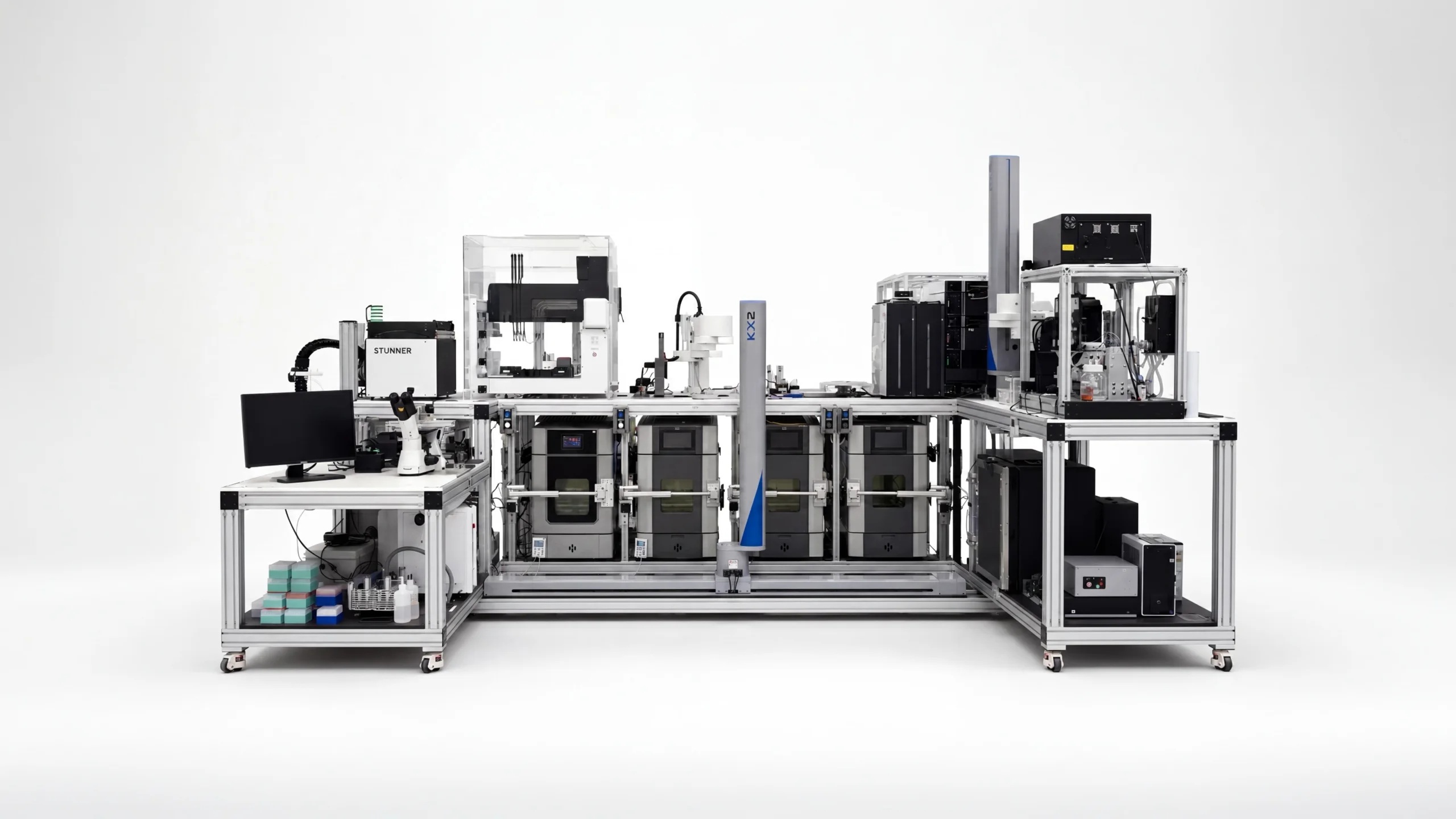
The attraction is the bottleneck. A faster way to discover molecules increases the value of a reliable way to develop their formulations. Progress in one part of an industry can create pressure somewhere else. Cartography’s approach invites investors to look for that pressure before assuming the most visible product contains the whole opportunity.
A material, a policy, an engine
MatNex supplies another example. It designs materials against customers’ performance and cost requirements using computation, machine learning, and materials engineering. Its February 2025 partnership with Viridien aimed to expand computing capacity; the announcement named Cartography as an investor. Here, the thing holding up a product might be a material that does not yet meet the specification.
The portfolio has room for less obvious infrastructure. Flora develops individually owned fertility insurance. Its 2024 pre-seed announcement named Cartography as a co-investor. Insurance changes who can afford access to care. The underlying obstacle is financial rather than chemical, but it still sits between a useful service and the person who needs it.
Then there is Blaze Energy. On October 6, 2026, it announced a $6.5 million seed round including Cartography. Blaze develops systems intended to let combustion engines use alternative fuels, initially for maritime shipping. Its planned 2027 vessel deployment remains a future milestone. The proposition addresses a practical hesitation: committing to a fuel while the surrounding supply infrastructure is still changing.
Operators who crossed the table
Cartography’s team presents itself through operating experience. Managing Partner Daniel Quintero’s biography describes three founding ventures and acquisitions involving Twitter and JPMorgan Chase. General Partner Ben Stein previously worked across product, sales, and customer success at Square, Opendoor, and SMBX. The firm’s team page also lists finance and operations leaders.
Those backgrounds suggest an interest in the messy passage from promising technology to functioning company. They do not establish what any particular founder receives. A useful founder conversation would get specific: which customer introduction, manufacturing decision, or financing milestone can this investor help with?
That distinction matters when reading the large numbers on a venture website. A team’s earlier fundraising and exits describe its experience. Fund returns describe what happened to investors’ money. The two answer different questions. Cartography belongs in the market for early-stage private capital, where founders compare investors as prospective partners and limited partners assess an investment manager.
“We invest in origin stories.”Cartography Cap’s LinkedIn tagline
There are two relationships to keep in view. Founders seek capital to build companies; limited partners supply capital to an investment manager. The manager selects and monitors investments on their behalf. A portfolio product’s customer is a third party again: a pharmaceutical scientist, an industrial buyer, or a shipowner. Keeping those roles straight makes the firm’s offering clearer. You approach Cartography about investment; you approach the operating company about using its technology.
Then the spreadsheet got in the way
The firm encountered its own enabling-system problem. A Visible customer story describes portfolio updates collected through spreadsheets, calls, and email becoming unsustainable as Cartography prepared an infrastructure-focused second fund. It selected Visible in early 2024, introducing automated requests, dashboards, and a central investor data room.
The copyable practice is to decide which information matters before automating its collection. Different businesses need different measures. A fuller dashboard helps only when founders supply timely information and the figures mean what the reader thinks they mean.
Follow the dependency
For a founder, Cartography offers a potential capital partner whose stated thesis makes room for enabling technology. For an industry observer, its portfolio offers a useful exercise: trace a desirable outcome backward until you reach the unresolved constraint. Ask who pays to remove it.
The next questions should be equally concrete. What experiment would change the conclusion? Which buyer has the problem today? How much capital is needed to reach the next useful proof point? A technical dependency becomes an investable proposition only when somebody can explain the route from an interesting result to a repeatable sale. That is a useful discipline even for readers who never write a venture check.
That exercise has limits. A necessary component may still be expensive to manufacture, hard to qualify, or too early for customers to buy. Scientific validation and commercial demand must meet on a workable timetable. Better reporting can reveal that distance; financing can help a company cross it. Neither makes the distance disappear.
Cartography’s most interesting question is therefore quite concrete. Before the new product can succeed, what else has to work? Somewhere between the molecule and the medicine, or the fuel and the engine, a founder is working on the answer.