The ordinary miracle of a payment is how little of it we see. A card touches a terminal, a phone approaches a reader, a confirmation appears. Behind that tidy gesture sits a crowded room: banks, processors, networks, authentication providers, fraud systems, cloud services and data tools, all passing messages quickly enough to preserve the illusion of simplicity. Carolina Mondragón Romero has built her career in the distance between the tap and the crowded room.
She is the Chief Marketing Officer of CLAI PAYMENTS, working from San José, Costa Rica, across a Latin American market where old and new forms of money must often share the same rails. Her assignment is easy to state and stubbornly hard to execute: connect payment technology with what banks, processors, cooperatives and fintech companies actually need. A switch has to become a business choice. Interoperability has to sound less like a conference badge and more like a workable future.
Mondragón describes her own position as the intersection of strategic marketing, financial technology and commercial growth. The useful word is “intersection.” She did not arrive through computer science or banking. She arrived through graphic design, a profession built around hierarchy, sequence and the disciplined placement of attention.
First, she learned to arrange the page
From 2006 to 2010, Mondragón studied graphic design at the Universidad Nacional de Colombia. Her early marketing work at Cesvi Colombia, the country's automotive research and road-safety center, stretched well beyond a single channel. Public career records describe responsibility for corporate strategy, digital positioning, websites, an institutional magazine and a graphic-design team. Her professional profile also records participation in Revista Auto Crash beginning in 2013.
It was an education in subjects that resist breezy treatment. Vehicle repair, insurance research and road safety demand precision. So does a magazine page: the reader must know where to look, what matters and how one piece relates to the next. There is little romance in a mislabeled diagram. There is even less in a misunderstood technical claim.
The move into payment technology in 2015 changed the machinery but preserved the method. Mondragón joined CLAI PAYMENTS as marketing manager. She added a specialization in strategic marketing management from Universidad Piloto de Colombia that year, later took the university's seminar in effective service management, and completed a master's in commercial management and sales at UNIR from 2019 to 2021. More recently, she has added training in SEO, growth marketing and conversion-rate optimization. The collection suggests a practitioner repeatedly updating the toolkit around the same problem: how people find, understand and act on complicated information.
Then the page became a payment ecosystem
At CLAI, the nouns multiplied. Payment hubs. Card cores. Tokenization. Cryptographic servers. ATM and point-of-sale management. Reconciliation. Transaction routing. The products live behind other products, which makes their marketing an exercise in earned clarity. Consumers may love a smooth checkout, but they rarely write poems to the transaction switch.
Mondragón's public work shows how she approaches the task. In 2021, writing as CLAI's marketing director, she published an article about the keys to security in payment platforms. In 2022, she co-authored a report on the future of ATMs with ATM specialist Adrian Molina and research-and-development chief Joset Carmona. Its premise was practical: the cash machine need not remain a sealed box that only dispenses money. With the right transactional integration, it can support more services, centralize operations and offer a better interaction.
That argument contains a recurring Mondragón idea: modernization is not always a bonfire for everything already installed. Existing infrastructure can be made more useful. The hard part is coordinating it with new channels, new partners and new security demands without turning every addition into a fragile custom project.
The same theme surfaced at Fintech Americas Miami in 2022, where Mondragón, identified as CLAI's CMO for Costa Rica, helped lead the data and analytics track with Pablo David Narváez. The program framed data in unusually human terms. Better information could help institutions understand users, their needs and their aspirations, and thereby gain empathy. In a sector fond of dashboards, empathy is a slightly unruly metric. It is also what prevents “customer experience” from becoming a polished label pasted over institutional convenience.
The regional room is part of the job
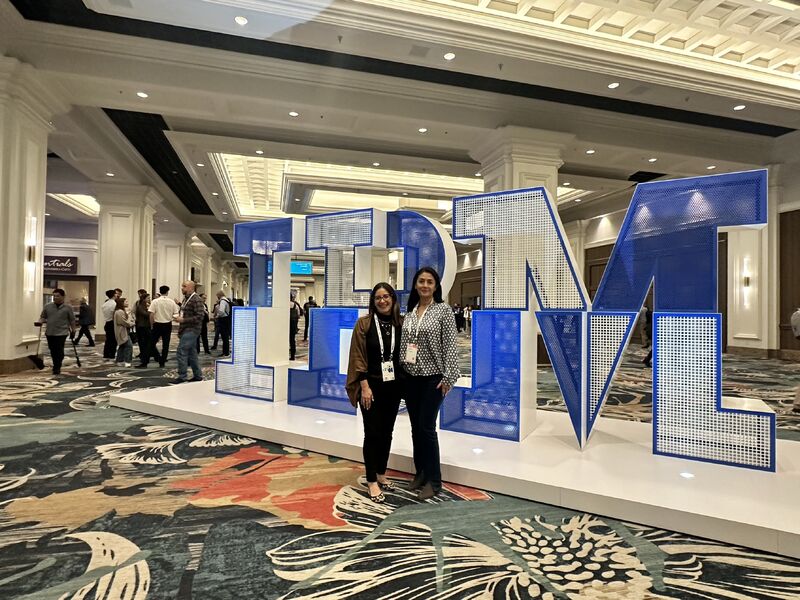
Payment systems are national, regional and global all at once. Regulation changes at borders; networks ignore them; customers simply want the transaction to work. Mondragón's calendar reflects the geography of that contradiction. In 2022 she appeared at Fintech Americas Miami. In 2024 she and colleague Amanda Merchán Guerra represented CLAI at IBM TechXchange in Las Vegas, where the company prepared a breakout conversation about the future of payments and the factors that belong in a transactional ecosystem.
In 2026, the conversation moved through Latin America. At Banking Tech Summit Honduras, Mondragón and CLAI's Central America manager Esteban Corrales discussed the move from transaction growth to frictionless integration. Honduras offered a particularly useful case: cash remained prominent, remittances mattered, and electronic transfers were growing. The point was not to declare one method the winner. It was to build infrastructure capable of letting different methods coexist.
She also represented CLAI at ESIS in Quito, alongside Jairo Garzón and Fabio Sánchez, in discussions spanning digital payments, artificial intelligence and cybersecurity. Afterward, her public note thanked ATEFI, BANRED and host Monica Altamirano, and said the team was already eager to return. The remark is small but revealing about how regional industries function. Ideas travel through panels; trust travels through repeated encounters.
- 2006-2010Studies graphic design at Universidad Nacional de Colombia.
- 2010-2015Builds a broad marketing practice at Cesvi Colombia, including digital work and editorial production.
- 2015Joins CLAI PAYMENTS and specializes in strategic marketing management.
- 2021-2022Publishes on platform security, completes a commercial leadership master's and co-authors an ATM report.
- 2024-2026Represents CLAI in Las Vegas and across Latin American banking and payments events.
Growth creates its own tangle
The cleanest expression of Mondragón's current field came in a 2026 discussion of digital payments in Honduras. More transactions are a welcome signal, but volume alone does not produce a future-ready system. Every channel, fintech partnership and specialist provider adds another connection that must exchange information safely and remain available. Digital success creates an integration problem.
This is where her design background feels less like an origin anecdote and more like a working advantage. Good design is not the removal of detail. It is the arrangement of detail so the whole becomes navigable. Payment orchestration asks a related question in software: which route should a transaction take, which controls should intervene, and how can new parts join without upsetting the system already in motion?
The marketing version has its own sequence. Start with the institution's actual constraint. Preserve the technical truth. Show the consequence in the customer's life. Resist the temptation to turn every architecture diagram into a promise of revolution. Mondragón's public vocabulary returns instead to integration, security, efficiency and experience. These are sober words. In payments, sobriety is a feature.
A career built on connecting the parts
Eleven years after joining CLAI, Mondragón's remit has expanded from managing marketing to leading the company's communications, positioning and understanding of the financial sector. Her stated aspiration is connective: bring payment technology, market knowledge and commercial growth together in Latin American banking. Her recent comments add the operating conditions. Platforms must be ready to scale with security, efficiency and attention to the user's experience.
There is no dramatic career break here, no reinvention that requires the previous chapter to be disowned. The magazine, the marketing specialization, the sales master's, the security article, the ATM report and the regional stages form a continuous line. Each added a new kind of complexity and another audience that needed a clear entrance.
Her newer credentials make the same point in miniature. SEO concerns discovery. Conversion-rate work asks what helps an interested person move. Growth marketing joins those decisions to a larger commercial system. None replaces the editorial eye; each extends it. For someone selling infrastructure to other businesses, the journey from first explanation to technical confidence can be long. Mondragón's career has accumulated tools for every step along that route, without confusing the route for the relationship at its end.
That continuity is the interesting thing about Carolina Mondragón Romero. A designer learned how to direct attention. A marketer learned the commercial stakes. A payments executive learned that the system grows more complicated whenever it succeeds. Her work now sits inside a paradox familiar to every infrastructure business: the better the machinery performs, the less anyone notices it. Someone still has to explain why it works.