A nurse can find a job on a screen in seconds. Getting that nurse onto a hospital floor is another matter. Someone has to verify a license, collect the right documents, arrange the assignment, and make sure the pay arrives. The listing is the visible part. The machinery behind it is where a staffing company earns its keep.
- Care Career buys specialist staffing businesses and keeps their brands.
- Shared services cover credentialing, payroll, billing, and staffing support.
- The MAS acquisition adds Maestra, a platform for viewing and self-scheduling shifts.
Care Career has been assembling that machinery at speed. By July 2026, the company said it had completed seven acquisitions in roughly two years, taking annual revenue beyond $150 million. Its proposition contains a useful tension: bring the businesses together while preserving the identities that made them worth buying.
01 / THE ACQUISITION LOGICA bigger network, a familiar recruiter
The sequence began with Alliant Personnel Resources in August 2024. Amare Medical Network and MedUS Healthcare followed in March 2025; Next Move Healthcare joined in April. In its announcement that May, Care Career said those companies would continue under their existing brands and leadership. The arrangement made continuity an explicit part of the deal.
There is a practical reason to care about a name. Healthcare staffing involves personal knowledge: what a clinician can do, where they want to work, which assignment suits their circumstances. Care Career’s strategy suggests that these relationships are assets worth protecting. A new parent company can supply resources without requiring every recruiter to introduce themselves all over again.
“centralized strength while preserving their unique voices”
SIVA KONATHAM · MAY 2025 ACQUISITION ANNOUNCEMENT
The additions also change what the group can supply. Source Medical Staffing, acquired effective October 25, 2025, brought therapy and post-acute expertise. Its disciplines include physical, occupational, and speech therapy. IDR Healthcare then expanded the network’s healthcare and education staffing capabilities in 2026. Each deal adds a particular kind of knowledge alongside the extra reach.
02 / THE LESS GLAMOROUS WORKThe paperwork is part of the product
Look past the travel nursing language and Care Career has another customer: the staffing firm itself. Its operational services include primary-source credential verification, license tracking, background checks, and ongoing monitoring. It offers payroll processing and tax reporting, plus billing services that reconcile invoices with managed service providers and vendor management systems.
These are wonderfully unphotogenic activities. They also sit directly between a successful match and a functioning assignment. Care Career lists around-the-clock per diem support for urgent coverage and schedule changes. Sure Staff, another portfolio-listed business, supplies offshore staffing support, credentialing, and back-office services. The recurring theme is administrative work that many staffing businesses would otherwise have to organize separately.
The commercial logic is straightforward: serve facilities through staffing and placement work, and serve staffing operators through operational support. For a hospital, the purchase is access to appropriate talent and the work needed to place it. For an agency, it can include capacity behind the scenes. The group occupies both sides of that operational problem.
03 / A DIFFERENT KIND OF ASSETWhen a staffing deal buys software
The July 2026 acquisition of MAS Medical Staffing makes the strategy more interesting. MAS brought travel nursing, allied health, and per diem operations, along with its proprietary Maestra platform. Maestra allows clinicians to view and self-schedule available shifts. A staffing transaction had also become a purchase of software people could use.
Care Career said Maestra’s scheduling, credentialing, and communication capabilities would be integrated into its technology stack. It also described plans involving artificial intelligence and workforce analytics. The distinction matters: self-scheduling is an identifiable function; the wider technology story is a strategy still being executed. A useful way to judge it is to count how many steps disappear for the clinician.
04 / THE CLINICIAN’S VIEWWhat a clinician can actually do
The Care Career app already offers a more concrete tour. Its listing describes job browsing without registration, profile creation, and applications. Once on assignment, clinicians can upload timesheets, request extensions, and track compliance. Those functions follow the working relationship beyond the moment a candidate clicks Apply.
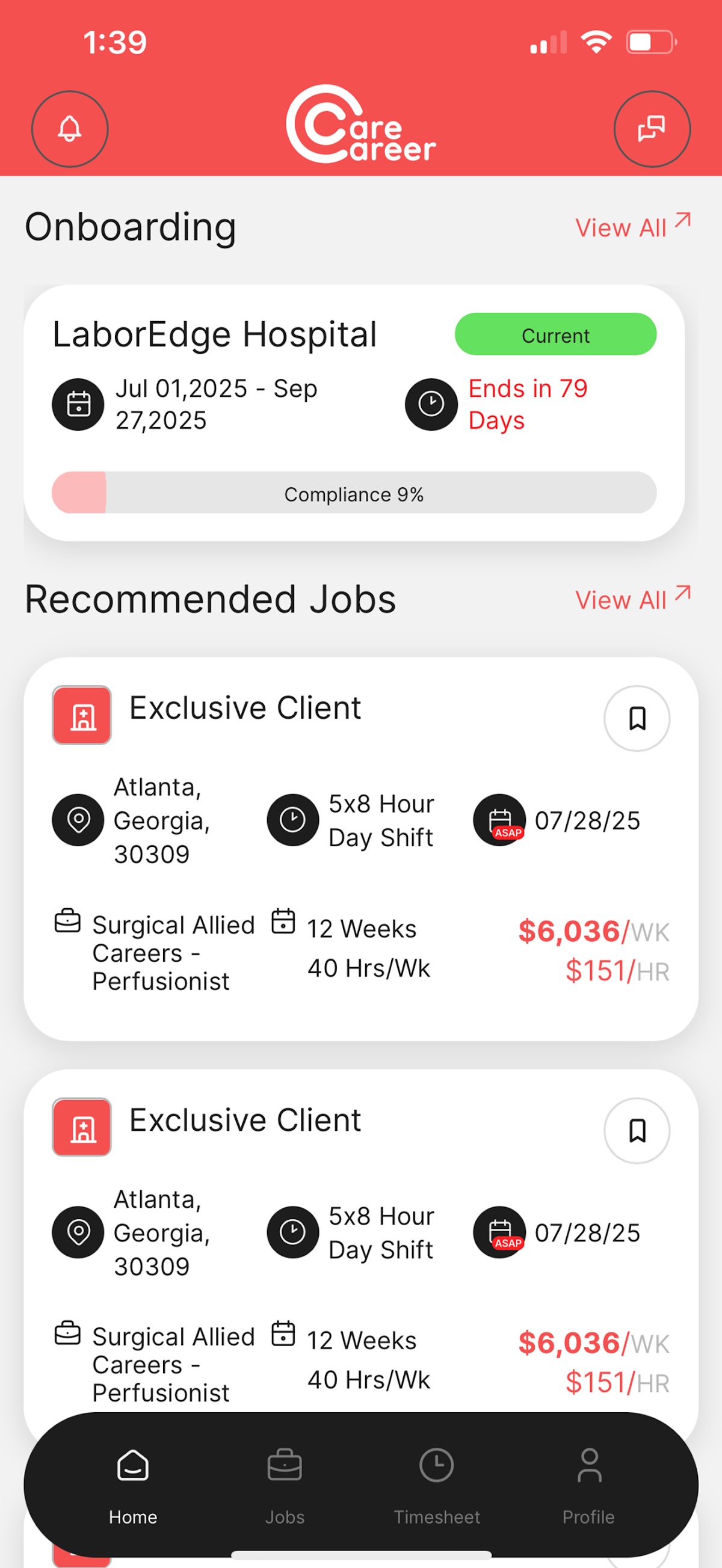
Onboarding progress and recommended assignments share the same screen.
For facilities, Care Career advertises dedicated account teams and a network spanning more than 75 specialties. It reports relationships with over 500 healthcare institutions and access to more than 100,000 travel nurses and allied professionals. Read those figures as the company’s description of its network. They do not mean 100,000 people are currently working assignments.
Its portfolio spans travel and local work, permanent placements, corrections, post-acute care, and more. Staff Universe adds a marketplace intended to connect clinicians, staffing partners, and facilities. The breadth puts Care Career in the wider healthcare workforce market, competing for attention with national staffing groups and independent specialist agencies.
05 / WHAT SCALE MUST DELIVERThe promise has to reach the shift
That places a particular burden on the group’s expertise. Its staffing page says the team includes practicing registered nurses. Its companies bring different histories: Next Move describes itself as nurse-owned and operated, while Source traces its beginnings to two sisters with nursing backgrounds. These details help explain why preserving a specialist identity matters. The proposed advantage is a combination of clinical familiarity and shared operating capacity. A buyer choosing between agencies still has to ask how that combination will improve the particular assignment in front of them.
The model has conditions. Care Career’s travel RN guidance says facilities generally seek at least two years of recent bedside experience in the relevant specialty. Licensing and certification requirements still apply. A larger network cannot turn an unsuitable applicant into a suitable clinician, or make a facility’s requirements disappear.
There is a lesson here for anyone combining service businesses: preserve the relationships people value and share the repetitive work that slows them down. That is an interpretation of Care Career’s approach, and a demanding one. If combining operations adds handoffs or makes support harder to reach, the logic weakens. For the clinician, the result must be tangible: the right assignment, the right documents, a clear schedule, and someone who answers.