Breaking — Canoa puts the whole FF&E workflow on one browser canvas 5,000+ designers now specifying inside Canoa Founded 2019 at Dock 72, Brooklyn Navy Yard Design platform went free for designers in 2025 Backed by Eclipse, Building Ventures & TMV Mission: a circular, low-carbon furniture economy Breaking — Canoa puts the whole FF&E workflow on one browser canvas 5,000+ designers now specifying inside Canoa Founded 2019 at Dock 72, Brooklyn Navy Yard Design platform went free for designers in 2025 Backed by Eclipse, Building Ventures & TMV Mission: a circular, low-carbon furniture economy
Company Profile · Design Software

CANOA

One browser canvas for the people who furnish the buildings we work in. Mood boards, scaled layouts, real product data, and a furniture industry that wastes a little less.

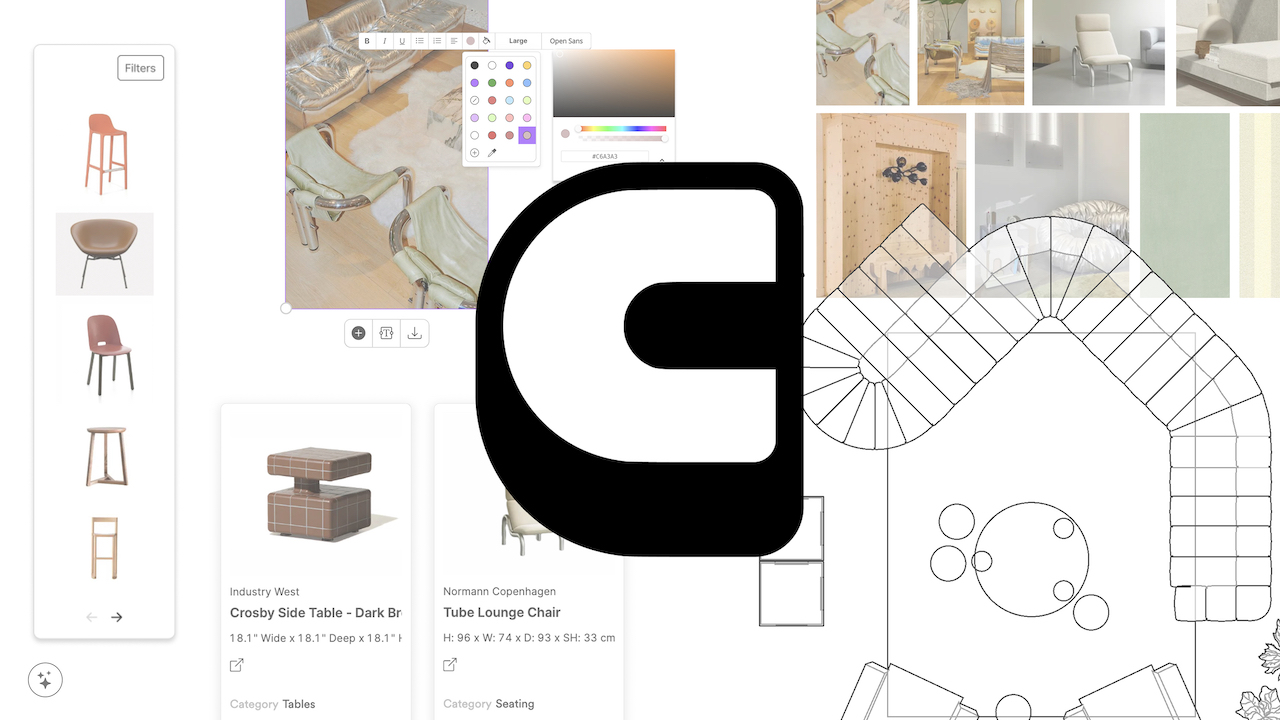
The Canoa design canvas: furniture cards, a mood board and a floor plan around the Canoa logo

Above: the Canoa canvas, caught mid-thought - a stool here, a Tube Lounge Chair there, a floor plan drawn at architectural scale, and that fat black “C” presiding over it all like a very calm landlord.

Brooklyn, NY Est. 2019 ~27 people SaaS · AI · Climate canoa.supply
Who they are now

A designer opens one tab. The job gets done in it.

It is a Tuesday somewhere, and an interior designer is furnishing an office floor. Not long ago that sentence meant six open programs - a floor plan in AutoCAD, a model in Revit, a budget in Excel, a mood board in PowerPoint, a dozen browser tabs of brand PDFs, and an inbox full of “is this in stock?” This is the part of design nobody photographs. Canoa is the company betting that all of it belongs in a single browser window.

Today more than 5,000 designers collect inspiration, lay out furniture to architectural scale, pull live product data published by hundreds of brands, and hand a client an approval-ready schedule - without leaving the page. The work that used to be stitched together from five tools now lives on one canvas. Canoa is small, deliberate, and aimed squarely at a problem the design world had quietly agreed to tolerate.

“Designing a space freely, responsibly, and together” - the whole pitch fits on a single browser tab.
Canoa, on what it is building
Field note

Canoa lives at Dock 72 in the Brooklyn Navy Yard - a building that, fittingly, is all about putting a lot of working space under one roof.

5,000+
Designers on platform
100s
Brands publishing data
~$17M
Total funding raised
2019
Year founded
The problem they saw

Furniture is a data problem wearing a design costume.

Here is the tension that explains everything about Canoa. The act of furnishing a building looks like taste. It is actually logistics. Every chair has a SKU, a lead time, a finish, a price, a carbon cost, and a dimension that has to fit a plan. That information sits in scattered catalogs and spreadsheets that never quite talk to each other. The designer becomes a translator between systems that refuse to be introduced.

Federico Negro learned this the hard way. As Global Head of Design at WeWork, he watched the company sprint into 500-plus locations across 30 countries. At that scale, the gaps stopped being annoyances and became expensive. As he put it, data silos and workflow discontinuity lead designers to waste time and money - and to generate real-world waste. The landfill is downstream of the spreadsheet.

The waste in furniture doesn’t start at the dumpster. It starts where the data goes missing.
The thesis underneath Canoa

This is the thread worth following through the rest of this page: Canoa is not really selling a prettier mood board. It is arguing that if you fix the data, you fix the workflow - and if you fix the workflow, you can finally make sustainable, circular furniture decisions the easy default instead of the heroic exception.

The founder's bet

A design-tech veteran, betting on his own annoyance.

Negro is not a tourist in this industry. He studied architecture, worked at SHoP Architects, and founded CASE, a firm built around design technology for the built environment. WeWork acquired CASE in 2015, which is how he ended up running design for one of the fastest-growing real-estate experiments of the decade. He had, in other words, already built the tools and already felt where they broke.

So in 2019 he left to build the thing he kept wishing existed. The bet was unglamorous: that interior designers would happily abandon a familiar tangle of software if one tool understood their craft well enough. Not a CAD program with furniture bolted on. A canvas built by designers, for designers, that treated real product data as a first-class citizen.

The most convincing founders are usually just escaping a problem they couldn’t stop noticing.
On why Canoa exists at all

In October 2024 the company handed the wheel to Ellie Cunningham, its longtime COO, who became CEO. Negro stayed on to focus on the core product and joined the board - a tidy bit of role-swapping that mostly meant the product obsessive went back to obsessing over the product. “Having worked with Ellie for over a decade, I know she’s the right leader to take our company into its next stage of growth,” he said.

Before Canoa

Negro built WeWork’s global design org across 500+ locations. Canoa is, in part, the apology note that infrastructure owed every designer who used it.
The milestone reel

How Canoa got here

Seven years, one stubborn idea, and a slow march from “nice mood board” to “the whole workflow.”

2015
CASE meets WeWorkNegro’s design-tech firm is acquired; he becomes Global Head of Design and sees FF&E break at scale.
2019
Canoa is foundedSet up in Brooklyn to give designers one connected, sustainable workflow.
2021–22
Seed round~$8.7M reported, led by Eclipse with Building Ventures, TMV and Gemini Ventures.
2022
Press takes noticeArchDaily and ICFF cover Canoa as a design tool and marketplace for low-carbon offices.
2023
Series AFurther capital, with Liquid 2 Ventures joining existing backers; total raised climbs toward ~$17M.
2024
New CEOEllie Cunningham promoted from COO to CEO; Negro moves to product and the board.
2025
Free for designersCanoa makes its design platform free and sets out to more than triple its user base.
The product

Four parts, one canvas.

Canoa is a browser-based, scaled design editor - which is a dry way of describing something that feels a bit like a design studio that never closes. You collect, you arrange, you specify, you share. The cleverness is that each step quietly carries the data forward, so the mood board and the budget are the same object viewed from different angles.

Canvas

The scaled editor

Mood boards, furniture layouts, slide presentations and large-scale pinups, drawn at architectural scale with CAD import for DWG, DXF and AutoCAD files.

Catalogs

Real product data

Hundreds of furniture and FF&E brands publish live product information, so schedules and specs are built on facts, not guesses.

AI

A design co-pilot

Product discovery, object recognition and recommendations that get sharper as more product data lands on the platform.

IMS

Inventory & reuse

An inventory management layer to track FF&E across spaces and keep good furniture in circulation instead of in a skip.

Most software makes you choose between fast and accurate. A scaled canvas with live data quietly refuses the question.
On the trick at the center of Canoa
The proof

Adoption, and the people writing the checks.

Skeptics are right to ask whether designers actually switch. The honest answer is that switching tools is painful and most attempts fail. Canoa’s evidence is a growing base of more than 5,000 designers and hundreds of brands publishing data - plus a roster of investors who fund built-environment software for a living and decided this one was worth backing across rounds.

Who’s on the canvas

Reported figures - approximate, directional, and worth a pinch of salt.
Designers
5,000+
Brands w/ data
100s
Funding (USD)
~$17M
Team
~27
“Bridging the gap between brands and designers by building a more connected ecosystem will be our top priority.”
Ellie Cunningham, CEO

The backers - Eclipse Ventures, Building Ventures, TMV, Stackpoint and Liquid 2 Ventures - are not chasing a consumer app. They invest where industrial workflows are stuck. Building Ventures returned for more, which in venture is roughly the equivalent of a second date going well.

The mission

Circularity, spelled out as a feature.

Plenty of companies bolt a sustainability statement onto the footer and call it a day. Canoa’s is load-bearing. The company was born from the desire to help decarbonize office buildings by bringing transparency to furniture, lighting and interior prefab systems. The logic runs in a straight line: if a designer can see a product’s real data, including what it costs the planet, the responsible choice stops being the hard one.

Its inventory tools exist so good furniture gets reused instead of replaced - keep goods in use, design out waste, preserve resources. That is the circular economy, minus the lecture. The bet is that you don’t change an industry by guilt-tripping it. You change it by making the better path the more convenient one.

Sustainability survives longest when it’s disguised as the easier option.
How Canoa frames the climate case
Why it matters tomorrow

Back to that Tuesday.

Return to the designer furnishing an office floor. In the old version of this story she ends the week exhausted by software - reconciling a budget that never matched the plan, chasing stock that was never confirmed, and quietly accepting that some of what she specified would end its life in a landfill nobody planned for.

In Canoa’s version, she opens one tab. The mood board carries its own budget. The furniture knows its own dimensions and lead times. The plan stays honest because the data underneath it is. And when the next office needs furnishing, the last one’s inventory is still on record, ready to be reused rather than rebought.

That is the whole argument. Canoa didn’t set out to make design prettier - design was never the problem. It set out to make the invisible plumbing behind a furnished room actually work, on the theory that a better-connected industry is also a less wasteful one. Whether 5,000 designers becomes 50,000 is still an open question. But the tab is open, the canvas is loading, and the spreadsheets are starting to look nervous.

Last word

The name nods to a canoe - light, shared, and only useful when everyone paddles in the same direction. On a project, that’s harder than it sounds.