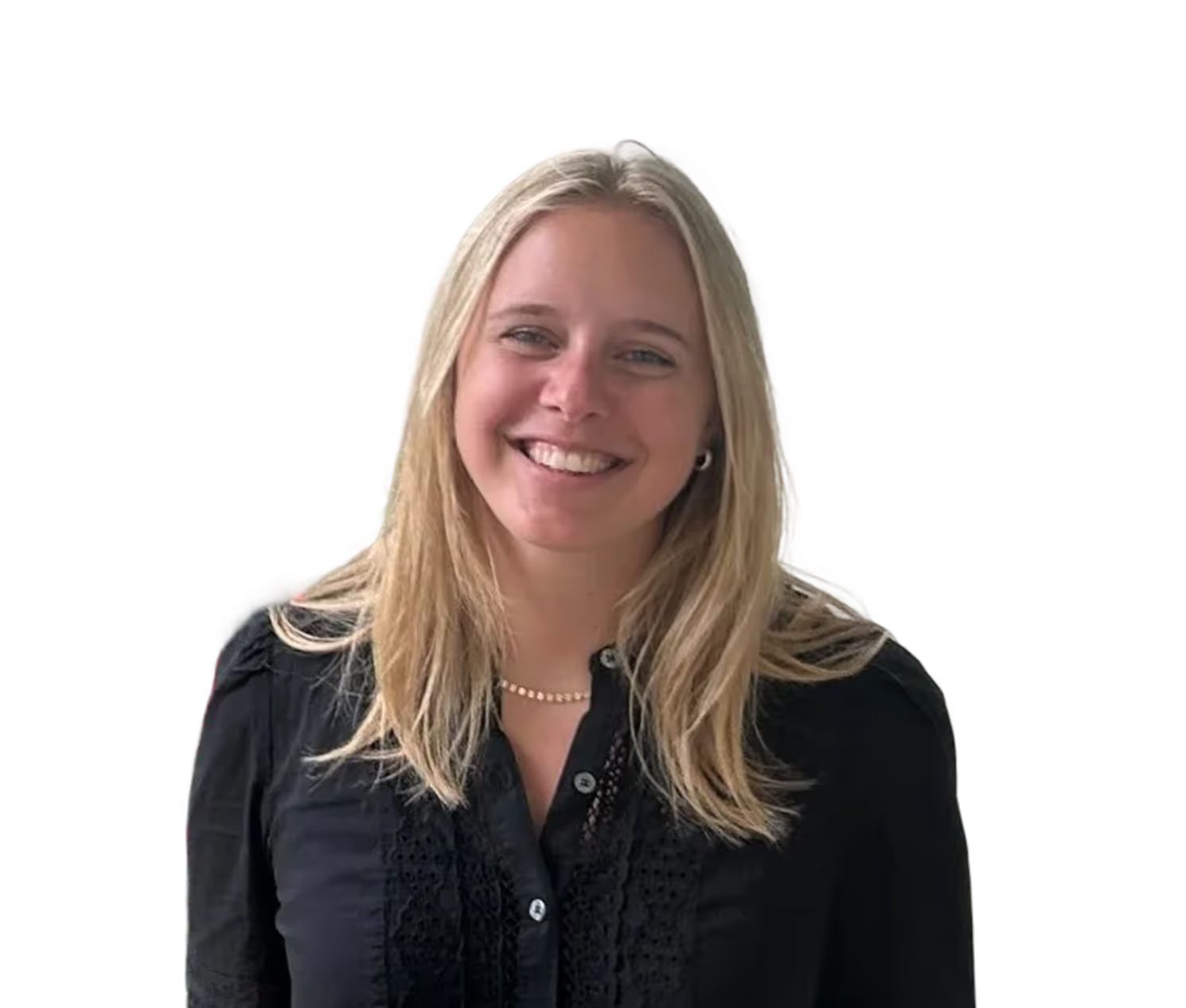
Precision at Scale - From Pennsylvania Ave to the Factory Floor
There is a specific kind of person who can run a presidential schedule without the whole thing collapsing - someone who treats a ten-minute buffer as sacred ground, who understands that every room, every handoff, every motorcade stop is load-bearing. Bridget Williams was that person inside the Biden White House. She is now that person at Squint, one of the more interesting AI companies operating in spaces most software founders have never visited.
Squint makes software for factory floors. Not the clean, quiet kind of factory you see in press materials. The real kind - loud, fast-moving, complex environments where operators work with industrial machinery, where the knowledge of how to do things the right way lives in the heads of veteran workers who may or may not be available when something goes wrong. Squint's platform captures that knowledge, turns it into AR-powered procedures, and delivers it to workers in real time. The company calls it Manufacturing Intelligence. Its customers include PepsiCo, Michelin, and Ford. It just raised $40 million at a $265 million valuation.
Williams joined Squint as Chief of Staff to CEO Devin Bhushan. In a company of 94 people operating at Series B velocity, that title means everything organizational: strategic planning, executive coordination, internal communications, and the kind of cross-functional work that keeps fast-growing companies from fragmenting under their own momentum. It is, in a different register, not so different from the work she did at 1600 Pennsylvania Avenue.
The Career Arc Nobody Plans
Williams graduated from the University of Delaware in 2020 with a degree in International/Global Studies - the same year the country's political landscape made it impossible to sit still. She went straight into the Biden for President campaign, working first as an Advance Associate and then as the Connecticut Organizing Director. Advance work is one of the more unglamorous high-stakes jobs in politics: you arrive in a city days before the candidate, you walk every room, you account for every contingency, and then you disappear before anyone knows you were there.
When Biden won the presidency, Williams went to Washington. She joined the White House first as an Advance Associate and then moved into the Executive Office of the President as Deputy Director of Presidential Scheduling. Presidential scheduling is not a job for people who prefer ambiguity. The President's time is the scarcest resource in the federal government. Every request that lands on that desk is coming from someone who is certain their issue is the most important thing in the building. Williams's job was to make the calls, protect the calendar, and keep the operation moving without drama.
"Accelerate human potential by bringing digital knowledge into the real world."
- Squint's mission statementAfter her time in the Executive Office, she moved to the U.S. Department of Education as Deputy Director of Scheduling in the Office of the Secretary. From there, she made a geographic shift that would prove formative - to San Francisco, where she served as Interim Director of Scheduling on the transition team of Mayor Daniel Lurie. It was a role that put her in contact with the city's political and civic infrastructure at exactly the moment San Francisco was trying to figure out what kind of city it wanted to be post-pandemic.
- Biden for President - Advance Associate & Connecticut Organizing Director
- The White House - Advance Associate, Executive Office of the President
- White House - Deputy Director of Presidential Scheduling
- U.S. Department of Education - Deputy Director of Scheduling, Office of the Secretary
- San Francisco Mayor's Office - Interim Director of Scheduling (Lurie Transition)
- Squint - Chief of Staff to the CEO (current)
What the White House Actually Teaches You
The operational skills required to run a presidential schedule translate in ways that are not immediately obvious until you see someone who has done both. The Chief of Staff role at a Series B startup is, structurally, a coordination problem of enormous complexity. You are simultaneously managing upward (to a CEO who should be spending time on strategy and customers, not logistics), managing across (to department heads who each think their priority should be next on the list), and managing outward (to investors, board members, and external partners who need answers on different timelines).
Williams arrived at Squint with a toolkit that most operators at her career stage do not have. She had worked inside government institutions that run on strict protocol, inside campaign organizations that run on adrenaline, and inside city hall transitions that run on improvisation. Squint is a company that needs all three at once: the discipline of a well-run institution, the urgency of a startup, and the ability to build systems where none existed before.
The Company Behind the Role
Squint's core insight is that manufacturing's most persistent problem is not hardware, not supply chains, and not labor - it is knowledge. Specifically, the knowledge that experienced operators carry in their heads about how to do things correctly, troubleshoot problems, and adapt to machine variability. When that knowledge is not written down anywhere - a phenomenon the industry calls "tribal knowledge" - it disappears when the people who carry it retire, quit, or simply aren't available on the shift when something breaks.
Squint captures that knowledge and turns it into digital, AR-powered procedures that workers can access on the floor in real time. The platform handles everything from video-to-procedure AI conversion to spatial AR mapping, multilingual translation, and real-time data analytics. One major consumer goods company using Squint reported a 50% reduction in procedure execution time. Across its customer base, the platform achieves 91% satisfaction ratings. These are not typical SaaS metrics.
Squint's platform serves tens of thousands of operators across hundreds of factories globally. Investors include Sequoia Capital, TCV, Menlo Ventures, and The Westly Group. The Series B closed in August 2025 at a $265 million valuation, with $40 million raised in that round alone.
The company's leadership is deliberately cross-functional. CEO Devin Bhushan built the original product with engineering co-founders, but the team around him draws from operations, design, finance, and now government. Williams's background gives Squint something genuinely rare in industrial AI: institutional fluency. She has worked inside organizations that measure success in policy outcomes and voter registration numbers, not DAUs and MRR. That perspective is useful when your customers are Ford's plant managers and Michelin's operations leads.
The Funding Picture
The August 2025 Series B was a significant moment. Manufacturing AI has become genuinely competitive - there are well-funded companies attacking the space from enterprise software, from robotics, from digital twin infrastructure. Squint's differentiation is depth of deployment and breadth of use case: its platform handles not just procedure documentation but spatial navigation, multilingual delivery, performance measurement, and AI-driven troubleshooting. The $40 million gives the company runway to expand its engineering team, accelerate enterprise sales, and push deeper into verticals like energy, healthcare, and construction.
The Operator's Perspective
Williams occupies a role that is, by design, largely invisible from the outside. The Chief of Staff is not the person on stage at fundraise announcements. She is the person who made sure the announcement went smoothly - who briefed the right people in the right order, who cleared the CEO's calendar for the week before close, who coordinated with legal and communications and investors without letting any of those threads cross. That is the job. It is not glamorous. It is essential.
Her career has been defined by exactly this kind of precision-under-pressure work. The Connecticut organizing director who had to mobilize volunteers in a compressed timeline. The White House scheduler who had to say no to senators. The city hall transition director who had to build a functional calendar operation from scratch in weeks. Each role required the same underlying capability: the ability to understand what matters most, protect the conditions that allow it to happen, and move everyone else along without making them feel moved.
She now does that for a company that is, in a meaningful sense, trying to do the same thing for factory workers. Squint's platform is designed to make operators more effective by giving them the right information at the right moment, without friction. The operational philosophy is the same whether you are running a presidential schedule or a manufacturing floor: clarity, sequencing, and no unnecessary surprises.
- Video-to-procedure AI converts existing training content into structured AR workflows
- Spatial AR mapping overlays instructions directly onto physical equipment
- Multilingual translation delivers content to global workforces without separate localization effort
- Real-time analytics surface operator performance and process bottlenecks
- On-device deployment supports air-gapped industrial environments with strict security requirements
From Newark to the Factory Floor
There is something worth noting about the career path Williams has followed. She graduated from the University of Delaware - a solid public research university, not a coastal brand-name school - and did not follow the typical route into consulting or finance or another graduate degree. She went directly into the most logistically complex operational environment in American public life: a presidential campaign in a pandemic year, followed by the White House, followed by government agencies, followed by a high-growth startup.
At each stop, she was solving the same problem in different contexts: how do you organize the activity of a complex, high-stakes organization so that the people at the top can focus on what only they can do? That question does not have a permanent answer. It has to be re-solved every time the organization changes. Williams has been re-solving it for five years.
The startup world is full of people who write about "operational excellence" but have never operated anything more complex than a product roadmap meeting. Williams has operated at the presidential level. She brings that to a company that is asking its customers - the Pepsi plant managers, the Michelin operations leads, the Ford production supervisors - to trust a new kind of system with one of manufacturing's most critical resources: how people do their jobs.