Brian McVeigh has spent most of his career arranging passages. A scientific idea passes into a development plan. A proposal passes across a negotiating table. Capital passes into a young company, provided the people holding it can see a credible route forward. Now, at Code Biotherapeutics, the passage is literal: a piece of genetic cargo needs to cross the body, find a particular cell and get inside. The company is built around the vehicle.
This is an unusually tidy meeting of biography and business model. McVeigh trained in accounting and finance, then spent 25 years at SmithKline Beecham and GSK learning how large pharmaceutical organizations make decisions. He worked in finance, marketing, corporate functions, research and development, and finally business development. The nouns changed. The underlying craft did not: understand what each party values, then construct a bridge sturdy enough to carry the risk.
His current title contains three jobs - chairman, chief executive officer and co-founder. The company he leads contains a similarly compact ambition. Code Bio's 3DNA platform is a synthetic, branched DNA scaffold. Targeting molecules can be attached to help direct it toward selected cells; therapeutic cargos can be attached to ride along. A standard scaffold, in the company's telling, can be configured for different assignments. It is less a silver bullet than a molecular switchboard.
Chapter oneThe accountant in the deal room
McVeigh's education reads like preparation for a meeting that keeps adding chairs. At La Salle University he earned bachelor's degrees in accounting and finance. Villanova supplied an MBA concentrated in finance. Saint Joseph's added pharmaceutical marketing, and Wharton added executive development. He also collected the initials CPA, CMA and CLP: public accountant, management accountant and licensing professional.
Credentials can become decorative. His became operational. During 15 years in GSK business development, McVeigh personally led the assessment and negotiation of more than two dozen significant transactions. The list included acquisitions of Sirtris Pharmaceuticals, Domantis and Genelab Technologies. In his final GSK role, he formed and led the worldwide group responsible for business-development transactions and investment management. That team executed more than 100 deals.
He also managed more than $500 million in invested and committed capital across GSK's stakes in research collaborators and venture funds. The portfolio delivered more than $650 million in realized returns while he led it. The numbers matter, but the repetition matters more. A hundred transactions amount to a hundred lessons in why an elegant proposal stalls, why a counterparty says yes, and which risks can be allocated but never wished away.
That sentence is more revealing for its verb than its adjectives. Dedicated suggests a single line. McVeigh's line has simply crossed different institutions. After GSK, he served as CEO and a director of KBP Biosciences USA. In 2018 he became chief business officer of the public biotech Zafgen, leading corporate strategy, business development and new-product planning. He participated in a $69 million follow-on offering and helped lead the 2020 merger with Chondrial Therapeutics that formed Larimar Therapeutics.
The founder turnA platform meets its translator
The Code Bio story runs through Genisphere, a Philadelphia-area company that had developed 3DNA for research, diagnostics and delivery applications. McVeigh joined Genisphere's board in 2018 and later became chairman. Robert Getts, Genisphere's scientific leader, had spent years working with the scaffold. In 2020, McVeigh, Getts and Lori Getts co-founded Code Biotherapeutics to develop the platform for genetic medicines.
McVeigh explains the design in the plain language of assembly: “We have a proprietary process to attach therapeutic payloads and targeting moieties to the DNA scaffold.” The platform is designed to be non-viral, carry large genetic payloads and permit repeat dosing. Its multivalent structure offers many attachment points. The company can vary the targeting element without rebuilding the underlying scaffold from scratch.
That modularity is a scientific proposition, but it creates a corporate one too. A platform company can advance its own programs while inviting partners to apply the technology elsewhere. The challenge is focus. Possibility makes a generous brochure and a terrible weekly agenda. A founder has to decide which proof points earn the next proof points, and which opportunities are better carried by someone else.
The company builderOptions are useful when they have deadlines
Code Bio launched publicly in April 2021 with $10 million in seed financing. Fourteen months later it announced an upsized $75 million Series A. The syndicate included 4BIO Capital, CureDuchenne Ventures, the JDRF T1D Fund, UPMC Enterprises and Takeda Ventures. The funding was assigned to internal discovery work, broader platform applications, manufacturing and operations. It turned a technology lineage into a company with an $85 million runway.
Between those rounds came a partnership that bears McVeigh's fingerprints. In February 2022, Code Bio and Takeda agreed to work on a liver-directed program and additional central nervous system research. Takeda received options for exclusive licenses across four programs. Code Bio would lead research through candidate selection; after an option exercise, Takeda would take responsibility for later development and commercialization. The announced economics included double-digit millions in upfront and near-term payments, plus potential milestones of as much as $2 billion if all four programs hit every specified mark.
Potential is the most mischievous word in a biotech press release. The $2 billion is not revenue in the bank. It is a long ladder of contingent events. Yet the structure itself is instructive. It gives Code Bio funding and a partner's expertise while preserving a defined handoff. It gives Takeda a way to investigate several applications before making larger commitments. Each side buys information before it buys more risk.
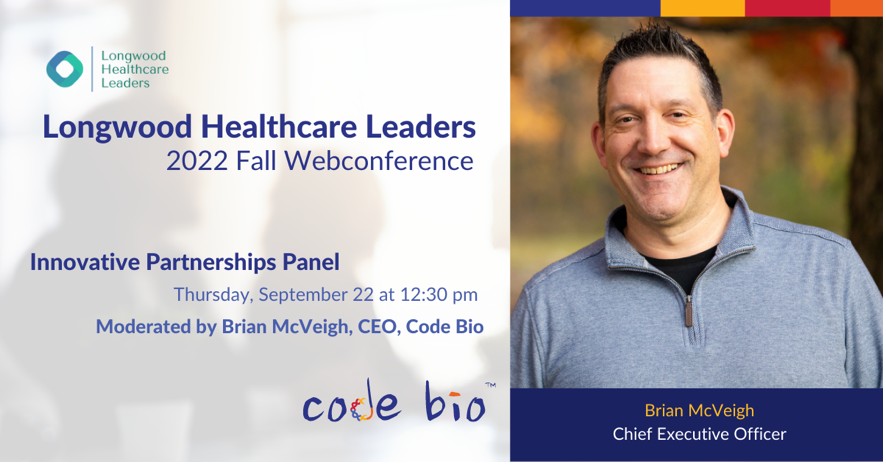
McVeigh continues to move between tables. He is a venture partner with 4BIO Capital, where he was recruited in 2020 to expand the firm's reach in the United States. He chairs Genisphere and has held advisory roles with UPMC Enterprises, IP Group and SciNeuro Pharmaceuticals. At the 2022 Longwood Healthcare Leaders conference he moderated a panel on innovative partnerships. On a 2023 biotech leadership podcast, the topic was early-stage venture funding. In 2024, he joined a Philadelphia forum about investment and partnership opportunities.
The connective tissueA career assembled from handoffs
Twenty-five years across SmithKline Beecham and GSK, culminating in worldwide transaction and investment leadership.
CEO at KBP Biosciences USA, then chief business officer at Zafgen and a leader in the merger that formed Larimar.
Co-founds Code Bio and joins 4BIO Capital as its U.S.-based venture partner.
Launches Code Bio, signs the Takeda collaboration and closes a $75 million Series A.
Presents at BIO and joins public conversations on partnerships, financing and the Philadelphia biotech ecosystem.
The public record also sketches a leader with interests beyond the term sheet. As a La Salle student, McVeigh spent four years volunteering and fundraising through PUSH America and served as treasurer in campus organizations. In 2011, the Greater Delaware Valley Chapter of the National Multiple Sclerosis Society gave him its Larry Kane Chairman's Cup, recognizing his fundraising for the MS150 City to Shore Bike Tour and his service to the organization. A longtime colleague's public recommendation emphasizes emotional intelligence, integrity, mentoring and a willingness to receive feedback as carefully as he gives it.
Those details complicate the familiar dealmaker caricature. Negotiation is often depicted as combat with refreshments. In practice, the durable version is closer to systems design. It requires memory, trust and an awareness that today's counterparty may be tomorrow's partner, investor, director or reference. McVeigh's career has accumulated exactly that kind of connective tissue across Philadelphia, London and Boston.
Code Bio still has the difficult work in front of every early biotechnology platform: manufacturing consistently, selecting programs, generating convincing data and turning a versatile architecture into specific products. Its disclosed work has been preclinical. No amount of transaction experience can negotiate with biology. It can, however, build an organization that asks cleaner questions, preserves useful choices and knows when a partner should carry the next leg.
That is the thread through McVeigh's many titles. The accountant learned the language of the laboratory. The corporate executive learned the tempo of a startup. The buyer became a seller, adviser, investor and founder. He has spent three decades thinking about what must move, who must agree and where responsibility changes hands. At Code Bio, even the molecule has been designed around the same question: how do you get the important thing where it needs to go? The answer is always tested in motion.