Brett Tejpaul had already looked at crypto and decided it was too early. That is an awkward beginning for someone who would become co-CEO of Coinbase Institutional, though a useful one. He arrived with reservations. Years later, describing his first stretch in the business, he chose a wonderfully unglamorous image: “the slowest horse in the race.” In an industry fond of speed, he was making a case for taking his time.
The career behind that judgment began well before bitcoin. A Boston College graduate, Tejpaul worked at J.P. Morgan before moving to Barclays. His work included credit, trading and sales, the business of turning complicated financial products into something another institution could actually use. Those jobs required fluency in markets, but also in the organizations making the decisions. A product could be clever and still fail to earn a place on a client's desk.
At Barclays, his responsibilities eventually ranged across global sales in fixed income and equities, credit and commodities. He also served on the five-member Markets Executive Committee. His senior roles took him through the United States and the United Kingdom. By the time Coinbase announced his appointment in April 2020, it was hiring someone accustomed to both the scale of a large bank and the patience required to change one.
Before the blockchain, the desktop
The interesting turn in Tejpaul's banking career was toward the machinery underneath the transactions. He became Barclays' first head of digital, with responsibility that included fintech venture investments. Digital strategy put a different question on the table. Alongside what a client wanted to trade came how the client would reach it, what software would get in the way, and how a bank could change without stopping work.
A small piece of that history survives in a May 2019 OpenFin funding announcement. Barclays participated in a $17 million round for the financial desktop software company. Tejpaul, then head of digital and client strategy, emphasized interoperability and the value of people's time. His concern was practical: better workflows would let colleagues and clients spend their hours more productively. Even the future of finance, apparently, had to contend with a crowded desktop.
That episode helps explain the continuity in his move to Coinbase. He had been working on connections between financial systems before he began working on connections to crypto. The screen, the account, the trade and the record of the trade all belonged to the same problem. Improving one while leaving the others awkward could make a demonstration look good without making a working day much easier.
The first question was where to put it
Coinbase introduced Tejpaul as head of institutional coverage on April 20, 2020. His remit combined expanding the client base, developing the coverage team, helping introduce services and educating institutions. The company had launched its institutional suite in 2018. He was joining an existing effort, with teams stretching from New York and San Francisco to the UK and Asia, and a substantial amount of building still ahead.
When he spoke at SALT in April 2021, custody occupied a central place in his explanation of institutional adoption. “Custody was the linchpin,” he said. Being able to buy an asset did not settle the question of how to hold it safely. A regulated custodian offered an answer to a problem that enthusiasm about a price chart could not solve.
It is an unfashionable subject with considerable dramatic potential. Buying something is an event; being responsible for it continues afterward. For Tejpaul, the institutional conversation extended beyond the moment of execution. His account of Coinbase's public listing that month also emphasized the importance of validation and adoption. Trust had to survive the transaction. The opening trade was only the beginning of the relationship.
“Custody was the linchpin.”
Brett Tejpaul / SALT Talks / April 2021
A second builder joins the picture
In May 2020, a little over a month after Tejpaul's appointment, Coinbase announced an agreement to acquire Tagomi. The institutional brokerage brought professional trading technology and a team whose experience crossed conventional markets and crypto. Its co-founders included Greg Tusar, Jennifer Campbell and Marc Bhargava. The intended combination would bring custody, trading features and prime brokerage into one platform.
Tusar's arrival matters to Tejpaul's story because this was a shared construction project. Tusar had worked at Goldman Sachs and KCG before co-founding Tagomi. Coinbase now lists Tusar and Tejpaul together as co-CEOs of its institutional division. Their histories meet at the point where client demand requires working market infrastructure. Neither a sales conversation nor a piece of trading software, on its own, completes that job.
The acquisition announcement offered a clear statement of the ambition: make the experience familiar to investors accustomed to equities and foreign exchange. Familiarity can sound like a modest objective. In financial services it can mean that someone understands the controls, knows which team to call and can fit a new activity into an existing process. Those are consequential conveniences.
- 2020Tejpaul joins Coinbase; Tagomi acquisition announced.
- 2022Aladdin connectivity announced with BlackRock.
- 2024US spot bitcoin ETFs bring a familiar route to exposure.
He was talking about the wrapper in 2021
By November 2021, Tejpaul was writing about the future of crypto exchange-traded funds. The first US bitcoin futures ETF had launched the previous month. A spot product, holding exposure to bitcoin itself rather than futures, remained the larger goal for many in the industry. His argument dwelt on the investment vehicle and the work required to manage it, rather than treating approval as a finish line.
He compared the debate with earlier generations of ETFs, including the original US equity product. New exposures had repeatedly needed scrutiny before becoming familiar parts of portfolios. In his telling, investor protection belonged at the center of the discussion. Familiar packaging could give investors a way into an unfamiliar asset, while the people operating the fund would still need experience with crypto's particular demands.
This was a salesman's argument, certainly, but one with an operational spine. An ETF can simplify a buyer's experience while leaving considerable complexity behind the scenes. Someone still has to manage the underlying exposure. Tejpaul's interest lay in that junction: the point at which an investment idea becomes a product people can access through a structure they already understand. The wrapper had work to do.
BlackRock brings the existing workflow
On August 4, 2022, Tejpaul and Tusar announced a connection between Coinbase Prime and BlackRock's Aladdin investment management platform. The arrangement began with bitcoin and was designed for institutions that were clients of both firms. It covered trading, custody, prime brokerage and reporting. Functionality would arrive in phases, an appropriately procedural entrance for a new asset class.
The practical attraction was that Aladdin clients could manage bitcoin exposure within existing portfolio management and trading workflows. A new investment would sit within a broader view of risk across assets. For someone whose earlier digital strategy had emphasized interoperability, the logic was recognizable. Crypto would become easier to accommodate when it could converse with the systems institutions were already using.
There is a less photogenic kind of progress hidden in an integration like this. It happens between screens, teams and records. An investor considering a new market also has to consider how the position will appear alongside everything else. The BlackRock relationship gave Tejpaul's institutional strategy a concrete example: expand access by connecting services to an established way of working. The existing workflow was part of the destination.
January 2024 gives the argument a market
US spot bitcoin ETF approvals arrived in January 2024. Tejpaul's reaction was to describe the opening for a wider audience. Speaking alongside Tusar that month, he called it the “first time crypto can go mainstream.” He also pointed to the combination of crypto-focused and traditional asset managers bringing products to market. The customers seeking access were beginning to see more familiar names at the entrance.
By July, a Coinbase article co-authored by Tejpaul and Tusar reported that the company was a partner and custodian for nine of the eleven spot bitcoin ETFs and eight of the nine newly approved ether ETFs. Those figures describe Coinbase's position at that moment. They also show how much of the ETF story depended on services behind the fund shares that investors could buy.
The numbers belong to the company and its teams. For Tejpaul, their biographical significance is more specific: work on institutional coverage had met a visible use case. The custody question from 2021 and the connectivity argument from 2022 now sat behind investment products. A long-running discussion about access had acquired something a client could put in a portfolio.
Confidence, with room left for learning
Tejpaul's public conversations offer another view of the executive behind the products. In an interview with Elisabetta Bartoloni, he discussed humility, a desire to learn, confidence and inclusiveness as ingredients of leadership. It is a revealing combination for a senior banker entering a field where experience helps, but does not eliminate the need to ask basic questions.
Confidence gets a proposal into the room. Humility makes it possible to notice what the proposal has missed. The pairing suits the career on display here: a person with extensive experience in financial markets taking on different assets and technologies. His account of initially hesitating over Coinbase gives those leadership ideas a concrete companion. He changed his judgment when he encountered a more ambitious plan.
His connections also extend beyond that operating role. He has served on Eightfold's advisory board, and an AVAX One filing identifies him as an adviser alongside Anthony Scaramucci. Boston College lists him on its Board of Regents, which supports the university's leadership on strategic priorities. The university records him as a member of the class of 1994. The college connection has continued well beyond the degree.
The slow horse has more ground to cover
At the Milken Institute's May 2026 conference, Tejpaul looked back on the financial crisis and the years of rebuilding that followed. He described those lessons as part of his approach at Coinbase: add capabilities deliberately, with regulation and capitalization in mind. His responsibilities had expanded across marketplaces, prime services and asset management. The cautious arrival of 2020 was now helping oversee a much wider operation.
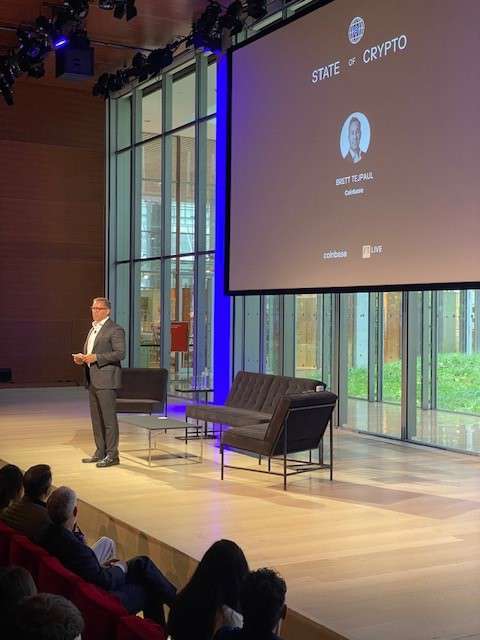
The opportunity he described next involved providing infrastructure to financial institutions and payment businesses that could in turn serve their own clients. In June 2025, he had also appeared with BlackRock chief operating officer Rob Goldstein at Coinbase's State of Crypto Summit. The conversation between traditional finance and digital assets was continuing through the people and organizations responsible for making the connection work.
By October 2026, his public discussion had widened again. An Access IPOs podcast episode covered Coinbase’s IPO access plans, tokenized stocks and the relationship between conventional securities and crypto. The subjects brought his career back toward familiar financial products, now approached through a different platform. He was also listed to speak at The Bridge in New York on October 27, continuing the institutional conversation in the city where his professional profile is based.
There is a pleasing stubbornness in the arc. Tejpaul entered crypto after years of helping institutions navigate other markets, and kept returning to the practical questions: where the asset sits, how it trades, how it fits. A market can announce its arrival in a second. Getting an institution comfortable enough to participate takes longer. He has made a second career out of that interval.