Brent Lang arrived at Michigan as a swimmer with a fairly clear idea of his events. Freestyle sprinting did not occupy the center of that picture. Then coach Jon Urbanchek needed someone to lead off a relay. Three older swimmers were already in place. He gave the freshman the fourth spot, and Lang discovered something his existing résumé had failed to mention: he could swim a very fast hundred.
It is an inconvenient beginning for a story about disciplined achievement. The familiar version would have him identify his destination, arrange his daily life around it, and arrive on schedule. His actual route depended on another person seeing a possibility and offering him a chance to test it. There was a plan. There was also an empty lane.
Within that small change of assignment lay a much longer career. Lang won Olympic relay gold in Seoul in 1988, became a technology executive, helped take Vocera Communications public, and led the company as CEO until its acquisition by Stryker. In November 2025, he became chair of USA Swimming’s board. The swimmer who benefited from a coach’s judgment now helps govern the organization behind the next generation of American swimmers.
A sport chosen partly by geography
Born in Phoenix in 1968, Lang grew up in Oregon and swam for the Tualatin Hills Swim Club. His childhood did not begin with a declaration that he would become an Olympian. Baseball and soccer competed for his attention. A family move to Guernsey, in the English Channel, changed the available choices. Baseball was scarce; the local soccer team was beyond his reach. Swimming offered a place to belong.
That detail makes his later success more interesting. A young person’s interests can look like pure preference until a move rearranges the menu. Guernsey gave him a pool and a team, and he took swimming seriously. Returning to Oregon, he attended Sunset High School before going to Michigan. His eventual specialty would still require another change.
Athletic biographies tend to make the early years behave themselves. Every childhood incident becomes an omen. Lang’s travels leave room for a less tidy account: he found something he could do, then learned that he could do a different part of it even better. The achievement belonged to him, but the setting and the people mattered.
The relay invitation at Michigan carried that process forward. A coach looked beyond the events on a recruiting record. A swimmer agreed to try. Neither needed to settle the rest of Lang’s life before the race began. They needed enough confidence to put him on the blocks.
Four titles, with homework attached
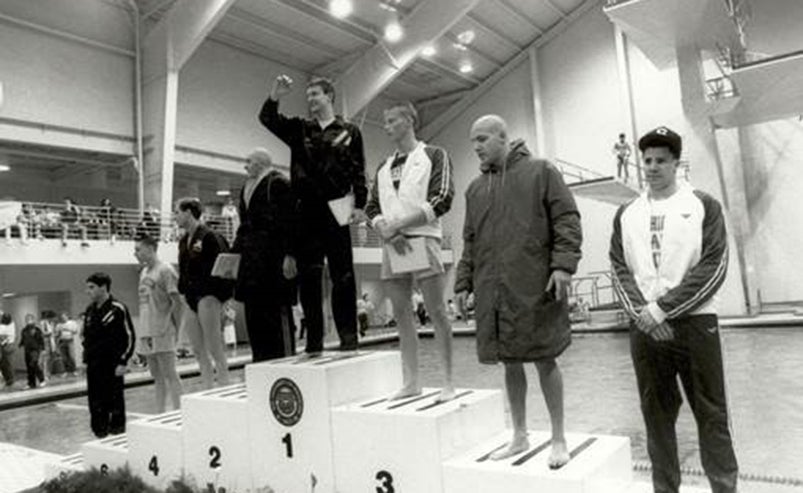
At Michigan, the new specialty became a record of results. Lang won the NCAA 100-yard freestyle in 1988 and 1990, and the 50-yard freestyle in 1989 and 1990. Four national titles give the experiment its answer. He also accumulated All-America honors and received the Big Ten Medal of Honor. A temporary opening on a relay had become the central line of his sporting career.
In Seoul, he earned gold as a member of the American 4 × 100-meter freestyle relay team. He later won relay gold at the 1991 World Championships. The distances and dates belong on a results sheet; the connection between them is harder to capture. His college coach had made room for an ability that Lang had not yet fully recognized.
Alongside the swimming, Lang studied industrial and operations engineering. He graduated summa cum laude in 1990 and was a Rhodes Scholarship finalist. Those facts resist the idea that his education was merely the price of admission to a pool. He was preparing for another occupation while still doing the first one well.
The NCAA’s Silver Anniversary Award caught that combination in 2015. It recognizes former student-athletes a quarter-century after their college careers end, considering what they have done beyond sport. The waiting period is rather sensible. At twenty-two, an athlete can show a fast time. Twenty-five years later, there is more to discuss.
The coach’s answer to a bad start
One of Lang’s most useful memories of Urbanchek involved a disqualification. As a defending NCAA champion, Lang false-started in the 100 freestyle preliminaries during his junior year. The coach could have made the lost points the entire conversation. Instead, he put Lang at the front of the relay that evening, offering an immediate chance to race again.
Years later, Lang connected that response to managing employees. People make mistakes. A leader’s reaction can help them recover or make the next attempt more difficult. His admiration for Urbanchek was practical: trust had consequences in the next race, and later in the next piece of work.
“Help people see where they need to go, create the vision, and then get out of the way.”
Brent Lang · reflecting on leadership, 2015
Getting out of the way sounds easy from a distance. It requires a manager to accept that somebody else will make decisions while the manager remains accountable for the result. Lang’s version starts with direction. People should know where the team is going before they are asked to find their route there.
The affection lasted beyond competition. Urbanchek accompanied Lang when he received the Silver Anniversary Award. An old coach and a former swimmer shared a stage long after the races that first brought them together. The relationship had acquired uses that a stopwatch could never measure.
At the startup, a title with loose edges
Lang’s professional route began with strategy consulting at Monitor from 1991 to 1993. He earned his Stanford MBA in 1995, then spent six years at 3Com, working in marketing and digital home products. Engineering, consulting, business school, networking technology: the sequence gave him several ways to look at a product before he joined a much smaller company.
Vocera hired him in June 2001 as vice president of marketing and business development. The title contained two jobs, and the work spilled beyond both. Pricing, potential customers, and a route to market all needed attention. His wife teased him that he was the “VP of business.” An organizational chart can be wonderfully optimistic about how neatly a startup divides its chores.
Vocera’s early idea was wearable, hands-free communication for people moving through their work. The founders brought the technical proposition; Lang helped investigate who would use it and how the business could reach them. The distinction matters. His part in the company’s development began with joining and helping build it, then expanded over time.
There is a recognizable connection to his sporting story, though business does not provide such obliging finish lines. Trying an unfamiliar event gives a swimmer a time. Trying a market requires conversations, pricing decisions, and repeated adjustments. Both can make an earlier description of your abilities look incomplete.
- 2001Joins in marketing and business development
- 2007Becomes president and chief operating officer
- 2012Helps lead the company’s IPO
- 2013Named president and CEO
- 2018Adds the board chair role
- 2022Stryker completes the acquisition
The public-company years took time
Lang became president and chief operating officer in October 2007. In 2012, he was part of the team that led Vocera’s initial public offering. The offering was priced in March and completed in April. That milestone arrived roughly eleven years after he joined. A stock-market debut can occupy one morning’s attention while representing a decade of work.
The CEO appointment followed in June 2013, when he succeeded Robert Zollars. He became board chair in June 2018. Keeping those steps in order makes the career easier to understand: he helped lead the IPO as an operating executive, then ran the public company. Responsibility accumulated rather than arriving all at once.
His tenure ended with Stryker’s acquisition in February 2022. Stryker paid $79.25 per share in a transaction with a announced enterprise value of approximately $3.09 billion. Those are company transaction figures. They describe the scale of the deal and the outcome for a business that Lang had joined when its commercial direction was still being worked out.
The chronology also provides a useful corrective to a compressed executive biography. “Former CEO” can sound like a single job. Here it contains product decisions, market development, a public offering, a succession, and years of operating responsibility. The list becomes more revealing when the intervals remain visible.
Back to swimming, with a different assignment
Lang’s work after Vocera has included company boards and sports governance. He joined Outset Medical’s board in March 2024 and serves on its audit committee. He chairs Eko Health’s board, and his current advisory work also includes Apella. The work draws on experience accumulated across a company’s development, from an early commercial role to public-company leadership.
Sports offered another setting for those skills. From 2018 through 2024, he served on USA Gymnastics’ board, including as treasurer. He also participates in the Positive Coaching Alliance’s National Leadership Council. His interest there grows from experience as a competitor, coach, and parent, and a belief that youth sport can teach lessons that travel beyond competition.
USA Swimming elected him to its board in September 2025. That November, the board unanimously selected him as chair, with a term through September 2029. His assignment concerns governance and organizational priorities. It puts the old swimmer’s knowledge beside the executive’s experience of budgets, responsibility, and people.
He still swims with a local Masters team and lives in Los Altos, California. In a May 2026 interview, he discussed the journey from early Vocera team member to CEO. His story continues to connect these different settings without requiring the pool to stand in for every business decision.
The most appealing continuity is simpler. Lang has experienced what happens when someone offers a useful opportunity before all the evidence is in. He has also seen the value of another attempt after a mistake. Now his place in swimming is farther from the starting blocks, but close to the decisions that help people reach them. There is still a team to think about, and another lane to open.