Brad Armstrong’s career lives in the connective tissue. Not the grand launch, but the agreement behind it. Not the app icon, but the line that lets one product speak to another. Not the triumphant photograph of two chief executives shaking hands, but the months in which lawyers, engineers, product managers and sales teams decide what that handshake must actually mean.
This is an unfashionably useful place to work. Software is sold as a collection of self-contained miracles. Customers experience something messier: payroll over here, identity over there, a CRM in another tab, messages piling up in a fourth. Every seam is a small tax. Armstrong has spent two decades trying to make those seams less visible.
He now serves as Strategic Advisor to the CEO at Lovable, the Stockholm company that lets people create software by describing what they want. It is a striking destination for someone whose résumé traces how software became a platform business in the first place. Before applications could be summoned in ordinary language, Armstrong was helping the companies underneath them learn the less magical art of cooperation.
First, learn where promises break
Armstrong came to technology by way of law. He graduated summa cum laude from UCLA with a degree in political science and international relations, then earned his J.D. at USC Gould School of Law. At international firms including Venable and Arnold & Porter, he worked with emerging companies, venture capital and mergers and acquisitions.
The legal beginning explains more than a credential line. Corporate law is an education in conditional language. What happens if a promise is late, incomplete or misunderstood? Who carries the risk? Which definition will become important at the least convenient moment? An integration can look charming in a launch announcement and still fail in the cold weather of daily use. The customer eventually discovers whether the agreement accounted for reality.
At Salesforce, Armstrong moved from legal work into strategic business development. Across an eight-year tenure he served in leadership roles and became a founding member of the AppExchange partner program. AppExchange helped turn the CRM into a place where other businesses could build and distribute software. The important shift was conceptual: a product did not have to contain every answer if it could become the place where answers gathered.
One craft, four platform eras
AppExchange
Integrations + M&A
Ecosystem + M&A
CEO advisory
That sounds obvious now, which is the reward for ideas that alter the furniture. In the early platform years, it required persuading developers to build, customers to trust and internal teams to share a stage with outsiders. The work was technical, commercial and diplomatic. Armstrong’s training happened at their intersection.
The company between the companies
Armstrong later joined Slack and led global business and corporate development. His remit included partnerships, alliances, the Slack Fund and M&A. Each part reinforced the others. Integrations made Slack more useful. Investments encouraged new products around it. Acquisitions brought selected capabilities inside. Alliances opened routes into established business systems.
Onstage at Slack’s Spec developer event in 2018, he described the mutual value of platform relationships. Customers who used connected products tended to get more from both. He admitted that “win-win” could sound campy, then used it anyway. This is one of the gentler ironies of partnership work: sophisticated negotiations often end in a phrase fit for a school poster because the underlying bargain really is that plain.
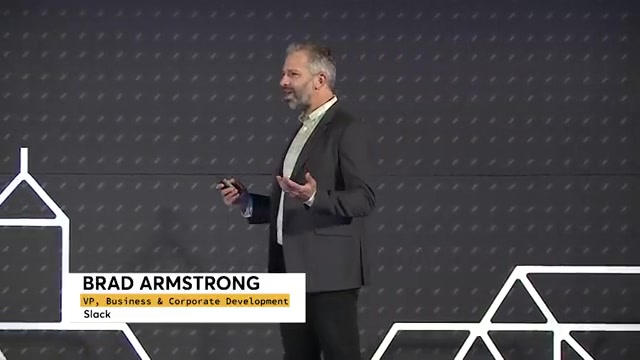
“Every product integration is a partnership.”Brad Armstrong, speaking during his Slack years
The statement is short enough to miss its bite. An integration is often treated as a technical artifact, a tidy API call wearing a logo. Armstrong’s formulation widens the frame. Two roadmaps must remain compatible. Two companies must decide what happens when priorities change. Support teams need a path for confused customers. Commercial incentives must survive the first burst of publicity. Code starts the connection. People keep it alive.
His years at Slack supplied visible examples. The company deepened ties with Zoom, Salesforce, Atlassian and other business-software providers. In discussing the Zoom relationship, Armstrong emphasized a committed joint roadmap and shared activities. The distinction matters. A button can be shipped once. A partnership is maintained in the future tense.
Make the shared workflow feel native, useful and easier than switching tabs.
Give both companies a reason to keep improving the connection after launch.
Keep decisions visible so new participants can catch up without a briefing ritual.
Let customers assemble the tools that fit their work instead of forcing a sealed suite.
A deal completed in the chat window
The cleanest anecdote from this period arrived in 2020, when Slack acquired the employee-directory company Rimeto. An in-person meeting planned for March became a series of video calls. Early conversations moved into a secure shared Slack channel. As the discussion became diligence, more lawyers and stakeholders joined. They could read upward to recover previous documents, questions and decisions.
Armstrong described M&A as a conversation that evolves into an enormously complex, multi-party project. His practical observation was that the shared channel removed long briefing calls and the forwarding of email chains. This was, conveniently, an acquisition process that demonstrated the product’s argument. Context did not need to be ceremonially transferred every time another person entered the room. The room remembered.
There is a stealable idea here for any team, regardless of its software. Complexity will volunteer. Context will not. Establish the shared record before the project becomes difficult. Keep decisions near the discussion that produced them. Make catching up a reading task rather than a meeting that seven people must attend to educate the eighth.
The room remembered. In a complicated deal, that became a competitive feature.
Operating experience, placed beside capital
While at Slack, Armstrong also became a founding member of The Operator Network. The group, organized by veteran technology executives, began investing in 2019 and later launched publicly. Its proposition paired members’ personal capital with practical help for founders. Armstrong credited his friend Frederic Kerrest with assembling a group of C-level and senior operators who had lived through the untidy work of scaling companies.
The model suited Armstrong’s arc. A conventional investor can offer judgment from the boardroom. An operator can also remember the Tuesday when a strategic launch stalled because two teams had defined success differently. Experience becomes most useful when it can be converted from anecdote into an earlier decision. The network’s premise was that founders might avoid a few grey hairs by borrowing those memories.
In January 2022, Armstrong joined Rippling as Senior Vice President of Business Development and Corporate Development. He led partnerships, ecosystem development and M&A as a member of the executive team. Rippling’s product range across HR, IT and finance created a familiar puzzle at a larger scale: many systems, one employer, and a customer who would prefer the parts to recognize one another.
His public comments there stayed close to the same theme. Announcing the hire, Rippling pointed to its partner ecosystem as an increasing reason to become a customer. Armstrong’s task was to connect the business systems those customers already used. The strategy respected a stubborn truth: no enterprise begins with an empty desk. New software enters a room crowded with old commitments.
Lovable, and the next layer of the platform question
Lovable changes who can make software. A person can describe a product, internal tool or business and watch the platform construct it in real time. The company handles pieces that once demanded separate decisions: hosting, authentication, payments, data connections and deployment. In August 2026, Lovable announced a $400 million Series C at a $13.3 billion valuation, following rapid growth in projects and usage.
Armstrong arrives as Strategic Advisor to the CEO with a particular kind of pattern recognition. He has seen a marketplace form around a platform. He has watched a collaboration product become a hub for other applications. He has managed alliances where competitors remained partners because customers wanted choice. He has led acquisition work and advised founders with his own capital beside the advice.
AI changes the speed of building, but it does not repeal the work between companies. If anything, faster creation produces more edges: models, databases, payments, identity systems, clouds, security tools and deployment targets. Someone still has to decide which relationships deserve depth, how joint roadmaps will work and where the customer should retain control.
Armstrong’s career suggests a durable answer. Start with the customer’s existing world. Treat the integration as a product and the partner as a continuing collaborator. Preserve context. Make incentives explicit. Then remove enough friction that the arrangement feels ordinary.
The grand ambition at Lovable is to let far more people build software. The quieter task is to ensure that what they build can live among everything else. Armstrong has been rehearsing for that problem since AppExchange. Platforms change their interfaces. The handshake remains.