Under Bobby Pinero's desk sat a Mac Mini with an unusually important job. It helped tell everyone at Intercom what was happening to their company. Pinero had bought the machine, written a Python script running to thousands of lines, arranged a server and scheduled the whole contraption to produce a daily report. It took weeks. Engineers had to help. When it broke, the repair bill was payable in his time.
The report was called the Daily Pulse. At 5 p.m., it arrived in the company's inboxes. No one had to remember a password or go hunting for a dashboard. The numbers simply showed up. Pinero believed the information changed how Intercom operated. He also believed the analysis itself could have been assembled in Excel in an hour. Somewhere between those two observations, a future company began taking shape.
There is a particular indignity in building elaborate machinery to reach a place you already know. Pinero had spent his career in spreadsheets. New tools kept offering to improve his working life by escorting him out of them. He wanted someone to improve the room.
A classroom idea, followed by a decade of work
Pinero studied Management Science and Engineering at Stanford, attending from 2006 to 2010. One class stayed with him: Steve Blank's Engineering Entrepreneurship. The assignment put students through the process of starting a company. Years later, Pinero remembered it as the experience that made him want to become a founder. The desire survived considerably longer than a semester.
His working life began in finance at IBM in 2010. Inflection followed in 2012, then Intercom in 2013. Each move brought him closer to the early decisions of a business. At Intercom, he became the first finance hire, eventually serving as senior director of finance and analytics. He stayed until 2021.
He was learning the less photogenic side of growth: how to explain it. A product can attract devoted users while its leaders still struggle to describe why revenue moves. Someone has to connect the activity to the money. Someone has to decide which number deserves the next question.
in the early days
by his departure
During his tenure, Intercom grew from below $1 million in annual recurring revenue to more than $150 million. Pinero helped build the finance and analytics functions through that expansion. The scale matters because the questions change as a company grows. A report suitable for a handful of people needs a different kind of discipline when hundreds depend on it.
The overheard list
Pinero's advice to analysts has a pleasantly nosy quality. Keep a list of things people say: an opinion in a meeting, a disagreement over lunch, an assertion that sounds testable. He calls it the overheard list. The comments become possible investigations. Some lead nowhere. Others become the question nobody had thought to put into a spreadsheet.
He treats curiosity as a practice that managers can help people develop. Telling an analyst to be more curious gives them very little to do on Monday morning. Collecting questions gives them somewhere to start. It also gives an interesting result a ready audience: the person whose remark prompted the investigation.
The method suggests an analyst paying attention to the company beyond its reporting calendar. A spreadsheet starts to become a way of settling arguments. Office gossip acquires a somewhat more respectable profession.
He is equally insistent about SQL, the language used to query databases. At Intercom, he required analysts to learn it during onboarding rather than treating existing proficiency as a hiring prerequisite. His argument was practical: pulling your own data helps you understand exactly what you are asking, and frees you from waiting for someone else's interpretation.
“Learning SQL unlocked my career.”
Bobby Pinero
The reference check that recruited a co-founder
As Pinero considered leaving Intercom, he was also considering another finance leadership job. The hiring process reached a backchannel reference check. The company called Ben McRedmond, an old Intercom colleague. Pinero and McRedmond had not spoken for a year or two. The call brought them back into conversation.
McRedmond was experimenting with a spreadsheet idea. Pinero had a list of business ideas of his own, including the kind of tool he wished had existed during his analyst years. Their discussions became Equals. A process intended to assess a candidate helped create a company instead. Reference checks rarely get such an entertaining return on effort.
They co-founded Equals in 2021. McRedmond brought product experience; Pinero brought years of living with the problems the product would address. Their familiarity also mattered. They had worked together at Intercom before attempting to build something together from scratch.
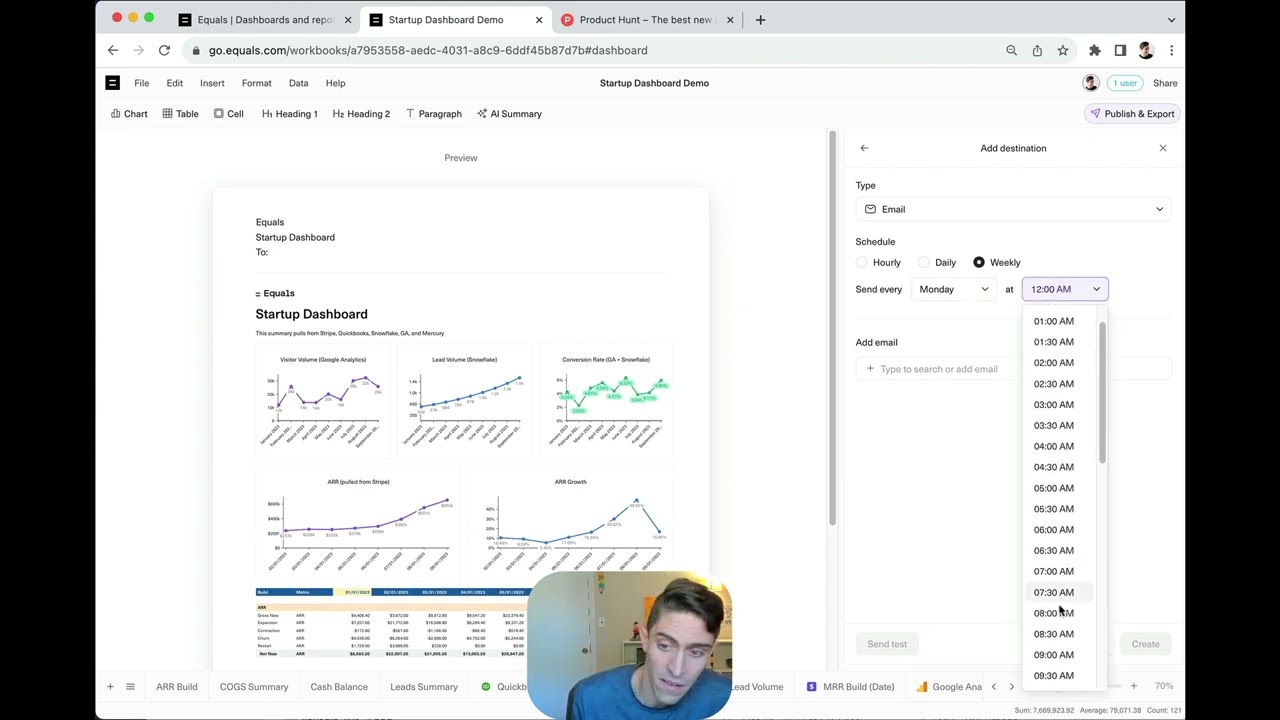
The ambition was a spreadsheet connected to live data and to the places where colleagues share work. The interface would remain familiar, while the fetching, refreshing and distribution became easier. In November 2022, Equals announced a $16 million Series A led by Andreessen Horowitz, with existing investors including Craft Ventures, BoxGroup, Worklife and Combine participating.
A cheque with a writing assignment
One early investor attached a condition to his support. Des Traynor, an Intercom co-founder, wanted Pinero to write regularly. Pinero committed to a weekly post. Before Equals had much of a public product to discuss, he could discuss the work he knew: finance, analytics and the decisions inside a growing startup.
He wrote for an earlier version of himself. That is a useful editorial constraint. It asks what would have helped someone doing the job, rather than what will make the company sound impressive. The writing also gave him practice putting his ideas in public while the product was still being built.
The habit left room for embarrassment. Pinero's account of his writing includes the fact that attempts to use a ghostwriter did not produce the same results. He keeps an idea bank in Notion and has described scheduling posts as a way to avoid reconsidering them at the last moment. Even an analyst can benefit from preventing himself from reopening a decision.
When free became expensive
Equals initially gave customers hands-on onboarding. Opening the product more widely looked like the next sensible step. In late 2022, the company introduced a generous free plan and removed the required onboarding call. Pinero expected easier access to help adoption.
There was an encouraging early signal: the number of companies using Equals daily and weekly increased fourfold. Over the following months, however, retention and conversion became problems. A larger audience had failed to become the growing business the founders expected.
“And then I broke everything.”
Bobby Pinero, reflecting on the freemium decision
In June 2023, Equals ended the free plan and introduced a trial requiring a credit card. Pinero reported that engagement and growth improved. It was a useful rebuke to the notion that every additional step in a signup process must be a mistake. But his account would acquire another chapter.
- 2022Hands-on launchLearn each customer's job
- LATE 2022FreemiumOpen access more widely
- JUNE 2023Paid trialRequire more commitment
- DECEMBER 2024Tailored self-serveStart with a specific report
Changes in onboarding and packaging, rather than a chart of revenue.
The empty workbook problem
In November 2024, Pinero revisited the conclusion. Removing the free plan had not explained everything. The team had gone back to onboarding prospects manually, and those conversations revealed how much work customers faced after connecting a data source. An empty workbook remained empty until someone knew what to build.
The team found repeated needs around recurring revenue, SaaS metrics and sales pipeline reporting. Those patterns gave it specific jobs to solve. A spreadsheet could serve many purposes, but a buyer usually arrived needing one particular answer.
By December 2024, Equals had reopened a self-serve route for Stripe-based ARR reporting. It synced and prepared data, then offered configurable reporting. The sequence is revealing: the founders returned to talking to customers, learned what could be repeated and then automated more of it. The human conversation supplied the specification.
For Pinero, this preserved the wider ambition. The spreadsheet remained the foundation, with individual reporting uses supplying a practical entry point. A large vision had acquired a smaller front door.
Numbers need manners
“Truth be told, I hate benchmarks,” Pinero wrote. His objection grew out of Intercom's early experience. Investors compared its churn with companies serving different kinds of customers under different acquisition models. A familiar number could invite a misleading comparison.
He still sees a place for benchmarks as references. He wants the business understood on its own terms first. That is a demanding position for a finance leader: you need to explain the differences, rather than simply protest that your company is special.
He co-wrote The Ultimate Guide to ARR with Chris Burgner, a former Intercom colleague who went on to run finance at Equals. The collaboration put their reporting experience into a practical book. Its contents include the awkward details that broad definitions skip, from discounts and refunds to deciding what counts as a customer.
He has also described changing his board-meeting agenda. Starting with metrics encouraged everyone to get stuck in the details. Moving the product discussion earlier helped keep attention on customers and the company's longer-term work. It is an amusing adjustment for someone who had spent so much time making sure the numbers reached the room.
Letters to the first numbers hire
In December 2024, Pinero announced his move from CEO to executive chairman, with McRedmond becoming CEO. He said he would continue working with Equals and sharing product demos. The partnership continued with a different division of responsibility.
In May 2025, he introduced The First Operator, a newsletter for the early numbers hire in a venture-backed startup. The title makes room for people in finance, business operations, analytics and revenue operations. Their common task is to help colleagues understand how the business works while much of that business is still being invented.
His October 2025 essay returned to a conversation with finance leader Ed Park. It emphasized building a shared model of the business and asking for help when the work begins to matter. Scrappiness can become an obstacle if the person explaining the company is too occupied maintaining its machinery.
That brings the story back beneath the desk. The Mac Mini was a resourceful answer to an immediate problem. Equals grew from asking why the answer required so much effort. Across Pinero's products and writing, the concern keeps returning: give the person doing the analysis enough time to think, and give everyone else a report they can actually use.