The first thing that failed to travel was the joke. In 2007, Blueprint Test Prep took its classes beyond California, including New York. Its instructors discovered that material about the 405 freeway and Los Angeles traffic did not land there. A company selling reasoning lessons had encountered a small problem of context: the audience had changed, and the punchline needed to change with it.
- The offer: courses, tutoring, and practice tools for law and healthcare exams.
- The difference: animated teaching, adaptive questions, and a plan for the work.
- The catch: course access buys a system. Students still supply the hours.
The joke that did not travel
Blueprint began in 2005 with Matt Riley, Trent Teti, and Jodi Triplett. Riley wrote the original LSAT curriculum. The company’s account of its beginning features a Los Angeles condo, late nights, takeout, and classes in five California locations. Its premise was refreshingly intelligible: people might learn more if the lesson held their attention.
That idea matters in test preparation because the customer has already agreed that the subject is important. Nobody needs an advertising campaign explaining why admission to medical school matters. The harder task is keeping someone engaged through another explanation, another passage, another evening when studying competes with everything else.
The early online product had an appropriately theatrical name: Blueprint: The Movie. It arrived in 2010. Today, the performances sit inside a more elaborate system of video lessons, live instruction, question banks, and study schedules. The entertainment remains useful only if it helps somebody return to the material.
One exam became a career
The decisive expansion came in 2018. New Harbor Capital combined Blueprint with Next Step Test Preparation, bringing LSAT teaching together with a business known for pre-health preparation. Next Step became Blueprint MCAT in 2020. This was an expansion into a neighboring problem: another difficult entrance exam, another student trying to organize months of preparation.
Then the company moved further along the medical career. In 2021 it acquired Cram Fighter, Med School Tutors, and Rosh Review. Together, those businesses added scheduling software, specialist tutoring, and clinical exam preparation. Sarah Michelle NP Reviews followed in 2022, extending the portfolio into nurse practitioner training.
Law school applicants
Next Step combination
Three specialist acquisitions
Sarah Michelle NP Reviews
That portfolio was still changing in February 2026. SMNP Reviews announced a Flex Upgrade to its Primary Care Live Study Group, removing fixed course start and end dates and making live sessions easier to reschedule. The change speaks to a different customer from the college applicant: a future nurse practitioner who may already be working as a registered nurse.
The commercial logic is straightforward. An aspiring doctor does not stop taking consequential exams after the MCAT. Medical school, residency, and professional certification create further occasions to buy help. Blueprint assembled expertise across those stages rather than expecting an LSAT instructor to become an authority on clinical medicine.
The next question is the product
For the student, the problem is less corporate. Should tonight go to chemistry, reading practice, or reviewing yesterday’s mistakes? Blueprint’s adaptive LSAT and MCAT question banks, released in 2023, are designed to select questions using predictions about individual performance. The promise is more useful practice per session.
Blue, its AI MCAT tutor, adds conversation to that process. Initially focused on Critical Analysis and Reasoning Skills, it expanded to all MCAT sections in March 2024. It can also help draft entries in a Lessons Learned Journal. That is a specific job: turn the discussion of an error into something the student can revisit.
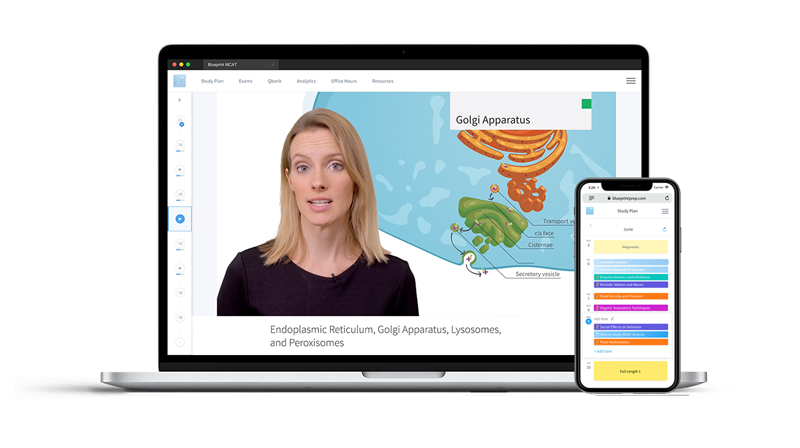
There is human help alongside the software. Customers can choose self-paced courses, scheduled live classes, private tutoring, and application consulting. Institutions also work with Blueprint. A partnership with Sketchy brought another visual approach to MCAT material. The common thread is giving difficult content a structure people can use.
The price includes your evenings
Blueprint charges for that structure. Its LSAT comparison lists a $1,299 live course and a $1,999 170+ course before promotions. The latter includes 60 hours of live instruction and six months of access. MCAT self-paced preparation starts at $1,499. These are advertised prices checked in October 2026; discounts and plan choices change the bill.
LSAT course pages list a separate required $124 LawHub Advantage fee, with exemptions possible. Promotions can reduce tuition.
The guarantee has a time price, too. The 170+ eligibility rules include a baseline score, eight practice exams, completed learning modules, and 2,500 answered questions, including 1,200 reading-comprehension questions. Students must attend at least 22 sessions live. The published conditions address scoring 170 or improving by at least ten points.
Those requirements deserve as much attention as the checkout button. A learner juggling shifts or family duties may struggle to complete them. Kaplan, The Princeton Review, specialist LSAT services, and medical question-bank providers offer alternatives, depending on the exam. The useful comparison is the amount and kind of support a student will actually use.
A calendar worth giving away
One revealing decision came in August 2023. After working with ten medical schools, Blueprint announced free nationwide access for medical students to its Med School Study Planner, formerly Cram Fighter. The company attributed the expansion to encouraging feedback from those initial relationships.
The tool divides chosen resources into daily tasks and can rebalance a schedule when the student falls behind. That last feature recognizes a fairly ordinary fact about ambitious people: an immaculate calendar does not guarantee an immaculate week. A plan needs a way to recover.
“Students will learn more when they’re having fun.”Blueprint’s founding premise
Borrow the routine
There is something here to copy without buying a course. Establish a baseline. Assign specific work to specific days. Review errors while the reasoning is fresh. Adjust the schedule when reality interferes. Blueprint packages those habits with teaching and tools; their value depends on whether the student follows through.
The traffic joke offers a useful closing test. A lesson can be expertly delivered and still miss its audience. Blueprint’s more interesting ambition is to keep changing the lesson, the next question, and the calendar until the student has a workable next step.