The most revealing moment in enterprise software is not the demo. It is the Monday morning when somebody asks, “Can we prove this machine was calibrated?” In a drug factory, the answer can affect a batch, an investigation or an inspection. A technician may have done the work perfectly. If the record is late, scattered or impossible to trace, the organization still has a problem.
Blue Mountain built its business around that administrative cliff. Founded in 1989 by bioengineer Jim Erickson, the Pennsylvania company makes Regulatory Asset Manager, or RAM: a cloud platform that keeps assets, calibration, maintenance and their electronic evidence together. The customer is not the neighborhood repair shop. It is a pharmaceutical plant, a biotech facility, a medical-device manufacturer or a contract producer operating under Good Manufacturing Practice rules.
This is vertical software in its purest form. Generic maintenance systems know about work orders and spare parts. Blue Mountain also knows about tolerances, electronic signatures, controlled workflows, audit trails, validation packages and the peculiar dread of a record that cannot survive an inspector’s follow-up question. Its public roster now exceeds 450 life-sciences companies.
The first thing to fail was the paper trail
Blue Mountain’s case studies repeat the same opening scene at different scales. At Senti Bio, calibration dates and preventive maintenance lived in spreadsheets and calendars; documents hid in email and shared folders. At BD, divisions used a mixture of paper and legacy systems. Fujifilm Biosciences had three independent installations in California, Pennsylvania and the Netherlands, each with its own data and controls. An unnamed medical-device manufacturer had five sites, 50,000 assets and fragmented processes.
The machine is rarely the first thing to break. Coordination breaks first. One site names an asset differently from another. A calibration certificate never reaches the master record. A corrective job closes without the reviewer who Quality expected. An acquisition brings a fresh database and another way to count overdue work. The result is not merely inconvenience. It is more review, more rekeying, more audit preparation and less confidence in the numbers.
Bend Bioscience offers the sharpest competitive story. The growing contract manufacturer had IBM Maximo, a respected horizontal asset-management suite. But Bend said the implementation lacked built-in 21 CFR Part 11 compliance, demanded extensive manual validation and leaned on third-party customization. It switched to RAM and later reported full compliance within weeks, expansion across three facilities, and a 25 percent reduction in validation and operating costs.
“Choosing Blue Mountain was one of the best decisions we’ve made.”Carol Bolger, Director, IT Applications, Bend Bioscience
What Blue Mountain actually sells
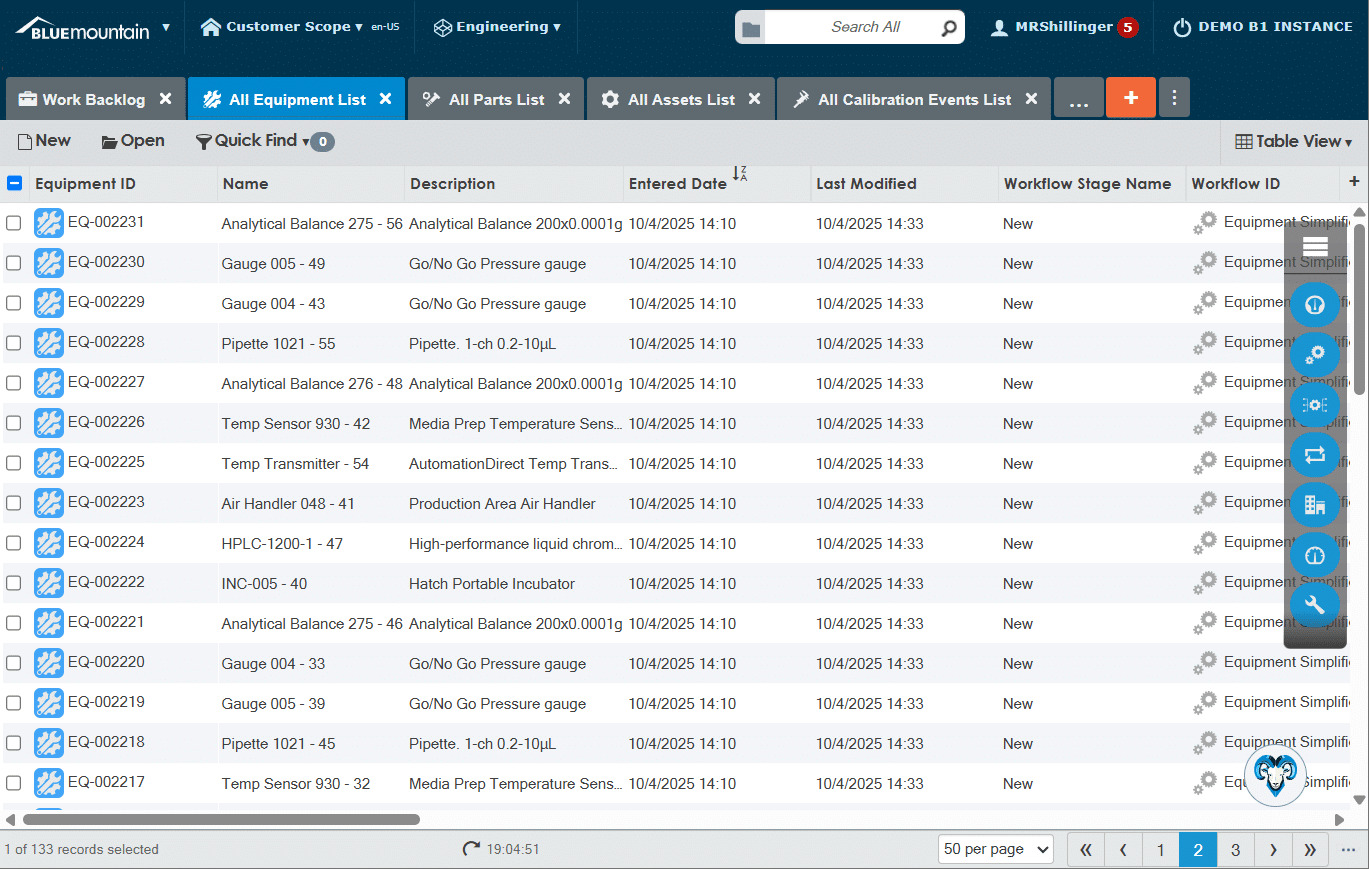
RAM is the center: the asset register, scheduled work, calibration history, parts and labor, approvals, signatures and searchable audit evidence. RAM Mobile puts work at the point of execution. RAM Data Migrator moves records out of spreadsheets and legacy databases with logs that can support validation. Implementation specialists help configure, migrate, train and document the new environment. Blue Mountain University adds role-based learning after launch.
Then comes the platform expansion. RAM Connect moves data between RAM and the surrounding factory stack. Its adapters include SAP ERP, Veeva QMS, ZenQMS, Sware Res_Q, Kneat and Apprentice Tempo. Shop-floor telemetry can create maintenance work when a condition crosses a threshold. A quality event can carry the relevant asset history. Parts consumption can flow back to ERP. The point is not integration for its own sake. It is avoiding the duplicate entry that quietly ruins traceability.
The vertical SaaS expansion ladder
The AI arrives with a chaperone
RAM Discover, released for production use in July 2026, is Blue Mountain’s answer to the familiar dashboard problem. A chart can show that corrective maintenance is rising; a manager still has to find which assets, sites and failure modes caused it. Discover accepts natural-language questions, examines the operational records and returns a narrative with contributing evidence and possible actions.
The interesting decision is restraint. Blue Mountain describes its AI program as assist, augment and, eventually, automate. Discover handles the first two. The company says it is not yet pursuing autonomous action, and its public examples retain human review. That is less cinematic than an agent dispatching technicians by itself. In a GMP environment, it is also more credible. The software can shorten the investigation without pretending the model owns the decision.
The Summer 2026 RAM release added Smart Scheduling, which recommends technicians using work history and workload, alongside a visual planning workspace and risk-based review. Blue Mountain also says 20 common actions are roughly 50 percent faster on average. Again, the product does not remove the supervisor; it puts a better suggestion and a faster interface in front of one.
How the economics change minds
The buying case begins with compliance, but it becomes durable when operations can count the waste. Boston Scientific standardized RAM across 31 manufacturing sites. Its case study projects more than $2 million in annual savings from upgrading R3 to R4, plus further savings from reduced downtime using asset-performance technology. BD uses RAM across 85 sites and connects it with SAP, Tulip and Apriso. The value is not a miraculous algorithm. It is one operating language across a very large estate.
Smaller companies reach the same conclusion earlier in their journey. Senti Bio selected RAM after comparing purpose-built functionality, implementation effort and total cost of ownership. Its initial deployment took a week with Blue Mountain specialists and focused on calibration, preventive maintenance, notifications and Quality review. That narrow start matters: it replaced a visible risk without demanding that the company reinvent every factory process at once.
Blue Mountain makes money as a private B2B software company: enterprise subscriptions supported by implementation, migration, validation, training and customer-success work. Five Arrows, Rothschild & Co’s alternative-assets arm, announced a majority investment in January 2026; Accel-KKR, which first backed the company in 2020, remained an investor. The amounts were not disclosed. The operational record is clearer: Blue Mountain ranked No. 2,639 on the 2026 Inc. 5000 after 122 percent growth over three years, its second consecutive appearance.
That service layer is easy to underestimate. In ordinary SaaS, configuration can be an annoying prelude to the product. Here it is part of the product’s credibility. A customer must map old asset IDs, preserve historical context, define who may sign which record, test the configured system and train users without creating a gap in controlled operations. Blue Mountain’s advantage is partly accumulated software and partly accumulated scar tissue from those transitions.
What another vertical SaaS builder can steal
- Start with the sentence customers fear. “Show me the record” is more urgent than “improve collaboration.”
- Encode the regulator’s nouns. Signatures, tolerances, audit trails and validation are product structure, not marketing vocabulary.
- Win one controlled workflow first. Calibration can establish clean asset data and user trust before maintenance, analytics and AI expand the footprint.
- Package the ugly services. Migration, validation evidence and training are part of time-to-value, even when they do not look like SaaS.
- Connect after becoming authoritative. Integrations matter more when the core system owns a record other applications need.
Where the model works - and where it does not
Blue Mountain sits between broad EAM suites such as IBM Maximo, SAP and Hexagon and narrower calibration or maintenance tools. Its advantage grows with regulatory intensity. A multinational medical-device maker with electronic signatures, site validation and acquisition-driven harmonization has strong reasons to buy specialization. A lightly regulated warehouse that mainly needs dispatch, inventory and basic preventive maintenance may prefer a cheaper horizontal CMMS.
GMP manufacturing, meaningful calibration load, several sites, strict electronic records, recurring audits and a Quality team willing to co-own the rollout.
Simple maintenance, poor asset master data, no validation burden, a lowest-price mandate, or an implementation treated as an IT handoff.
The system also cannot rescue undisciplined data by installation alone. Asset naming, ownership, criticality, schedules and approval rules have to be agreed. Automating a bad process simply produces bad records faster. The customers with the strongest stories paired software with standardization: BD aligned sites; Fujifilm consolidated three installations; Senti Bio put Facilities, Quality and IT in the same implementation week.
There is a second limit: specialization can become a cage if the adjacent systems refuse to cooperate. A plant still needs ERP for purchasing, QMS for deviations and MES for production. Blue Mountain’s response is RAM Connect rather than an attempt to replace them all. That is a sensible market boundary, but its value depends on customers governing each connection with the same care as the core platform. A live equipment signal is useful only when its identity, threshold and downstream action are trustworthy.
That is Blue Mountain’s place in the market. It is not trying to be the operating system for every physical asset. It is trying to be the trusted account of a regulated asset - what it is, what happened to it, who approved the work and whether the evidence will still make sense months later. The machines may make the medicine. Blue Mountain makes their alibis.