A mustache can be a surprisingly demanding customer. Give it a drink and it may take the first sip itself. In 2014, Blake Caldwell developed a modern answer to this small indignity: MoGuard, a removable guard that sits on a cup and keeps the contents away from the whiskers. Entrepreneurship has produced grander mission statements. Few come with such an immediately understandable demonstration.
The product belongs to a much older family of inventions. Victorian drinking cups sometimes had a built-in ledge for protecting facial hair. Caldwell’s version made the guard portable, so the protection could travel between cups. The customer could keep the mustache and change the glass. It was a neat adjustment to a very particular problem, carried into the world through a crowdfunding campaign.
Today Caldwell is the CEO and co-founder of FoundersBoost, which helps early-stage technology founders prepare for accelerators, investment, and revenue. The distance between the two ventures is amusing. It also makes his career worth examining. Before helping founders present their businesses, he had a product of his own to explain. Before organizing startup communities, he helped organize music events. His résumé contains both the thing being sold and the gathering where someone might discover it.
A small invention with excellent whiskers
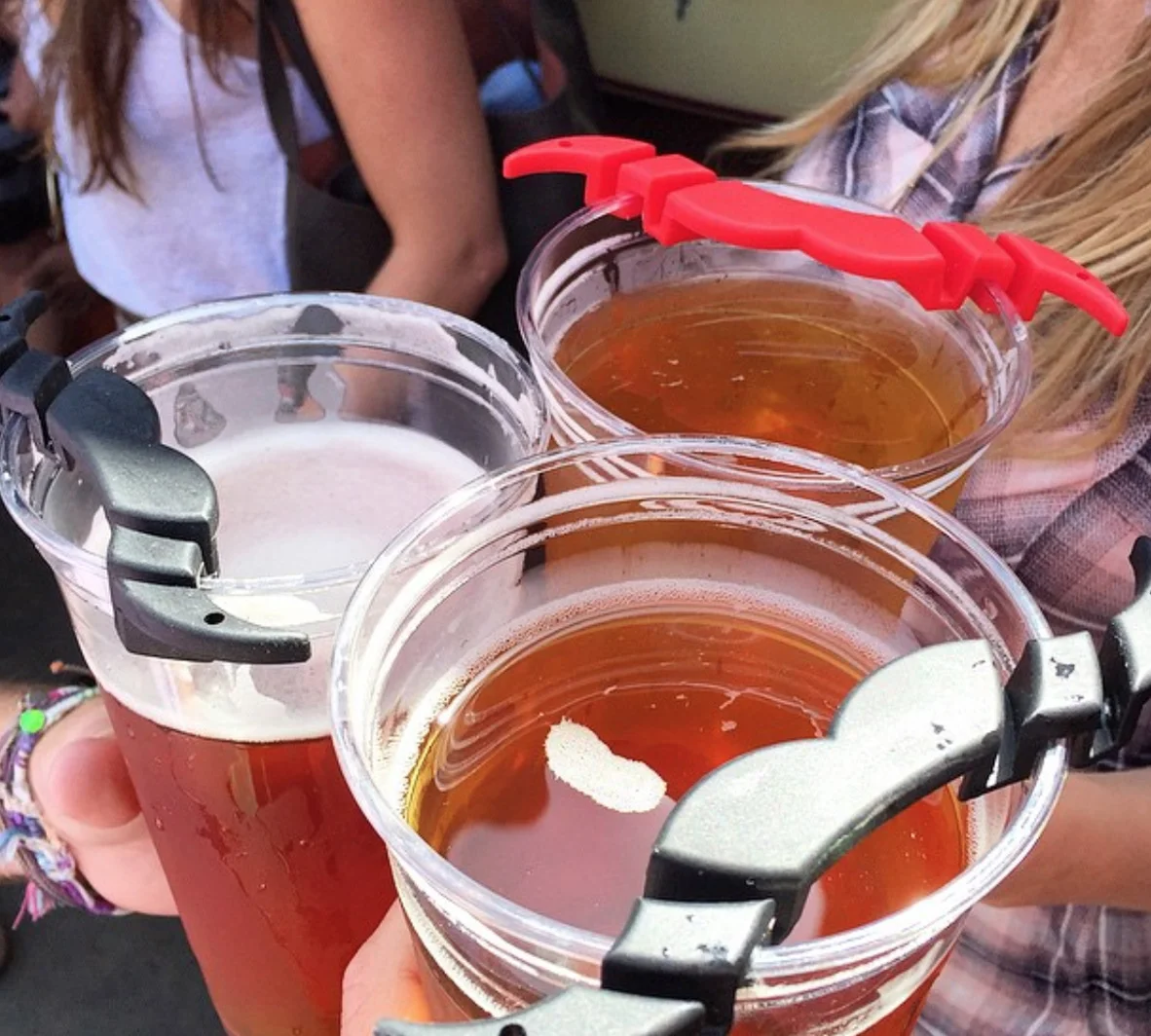
There is a useful discipline in a product that can be explained in one sentence. A person has a problem. An object does something about it. The humor helps people pay attention, but the object must still fit the cup. MoGuard’s double-sided design and removable construction turned an old tableware feature into an accessory. The novelty was in how a customer could use it.
Caldwell’s own portrait, complete with curled mustache, gives this chapter a pleasing visual consistency. The business also puts something concrete beneath the familiar description “serial entrepreneur.” His experience includes an actual consumer item, with a shape, a use, and a customer who can decide whether it works. It is an unusually tangible entry on the résumé of someone now associated with pre-seed companies and investor introductions.
People were already part of the product
Caldwell came through software engineering before his work running founder programs. He studied at Johns Hopkins, with a master’s degree in electrical and computer engineering listed in his professional background. His early career included software development at iCRco. These are useful particulars because they place him inside the work of making products before the later work of helping people build companies around them.
Another venture, 2332 Collective, concerned music production and festivals in West Los Angeles. Caldwell co-founded the music and entertainment events company before FoundersBoost. Organizing a performance and organizing a founder program are different jobs, but both depend on participation. A room needs people with reasons to be there. A calendar invitation can accomplish only so much on its own.
His direct apprenticeship in startup support included serving as co-director of Startup Next Los Angeles, a Techstars program. The program helped prepare more than 50 startups for accelerators and seed investment. That experience put mentorship near the center of his working life. It also gave him a view of the stage before a funding announcement, when a company is still learning how to make its case.
In 2017, he co-founded the organization originally known as Startup Boost, now FoundersBoost. Its early footprint included Los Angeles, Detroit, Canada, and Ireland. The name described an intermediate job: help a company gather enough preparation and momentum to take its next step. A founder might need an accelerator, an investor, or a customer. The program organized around those destinations.
The six-week proposition
FoundersBoost’s offer is unusually easy to state. Its accelerator program lasts six weeks, charges founders no fees, and takes no equity. Mentorship, education, and introductions fill the schedule. For a young company deciding where to spend time and money, those entry terms are substantive. The founder still has to do the work; admission does not make a business ready for investment.
The three destinations are often shortened to AIR: accelerators, investment, and revenue. They are distinct outcomes. A company preparing for another program has a different immediate task from one trying to make its first repeatable sales. Keeping all three in view gives the work a practical vocabulary. It allows progress to mean more than a polished presentation.
There is an economic reason to care about the early preparation. A founder’s time is finite even when ambition appears to have no natural ceiling. A mentor who has already faced a particular decision can make a conversation more useful. The program’s structure gives those conversations a deadline and a setting. Neither guarantees a successful company. Both can help a founder make the next decision with more information.
“Successful founders find mentors.”
Blake Caldwell, promoting the 2026 spring programs
Caldwell also has an investor role: he is listed as a general partner in FoundersBoost Fund. The fund focuses on program alumni. That relationship gives his career another connection to what happens after a cohort finishes, while the program’s published admission terms remain straightforward. Support during the six weeks and an investment decision are separate events in a company’s development.
Thirty-five platforms, one stubborn problem
In 2020, startup gatherings moved rapidly into digital spaces. Caldwell’s colleague and co-founder Gene Murphy later described him evaluating 35 online platforms during that transition. It is a wonderfully unglamorous detail. Somewhere behind an event that appears on a founder’s calendar is a person comparing software, trying to make the meeting behave like the meeting everyone actually needs.
The problem was larger than broadcasting a pitch. People attend demo days partly for what happens around the presentation: a question, an introduction, a conversation that lasts longer than the allotted slot. In June 2020, Caldwell promoted five remote demo days featuring 37 startups across Chicago, Los Angeles, New York, Pittsburgh, and Toronto. Their format included live conversations and movement around a virtual room after the pitches.
That choice reveals a practical concern in his work. Presentations could be transferred to a screen; opportunities to encounter another person required more thought. The software needed to support the social purpose of the event. Thirty-five platform evaluations sound less excessive when the goal includes recreating the moment someone decides to stay and ask a second question.
- PrepareMentorship & business work
- MeetDemo days & introductions
- ContinueAccelerators, investment, revenue
A program can put these encounters on the calendar. The company still has to make its next move.
A global network needs somewhere to meet
By 2025, Caldwell was asking a related question about geography. If investors increasingly look beyond the places where they live, what sustains a local startup community? He discussed the issue while FoundersBoost was working in Glendale. A global pool of capital can expand a founder’s options. The daily work of finding nearby mentors, colleagues, and introductions still needs people willing to organize it.
His response has included recruiting those people. For the 2026 relaunch of FoundersBoost NYC, Caldwell sought experienced operators, founders, investors, and community builders to lead the program. He pointed to the foundation left by previous co-directors Gene Murphy and Spencer Chandlee: 12 cohorts and more than 80 alumni startups over eight years. The invitation was to take responsibility for an existing community.
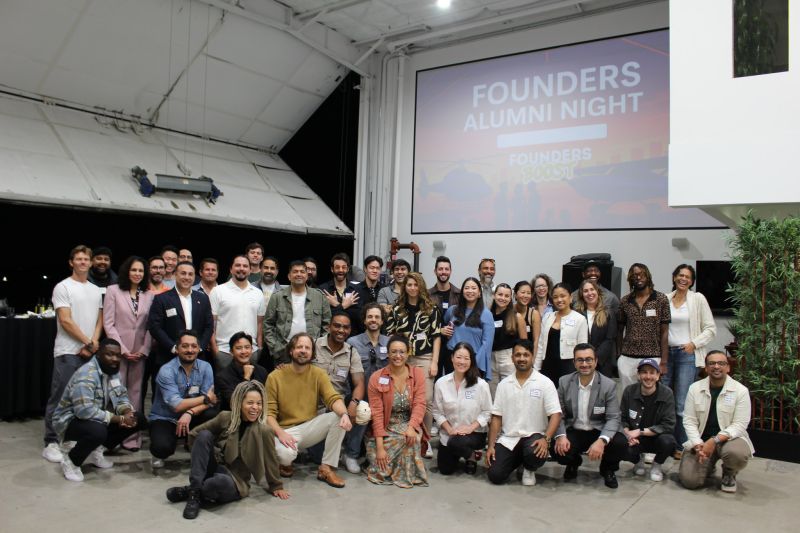
Southern California supplied a more theatrical setting. FoundersBoost’s first SoCal alumni gathering brought together founders from 16 cohorts, spanning 2017 to 2025, in a hangar at UP.Labs. A Pivotal Light electric aircraft shared the room. Some reunions offer name badges and lukewarm coffee; this one had aviation equipment. Caldwell described people reconnecting across years and discussing pivots, achievements, and possible collaborations.
The photograph makes the abstract word “alumni” pleasantly literal. People who entered the program at different times are standing in the same place. The gathering does not require them to be making the same product or solving the same problem. Their shared experience supplies the introduction. What follows can be as ordinary, and as useful, as comparing how each handled a difficult decision.
What happens after the pitch
The digital side continued in July 2026, when Caldwell promoted a Global Investor Showcase for spring startups from Los Angeles, New York, Glendale, Italy, and Malaysia. Investors could review pitches and connect with founders over a week rather than attend at one fixed hour. The format addressed another familiar obstacle: getting busy people to look at the same companies on a workable schedule.
Caldwell has also joined public conversations about investment. In an October 2024 episode of VC Unfiltered, he appeared with Marshall Smith and Maurice Maschmeyer on a panel hosted by Griffin Hermes. The discussion covered diligence, traction, advice, and teams. These are the questions founders eventually have to answer beyond the program room, when a prospective investor begins examining the business.
His career keeps returning to the practical conditions for that encounter. A product needs a clear use. A program needs mentors. A demo day needs conversations. An alumni network needs occasions for people to find each other again. Caldwell has worked on each part, sometimes with software, sometimes with a gathering, and once with a small accessory resting on the rim of a drink. The mustache got its protection. The founder still needs an introduction.