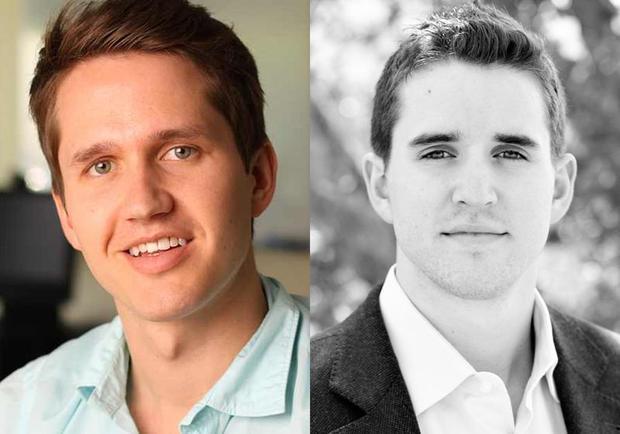
In 2015, Forbes put two brothers on the same page. Blake Byers, then a general partner at Google Ventures, was 29. Chad Byers, a general partner at Susa Ventures, was 27. Their father was Brook Byers, a longtime Kleiner Perkins investor. It was the sort of family portrait that almost writes its own, and usually writes it badly: a surname, a famous firm, a supposed inheritance of instinct. The more interesting part is what the photograph could not show. Blake had come to investing by way of a bioengineering lab, and he would eventually leave a venture partnership to become a founder himself.
A decade later, his professional description can still sound improbable in one breath: Duke engineering and economics graduate, Stanford Ph.D., former GV partner, independent investor, NewLimit co-founder. Yet the pieces fit together if the thread is curiosity rather than industry. His public portfolio jumps from a trading app to quantum computers to software tools and scientific companies. Byers calls himself an “avowed generalist.” It is an unusually plain label for a career built on judging complicated ideas before most people know what to make of them.
Before the term sheet
Byers’s route into venture capital began with an engineering education. At Duke University he studied biomedical engineering and economics, a pairing that would later make practical sense. The first discipline asks whether a system can be made to work. The second asks what happens when people, incentives and limited resources enter the room. He continued at Stanford, earning both a master’s degree and a Ph.D. in bioengineering. His published work ranged across several areas of laboratory research. He says he began running experiments in high school and kept doing so even after joining Google Ventures.
That last detail matters. Investment careers are often told as a clean escape from making things into financing them. Byers presents his lab work as a continuing habit. Before joining the firm, he also helped start two companies. He entered venture investing with the experience of projects that have to survive contact with instruments, schedules and imperfect results. That experience does not make an investor right. It does make a technical founder’s messy first drafts easier to take seriously.
One account from his GV years offers a wonderfully literal picture of this proximity. Max Hodak, the founder of the laboratory automation company Transcriptic, worked in Byers’s garage during the company’s early period. A report even describes chemicals stored in Byers’s freezer; Hodak told the writer there was no danger. The image is a long way from a polished partner portrait. It is also a reminder that some startups begin in places with folding tables and borrowed space, long before anyone has prepared a respectable slide about the addressable market.
“I am an avowed generalist.”Blake Byers
The portfolio with a denominator
Byers joined GV, then called Google Ventures, in 2010. He stayed for roughly a decade as the firm expanded. His own accounting says he invested in 38 companies during that period. He breaks the group down with rare specificity: 10 went public, seven were acquired, 17 were still active and four shut down. Those are his figures, and the status of a portfolio changes over time. Still, publishing the denominator gives the successes a little context. Venture investing is not a collection of inevitable triumphs. It is a stack of decisions made before the ending is known.
The names in that stack resist a tidy sector label. Robinhood offered a new way to trade stocks. IonQ developed quantum computing hardware. Gusto worked on payroll. Kensho built software for financial analysis. Factory makes tools for coding. Byers’s later personal investments have included companies working on artificial intelligence, space technology and mathematical reasoning. This is the broadness behind “generalist”: a willingness to ask whether a strong team can make a difficult idea concrete, even when it sits far from the investor’s last meeting.
The Robinhood connection is particularly revealing because it appears twice in the family album. Blake was involved in GV’s earliest outside investment in the company. His brother Chad led an early Susa Ventures investment. Their paths met around the same young startup, but through separate firms and separate decisions. An account of Robinhood’s first fundraising even describes a colleague researching the startup and finding an unrelated page of cat memes. It is a comic detail from an era before the brand became familiar. Early investing often looks less like spotting a famous company than deciding whether an unfamiliar one deserves another conversation.
The family connection remains part of the story without explaining it away. Brook Byers built his career at Kleiner Perkins; Chad built his at Susa. Blake’s own record runs through Stanford research, GV and then NewLimit. The three careers share a profession, but not a single job description. The 2015 Forbes photograph, charming as it is, caught one instant in three different trajectories.
Leaving the other side of the table
In 2021, Blake Byers left GV. The move came after years of early investments and a record that, on his telling, included multiple listings and acquisitions. He began investing independently through Byers Capital. That alone would have been a familiar venture story: a partner sets up a new vehicle, keeps meeting founders and builds a portfolio under his own name. His next move made the sequence less predictable. Later that year, Byers co-founded NewLimit with Brian Armstrong and Jacob Kimmel.
The founders brought notably different working histories to the company. Armstrong had built Coinbase. Kimmel came from computational biology. Byers arrived with both laboratory training and a decade of venture experience. The original announcement, signed by Armstrong and Byers in December 2021, described a company still assembling its founding team. That is a useful image to keep in mind when looking at the much larger organization that followed. A company can begin with a mission statement, but it advances through hiring, experiments, operating choices and the unglamorous work of deciding what to try next.
- 2010Joined Google Ventures, later known as GV.
- 2015Appeared with Chad Byers in Forbes’ venture capital 30 Under 30.
- 2021Left GV and co-founded NewLimit with Brian Armstrong and Jacob Kimmel.
- 2025NewLimit announced a $130 million Series B.
- 2026The company announced a $435 million Series C led by Founders Fund.
The financial milestones arrived in stages. NewLimit announced a $130 million Series B in May 2025, led by Kleiner Perkins. In June 2026 it announced a $435 million Series C led by Founders Fund, with new and returning investors. The later round is a substantial vote of confidence from backers. It is also capital for work that still has to be done. Byers knows this distinction well: over the years he has seen that a financing announcement is a beginning, a checkpoint or a change in scale, never the finished story.
There is a certain symmetry in his move. At GV he listened to founders explain why their hard thing might work. At NewLimit he is one of the people responsible for turning a hard thing into an organization. He can still invest through Byers Capital, but founding asks a different kind of patience. The investor can compare many opportunities at once. The founder has to return to the same one on Monday morning.
A generalist’s line of sight
Byers has offered a sentence that explains more about his choices than a list of logos can: he wants to work on projects that can “positively bend the arc of humanity over multiple generations,” or are simply fun, ideally both. It is grand in the first half and disarmingly human in the second. One can admire the scope without pretending that every ambitious project will succeed. A taste for difficult work requires a tolerance for uncertain endings, and perhaps enough humor to remain useful while waiting for one.
That combination is visible in the distance between a garage and a major financing round. The garage story concerns one founder, one improvised space and a technical idea still taking shape. The funding announcements concern institutions with large checks and names familiar across Silicon Valley. Byers has worked at both scales. His career is easiest to understand when neither is treated as a substitute for the other. A big round cannot do the small experiment. A small experiment cannot recruit a whole company. The work is in connecting them.
It is tempting to write a venture investor’s biography as a scorecard, especially when the investor provides the numbers himself. Byers’s 38-company tally is worth knowing. So are the 10 public listings and seven acquisitions he reports. But the more distinctive fact is the change in vantage point. The student who ran experiments became an investor who backed other people’s attempts, then became a co-founder with an attempt of his own. Each role exposes a different part of the same problem: deciding what deserves years of effort before anyone can promise a result.
The Forbes picture offered a tidy family story. The later career is messier and better: a scientist, a generalist, an investor, and now a founder still living with the outcome of a long bet.