A small exporter can find a buyer on the other side of the world, agree a price and arrange a shipment, then discover that the money has a more complicated itinerary than the merchandise. There are banks to satisfy, documents to supply and currencies to exchange. Bill Deng has spent much of his working life in that awkward interval between a deal and a usable bank balance. It is an unromantic place to build a company. The people waiting to be paid have excellent reasons to care.
Deng co-founded XTransfer in Shanghai in May 2017 after working at Visa and Ant Financial. He brought a payments insider’s knowledge to an exporter’s problem: small businesses were participating in international trade without enjoying the financial arrangements available to much larger companies. His career had put him close enough to both sides to see why the mismatch persisted.
By August 2026, XTransfer reported more than one million registered customers worldwide. That figure counts registrations, rather than businesses transacting every month. The distinction matters. Deng’s story concerns the patient construction of something quite specific: a way for small traders and financial institutions to do business with one another.
A decade before the leap
Deng, also known as Guobiao Deng, is a native of Guangdong and a graduate of Fudan University’s School of Management. His international payments apprenticeship began at Visa in 2007 as a management trainee. Over three years, he worked in Shanghai, Beijing and Singapore. Before he was trying to assemble a network of his own, he was learning inside an established one.
He joined Ant in 2010. Those seven years brought him into contact with the commercial life behind a payment: merchants, pricing decisions, overseas collections and the practical irritations of moving money. By 2014 he was responsible for Chinese vendors’ retail collections in Alipay’s international operations department; in 2016, his responsibilities included cross-border remittances. The eventual startup grew out of work he had already been doing.
At Ant, chairman Eric Jing had asked Deng to concentrate on competitive pricing for Alipay. Contact with small-business owners took him into the manufacturing regions of the Yangtze and Pearl River deltas. There, cross-border finance had a less polished appearance than the phrase suggests. An exporter needed the financial system to recognise an ordinary commercial transaction as ordinary.
In April 2017, he left Alipay. XTransfer followed the next month. The founding group brought together experience from Alibaba and Ant, including risk management, business development and payment technology. Alice Yao, Leon Deng and Liu Yanfang were among the colleagues whose specialisms helped turn the initial proposition into an operating business. This was a shared departure, with a decade of relevant experience packed into the luggage.
Management trainee
International payments
Co-founder and CEO
The bank has a question
The central difficulty was expensive scrutiny. Banks have to understand who is sending money, who is receiving it and whether the transaction makes commercial sense. A small exporter can generate substantial checking work without generating the revenue of a multinational account. Serving that exporter may become an unattractive proposition even when the underlying business is legitimate.
Deng’s response was to organise the information needed to make those relationships workable. XTransfer’s payment services connect businesses with financial institutions, while its risk systems examine the trade behind a transfer. Customer checks, transaction verification and anti-money-laundering monitoring are part of the machinery. They are also a large part of the reason the machinery exists.
By 2021, he was explaining this approach in a FintechHK interview: technology could help bridge banks and smaller exporters by reducing review and transaction costs. The emphasis is revealing. A company asking banks to serve a difficult customer group has to make the work of serving that group more manageable. A pleasant app cannot negotiate away the need for trust.
In a 2024 conversation at Web Summit Qatar, Deng described a B2B market whose digital tools remained scattered. Consumer payments already had familiar networks and platforms. Business trade still depended heavily on banks and disconnected processes. He saw room for an intermediary that understood the documents as well as the transfer.
His language about expansion paired appetite with caution. He urged founders to venture abroad while taking implementation carefully. That pairing fits the work. Every new market offers potential customers, alongside a new set of rules and institutions. Enthusiasm can book the flight. It cannot complete the regulatory work.
Still reading the customer messages
The scale of the ambition sits beside a smaller, useful habit: Deng personally reads WeChat messages from SME owners. For someone building payment infrastructure, these messages provide a direct view of what customers encounter. They bring the consequences of a process back to the person running it, without waiting for an account manager to turn the experience into a slide.
His own description of his working mentality is “da gong ren”, a hardworking employee. In Singapore for the November 2024 fintech festival, his schedule stretched from an eight o’clock breakfast meeting to a ten o’clock call across time zones. Between them came partner visits, speaking engagements and conversations with visitors. The founder’s calendar had acquired international complications of its own.
His advice to other entrepreneurs was compact: “The customer is king.” The phrase is familiar; keeping a channel open to small-business owners gives it some practical content. A trader struggling with a payment has little use for an explanation of the company’s long-term vision. They have a transaction to finish.
“The customer is king.”
Bill Deng, November 2024
Another choice carried over from Ant concerns ownership. Deng took inspiration from Jack Ma’s willingness to distribute company options broadly. By late 2020, XTransfer’s front-desk clerk had stock options too. It is a concrete detail about how Deng applied an idea from a former employer: participation extended beyond the people designing products or negotiating investment rounds.
New partners, familiar work
Hong Kong became a regional hub for XTransfer in 2023. Deng explained the location in terms of customers, international banks, financial talent and regulatory clarity. Chinese suppliers already needed services there; the city also offered a base for foreign businesses trading with China. His account of the decision was characteristically operational, concerned with the people and institutions needed to make expansion work.
The same logic carried into Europe. At Money20/20 in Amsterdam in June 2025, Deng presented updates on the company’s Netherlands electronic-money licence and payment network. XTransfer also signed a memorandum of understanding with BNP Paribas. Around the same event, its discussions included leaders from Deutsche Bank, J.P. Morgan and Barclays. For Deng, building a technology business includes a great many conversations with bankers.
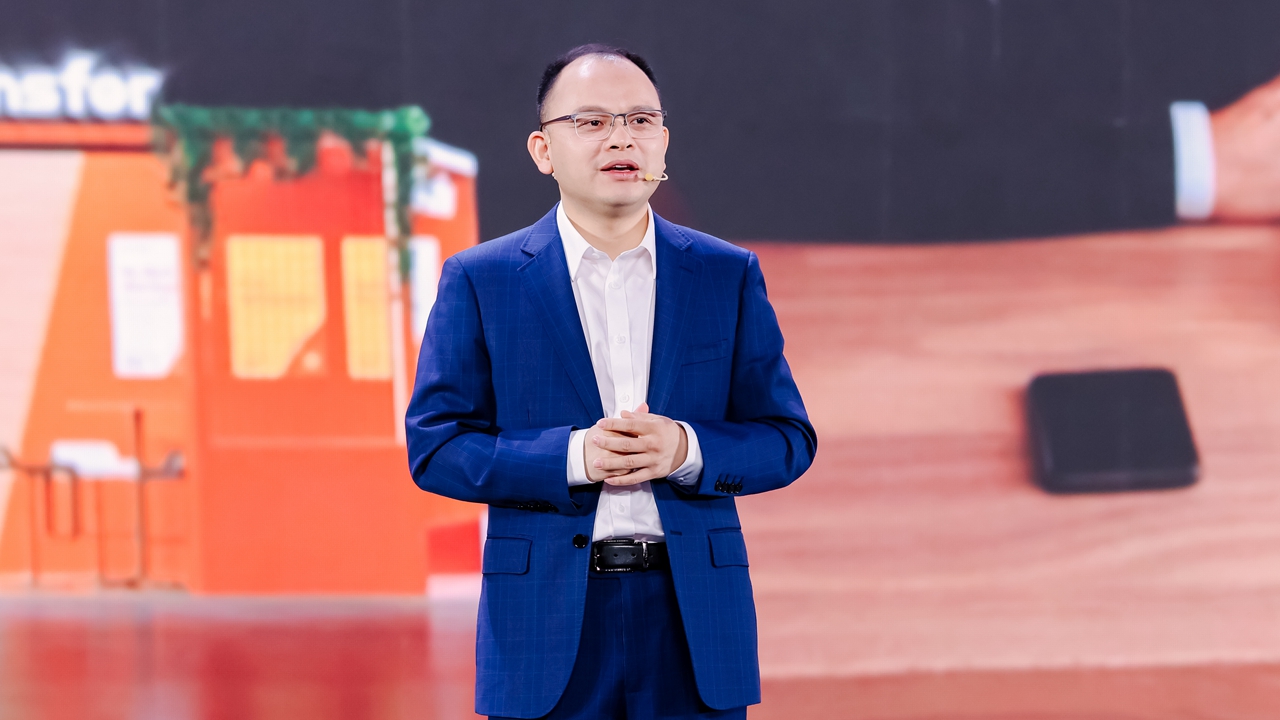
These relationships help explain his position in the industry. Banks bring local knowledge, regulated operations and existing customers. XTransfer brings a trade-focused platform and the ability to handle a large population of smaller businesses digitally. The partnership proposition depends on making those capabilities useful to each other. Deng’s early training inside Visa and Ant has found a second life in the negotiations.
AI gets a paperwork assignment
Deng was discussing language models for trade settlement at Web Summit in 2024, including work on a specialist model alongside outside technology. His interest followed the problem: trade generates information in awkward forms, and somebody has to interpret it. The promise of AI was the possibility of making that work repeatable without adding a person for every additional task.
By the August 2026 summit in Shenzhen, the company described TradePilot, its own risk-control system, as incorporating 72 AI agents across onboarding, trade verification and monitoring. Deng said transaction workload had grown while the risk-management team had stayed stable. These are company-reported accounts of the system’s operation, useful evidence of what he is trying to build rather than a guarantee about every payment.
Registered customers worldwide
Registrations measure the size of the customer base, not monthly payment activity.At that summit, the company also reported US$60.5 billion in transactions for 2025. The annual figure belongs beside its year; it should not be confused with a current monthly run rate. As the business grows, the bookkeeping around its own milestones deserves the same care Deng asks the financial system to apply to a trader’s invoice.
The emerging-market work continued into October 2026, when XTransfer announced that its Chilean subsidiary had completed registration with the country’s financial intelligence unit, UAF. A registration is a particular regulatory step, with a particular purpose. Its place in this story is the steady accumulation of local arrangements needed to support a global ambition.
A useful kind of impatience
Deng also advocates stablecoins as a possible future route for cross-border business payments. His January 2026 interview explored how shared ledgers might reduce the reconciliation required between separate institutions. It remains an argument about where the industry could go. His existing business still has to handle the trade, counterparties and compliance questions in front of it.
That combination makes him an interesting payments founder: impatient about the friction, attentive to the institutions involved. His aspirations have expanded from helping Chinese exporters to connecting smaller businesses across markets. The work keeps returning to the same test. Can a business that has found an overseas customer receive the proceeds through a process it can understand?
For Deng, the answer has required a career inside payment companies, a founding team, bank partnerships and software trained to examine commercial paperwork. For the exporter, success would feel considerably less elaborate. The sale is agreed. The goods are shipped. The money arrives. There is something rather appealing about a global ambition whose useful result gives somebody else one fewer thing to think about.
Follow the conversation
Interviews, career details and recent developments.