Before there were communications plans, there were television viewers with opinions. Bilen Mesfin Packwood’s first job after college was answering them. Working in viewer services at a public television station, she discovered that people cared quite a lot about their shows. The audience, it turned out, had a voice of its own. The person taking the calls had better listen.
She later became an editor at an arts and antiques magazine, another workplace where attention had to be earned. Readers interested in paintings and collectibles needed a reason to stop on a particular page. Journalism school sharpened the lesson: an opening line could invite someone into a story, or lose them before the second paragraph.
Those early jobs give her career a pleasing continuity. She has spent years thinking about who gets heard, who gets overlooked, and what makes another person care. Today she runs Change Consulting in Oakland, helping racial and social justice organizations communicate. The audiences have changed. That practical question about listening has followed her from the television station.
A room in East Orange
Her own arrival in the United States involved a much smaller room. She moved from Ethiopia at eleven, joining her mother with her brother. Her father followed a year later. The family lived in a studio apartment in East Orange, New Jersey, taking turns on a cot and a twin bed. She remembers the children at school as welcoming, though she said little during those first months.
Her mother had been an accountant; in America, she initially worked at a liquor store. Her father, a lawyer, first worked as a janitor. Packwood credits her work ethic to her mother, who rose at four in the morning and supported the family’s education. Packwood became an American citizen while in college.
The professional communicator has described how difficult it remains to put that experience into words. Moving among different worlds, she felt both conspicuous and unseen. Her account gives particular weight to the question her work keeps returning to: how do people get to describe their own lives?
Choosing a side of the story
Packwood earned a bachelor’s degree in English at Vanderbilt University and a master’s in journalism at the University of California, Berkeley. Her reporting and writing appeared in the Associated Press, the Nashville Tennessean, Edutopia, and Art & Antiques. She learned the craft from inside the newsroom before carrying it into the organizations seeking coverage.
She then worked on communications for Kamala Harris when Harris was San Francisco’s district attorney. Her responsibilities included explaining initiatives on truancy and reentry, reaching multicultural media, handling emerging communications problems, and serving as the office’s day-to-day spokesperson in print and on camera.
The work required translation between institutional decisions and public understanding. A policy announcement had to survive questions. A message had to make sense beyond the office that drafted it. That experience supplied another part of her eventual consulting practice: familiarity with the pressure on the person answering, as well as the reporter asking. Her career was assembling the ingredients of a business before she had decided to build one.
One laptop, then more chairs
In February 2009, she began Change Consulting at her kitchen table, with coffee shops around Oakland and San Francisco serving as occasional additional premises. A laptop was the essential equipment. She initially concentrated on earned media, helping social justice groups bring their work into public conversation.
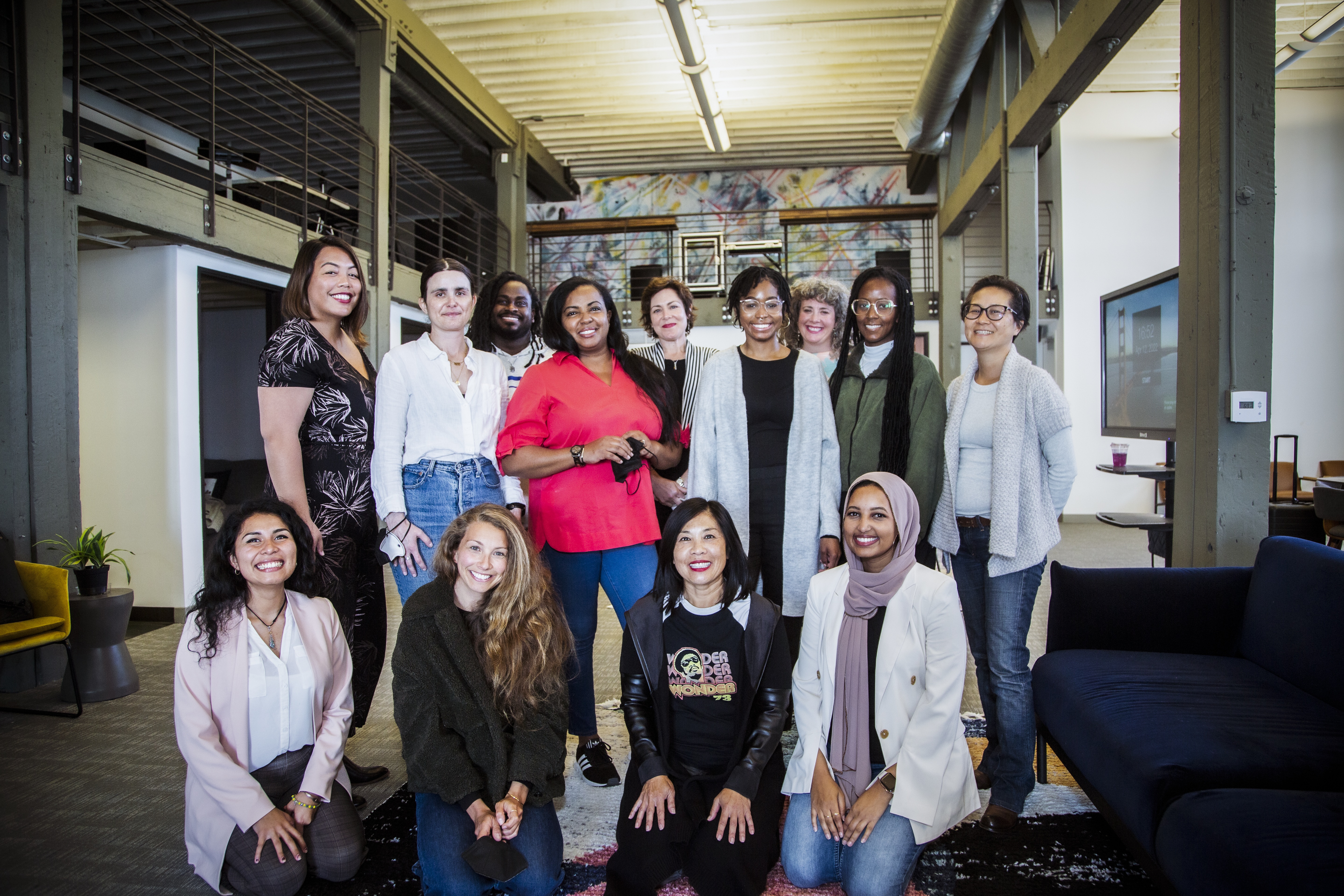
The decision to hire came in 2015. She wanted colleagues, shared responsibility, and the ability to serve more organizations. There was a thoroughly human motive, too: she no longer wanted to work alone. By her August 2022 account, the company had thirteen full-time employees. Seventy percent were people of color, and almost forty percent were Black.
The services expanded with the staff: research and messaging, digital work and content, media outreach, and training. Her frustration was with communications plans that gathered dust. She wanted a practice that stayed for the implementation. A document on a shelf can look impressively strategic while accomplishing the daily work of a bookend.
An accidental entrepreneur learns to listen
Packwood has called herself an accidental entrepreneur. Journalism came first; advocacy became the stronger pull. Running a company emerged along the way. By 2023, she was talking about leadership as creating the conditions in which other people could learn and grow.
That understanding mattered because she had once treated her own introversion as a reason to rule herself out of leadership. She preferred listening to talking. Building a team gave her a different way to understand the job: making room for others could itself be a leadership practice.
Her account of Change’s work also keeps the clients in view. She has pointed to the agency’s role in launching the California Black Freedom Fund and helping raise more than $60 million for Black power building in California. The distinction matters: the fund’s organizers and philanthropic partners have their own work and agency. Communications is one contribution to a larger effort. Packwood’s ambition is to make that contribution useful enough to affect what happens beyond the announcement.
The announcement with money behind it
The California Black Freedom Fund’s launch in February 2021 offers a concrete view of that larger effort. It began as a $100 million initiative intended to support Black-led organizing in California over five years. Packwood was listed as a media contact on the announcement.
The fund was co-created with Black leaders and organizers. Its stated purpose was sustained investment in locally rooted organizations working against systemic and institutional racism. The dollar figure described the initiative’s ambition at launch; it was a commitment to a program of work over time.
For a communicator, such an announcement contains several audiences at once: potential funders, organizations that might receive support, journalists, and people trying to understand what the money is for. A useful explanation has to connect the sum to the work. Otherwise a large number becomes a headline that floats away from the people it is meant to serve. Here, the central proposition was durable resources for organizing, with communications helping make that proposition public.
Low ego, with the volume up
Her preferred workplace manners are easy to understand. In a 2022 conversation about nonprofit marketing, she argued for keeping egos small and concentrating on the work. She also preferred making progress to waiting for perfection. That combination could save a considerable number of meetings.
The tone is direct, and the enthusiasm has a specific object. The people who excite her are those with ideas for making their communities better. She talks about helping nonprofit leaders find messages that reach the people they hope to move. Her interest in the work sounds personal because it is.
There is a soundtrack, too. For Change Consulting’s year-end 2024 playlist, she chose GloRilla’s “Let Her Cook.” A colleague, Kiah, had reintroduced her to the artist. GloRilla and Kendrick Lamar were playing in the background while she worked on Change and client projects. The executive biography makes room for a repeat button.
“I really believe in low ego, high impact.”Bilen Mesfin Packwood · 2022
Three days before the inbox
At the beginning of 2024, Packwood described a deliberately structured return to work. The agency had closed for two weeks. When people came back, the first three days went to an internal initiative called Change U, giving the team time to prepare and align before resuming client work.
She also expanded the leadership team and worked with colleagues to assess their collective impact and prepare for the year. Collaboration, she said, had made her better prepared than the work she had previously done alone. It is an admission many founders would benefit from putting on the calendar.
That practice sits comfortably beside her earlier advice to build long-term relationships and be generous. She has urged people to avoid treating every relationship as a transaction. In an industry measured partly by who answers a call or returns an email, that is a consequential preference. It asks what a working relationship can become over years, beyond the immediate usefulness of an introduction or a favor.
The attention specialist steps back
In October 2025, Packwood began a publication called Collective Attention. Its opening essay described an uncomfortable shift in tools she had once welcomed. Websites, social platforms, and digital campaigns had offered more ways to connect directly with people. Increasingly, she saw the platforms rewarding spectacle and demanding attention for themselves.
Her response was to make room for another kind of inquiry: how could people reclaim their time and their ability to come together? She proposed writing about the attention economy’s effects on communities and democracy, and about experiments in resisting its demands. She was also finding more time for offline interests, nature, and relationships.
The question reaches straight into her profession. Helping an organization win attention requires using the channels available. Yet a channel can change the terms of the encounter. A communicator may arrive with a carefully considered message and discover that the distribution system would prefer something louder. Packwood is now writing about that friction from inside the trade.
What gets her attention next
The recognition has continued alongside that questioning. In 2025, Packwood received a Silver Stevie in the Best Female Entrepreneur category for business services companies with eleven to 2,500 employees. Vanderbilt’s spring 2026 class notes also recorded her Anthem recognition: gold in Community Voice and silver in a business leadership category for diversity, equity, inclusion, and belonging.
The awards place her in the familiar public language of business achievement. The more revealing measure may be the kind of work she keeps choosing: helping leaders explain a vision, building a team that can carry the work, and examining whether the systems used to reach people still support human connection.
Her beginnings offer a useful way to read that choice. At the television station, she encountered people who wanted someone to hear what mattered to them. At the kitchen table, she began making a living helping others be heard. Now she is considering the conditions under which any of us can pay attention. The audience is still there. She is still listening.