The name BeyondTrust sounds like a dare. For a security company, it is also an occupational hazard. The business sits in the most sensitive corridor of corporate technology: the place where an administrator, contractor, service account or now an AI agent can obtain enough power to change a server, retrieve a secret or enter a production system. BeyondTrust sells the controls around that moment. It finds privileged identities, stores and rotates credentials, removes permanent admin rights, brokers remote sessions, records what happened and raises alarms when an identity behaves strangely.
That tidy description conceals a wonderfully untidy company. BeyondTrust is less a startup than a reunion tour. Its oldest branch is Symark, a Unix security vendor founded in 1985 by Bob Sommers and Doug Yarrow. A second branch began in 2003 when Joel Bomgar built remote-support software and named the company after himself. The original BeyondTrust emerged from DesktopStandard after Microsoft bought most of that company's products in 2006. Symark bought it for a reported $20 million in 2009, then kept the better name.
01 / The assembly jobSix histories, one control room
The corporate nesting doll snapped shut in 2018. Francisco Partners acquired Bomgar. Bomgar bought password-management specialist Lieberman Software, endpoint-privilege company Avecto and the earlier BeyondTrust, then renamed the combined operation BeyondTrust. Remote support came from Bomgar. Windows and Unix privilege tools came through different family branches. Password vaulting, vulnerability research and endpoint controls arrived through still more deals. In 2024, BeyondTrust bought Entitle to add just-in-time cloud access and entitlement management.
See the real route
Connect identity, cloud, endpoint and application data to expose who can ultimately reach privilege, including indirect paths.
Grant less, later
Vault secrets, remove standing admin rights and issue temporary access only when a person or machine needs it.
Watch and record
Monitor sessions, route events to security systems and preserve an audit trail for investigators and compliance teams.
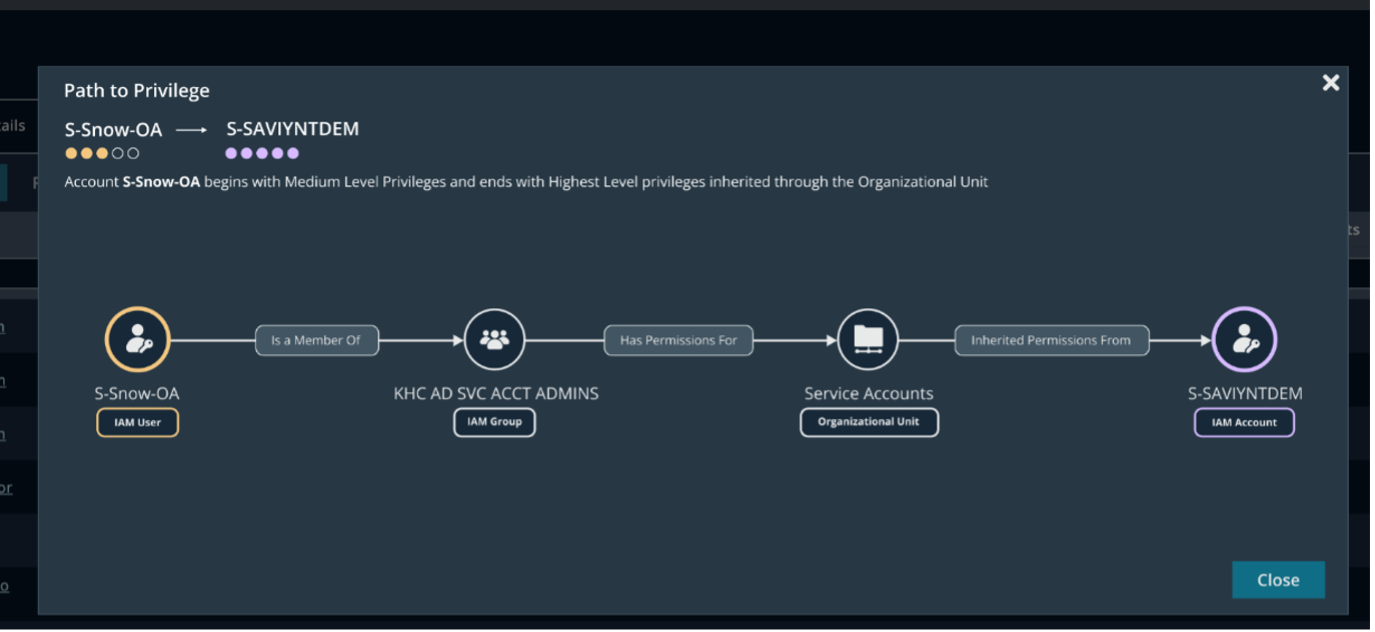
The roll-up matters because attackers do not respect product categories. A help-desk connection can become an administrator session. A forgotten service account can reach a cloud role. A developer's AI assistant may inherit the developer's credentials. BeyondTrust's pitch is that point tools see only their square of the chessboard. Its Pathfinder platform combines the pieces under one login and feeds them identity context from Identity Security Insights, including a graph of the hidden relationships that can lead to elevated access.
“Identity alone doesn't create risk. Privilege does.”BeyondTrust's current positioning, reduced to the sentence that explains the portfolio
02 / The stress testThe keeper of keys loses a key
In December 2024, that proposition met its sharpest public test. BeyondTrust found anomalous behavior in its Remote Support SaaS service. Its investigation concluded that attackers exploited a zero-day in a third-party application to enter an online asset in one BeyondTrust AWS account. From there, they obtained an infrastructure API key that could reset local application passwords in a separate AWS account running Remote Support. Seventeen customers were affected. The U.S. Treasury Department said the stolen key helped state-sponsored Chinese hackers remotely access workstations and unclassified documents.
What failed first was not the password vault itself. It was a third-party zero-day that opened a route to an overly consequential infrastructure credential. BeyondTrust's response was concrete: revoke the key, suspend and replace affected instances, bring in retained investigators, notify customers, publish indicators of compromise, patch every SaaS instance and push fixes for self-hosted deployments. No FedRAMP instance was affected, the company said.
The uncomfortable lesson is larger than one vendor. Centralizing access controls can reduce sprawl and improve detection, but it also concentrates consequence. A privileged-access platform must be designed as if its own management plane is a target, because it is. Buyers should ask how infrastructure keys are scoped, rotated and monitored, how tenants are isolated, what logs leave the platform, and how fast a hosted instance can be replaced.
03 / The businessTwenty thousand customers buy fewer standing privileges
BeyondTrust's buyers are security, identity, IT operations, service-desk, DevOps and operational-technology teams. The heaviest demand comes from enterprises and public agencies where contractors need controlled access, administrators manage thousands of machines and auditors want evidence. Password Safe handles credentials and sessions. Endpoint Privilege Management removes local admin rights without stopping approved work. Privileged Remote Access gives vendors a monitored route into sensitive systems without handing over passwords or a broad VPN. Remote Support gives help desks a security-conscious way to fix devices. Active Directory Bridge brings Unix and Linux systems under Microsoft directory policy.
A public snapshot, not a price list. AWS Marketplace lists one 36-month Password Safe Cloud subscription for 500 managed assets at $113,000. Most BeyondTrust products require a custom quote. Remote Support is licensed by concurrent users, while other products may count managed assets, accounts, features, deployment and services.
This is enterprise subscription software with cloud and self-hosted options, sold directly, through partners and in cloud marketplaces. Training, support and professional services add to the bill. The company said recurring revenue exceeded 70 percent of total revenue in 2021. Supplied company data estimates annual revenue at roughly $337.1 million and headcount around 1,800, but BeyondTrust is private and does not publish audited figures.

04 / What changedThe vault was no longer enough
BeyondTrust did not change direction because of the 2024 incident alone. The strategic shift was already underway. Cloud infrastructure made permissions temporary and distributed. Entitle brought self-service requests and just-in-time approvals across more than 150 integrations. Identity Security Insights added a graph that looks for effective access rather than trusting a permissions table. Pathfinder began turning a portfolio of products into a shared control plane.
Then AI agents arrived on employee laptops carrying the authority of whoever launched them. BeyondTrust reported enterprise AI agents in its telemetry growing 466.7 percent year over year. In 2026 it announced PathfinderAI, an MCP server, NHI Governance and AI Agent Security. The last product is designed to discover assistants such as Claude Code, Copilot, Cursor and Codex, then block unauthorized endpoint actions before they occur. It was in private beta in June, with general availability planned for fall 2026.
“The actor has changed, but our job has not.”CTO Marc Maiffret on extending least privilege from human administrators to AI agents
That is the company's most interesting bet: PAM will stop being a vault category and become a decision layer for every powerful action. It is plausible because BeyondTrust already sits on endpoints and remote sessions. It is not guaranteed. AI behavior is non-deterministic, policy mistakes can break legitimate work, and customers will not want another opaque agent judging an opaque agent.
05 / The buying decisionBreadth is the advantage - and the tax
| Alternative | Why buyers choose it | Where BeyondTrust presses |
|---|---|---|
| CyberArk | Deep enterprise PAM, secrets and a large ecosystem | Remote support plus endpoint privilege and identity-path analytics in one family |
| Delinea | Broad PAM with approachable mid-market options | Scale, remote-access heritage and cross-domain graph context |
| Teleport / StrongDM | Developer-first, cloud-native infrastructure access | Legacy estate coverage, service desk, endpoints and regulated-enterprise controls |
| TeamViewer / ConnectWise | Focused remote support and simpler deployment | Credential injection, privileged-session governance and a wider identity platform |
BeyondTrust works best when an organization has a mixed estate, many third parties, strict audit demands and a team capable of owning policy. The platform can replace overlapping remote-access, password, endpoint-elevation and cloud-entitlement tools. It works poorly when the inventory is unreliable, nobody owns approvals, integrations stop at deployment, or operators treat the vault as a set-and-forget appliance. Small companies with a handful of administrators may be buying a control room when they need a sturdy lock.
What a reader can copy on Monday
- Map paths to privilege, not job titles. Include service accounts, API keys, vendors, local admins and AI tools.
- Replace standing access with short, approved windows and inject credentials so users never see them.
- Export configuration changes and authentication events to an independent SIEM.
- Practice replacing a compromised tenant or key before an incident makes the rehearsal real.
- Review dormant accounts and patch self-hosted access systems with the urgency of internet-facing infrastructure.
The company has survived name changes, private-equity owners and a stack of integrations because the underlying problem keeps expanding. In 1985, privilege meant a powerful Unix command. In 2003, it meant a technician taking remote control. Today it can be a chain of cloud roles or an AI assistant with production credentials. BeyondTrust's opportunity is that all of those paths rhyme. Its burden is that customers are trusting it to stand at every door.