Before Beyoncé became a one-word institution, she was a child in Houston learning an unglamorous equation: breath plus repetition equals possibility. The useful origin story is not that talent announced itself and the world applauded. It is that talent was given chores. She sang in school choirs, entered local competitions and rehearsed with the group that would become Destiny's Child. One remembered exercise had her running while singing, training the body not to betray the voice when choreography arrived. Long before the stadium was a canvas, the lungs were a workshop.
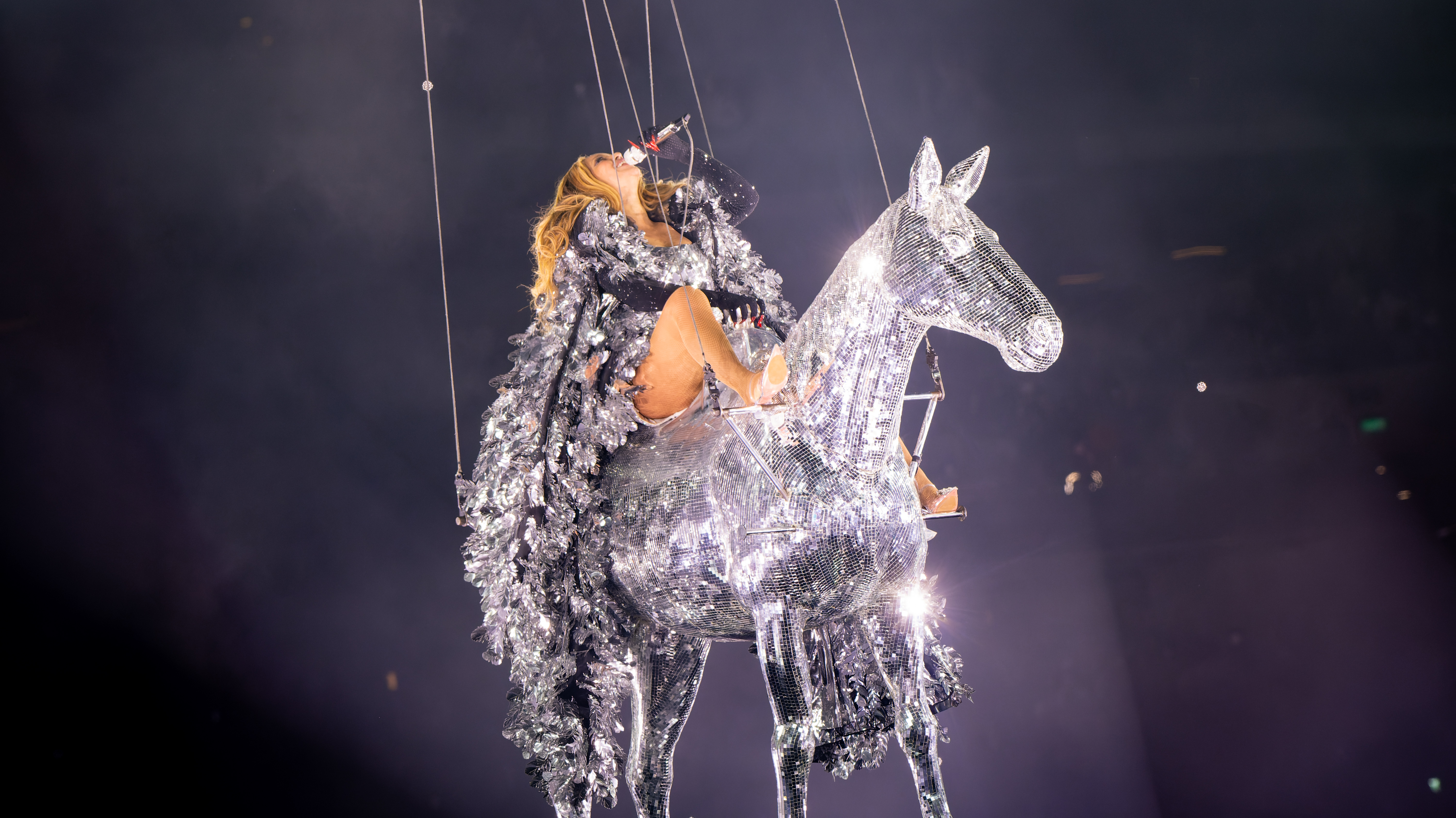
That detail explains more than any crown metaphor ever could. Beyoncé's career is often narrated through arrivals - the hit, the surprise drop, the festival entrance, the horse beneath a mirrored saddle. But her true subject is preparation. The show is grand because the machinery is exact. The machinery stays mostly out of sight because she has learned that mystery, properly managed, is also a production choice.
Houston taught the count-in
At nine, Beyoncé joined the music magnet program at Parker Elementary. Dance classes and talent shows fed into Girl's Tyme, the young ensemble that endured a televised loss on Star Search before evolving into Destiny's Child. Failure arrived early, on camera, and refused to be fatal. The group kept rehearsing. By 1999, “Bills, Bills, Bills” and “Say My Name” were No. 1 records. Their performances were clean, rhythmic and conversational: voices passing authority among one another while choreography made a small republic of the stage.
Destiny's Child was a pop education with unusually public exams. Lineup changes, press scrutiny and the blunt commercial logic of the record business taught Beyoncé how fragile a group can be and how valuable a point of view is. Kelly Rowland and Michelle Williams remained creative companions, not footnotes. The group taught her to lead without pretending that harmony is a solo act.
Her 2003 solo debut, Dangerously in Love, did not politely test the water. It topped the Billboard 200, produced “Crazy in Love” and “Baby Boy,” and earned five Grammys in one night. The horns in “Crazy in Love” sounded like a parade rounding the corner before anyone had cleared the street. Yet the album's larger consequence was structural: the ensemble's lead singer could now carry an entire commercial universe.
Then the artist acquired the office
Fame gave Beyoncé leverage. Parkwood Entertainment, founded in 2008, gave that leverage an address. The company brought management, film, music and live production into a system built around her decisions. In 2011 she ended her father's role as manager. It was an adult career move with an artistic result: the performer was becoming the executive producer of the performer.
This is the hinge in the story. Plenty of singers ask for creative control. Beyoncé built an organization capable of using it. Parkwood could hold the long rehearsal, the feature-length visual, the exacting tour, the documentary cut and the marketing decision that looked, to everybody outside the building, like no marketing at all.
On December 13, 2013, the self-titled Beyoncé appeared online without the usual runway of singles, interviews and countdowns. Seventeen videos accompanied fourteen songs. The trick was not mere secrecy; secrecy is cheap. The accomplishment was finishing an enormous interlocked work and keeping every component aligned until release. She converted silence into suspense and an album into an event no calendar had been allowed to spoil.
Lemonade widened the form again in 2016. Music, poetry and film moved through betrayal, anger, inheritance and repair. Country sat beside rock, gospel beside trap. The visual album did not behave like a folder of promotional clips. It had an argument, a geography and a family memory. Genre was already becoming less a box than a set of doors.
The spectacle shows its homework
At Coachella in 2018, Beyoncé became the festival's first Black woman headliner. She could have treated that fact as sufficient history. Instead she built a two-hour performance around the sound and pageantry of historically Black colleges and universities: ranks of brass, a drumline, steppers, dancers, a broad moving formation. The entrance was imperial; the references were collegiate, communal and exact.
The later Netflix film Homecoming did something sly. It preserved the spectacle, then interrupted it with rehearsal. We saw bodies counting, notes being adjusted, ideas tested, a pyramid engineered to hold motion. The film made labor part of the glamour. Beyoncé's perfectionism stopped being rumor and became plot.
She has kept an extensive archive of performances, photographs and interviews. This might sound like the habit of a person who expects museums to call. More interestingly, it is the habit of a working artist who expects the past to remain useful. Archives let footage return, let a costume rhyme with an older silhouette, let a concert film compare conception with result. Memory, in this operation, has production value.
A genre is a fence with good publicity
Renaissance, released in 2022, turned toward house, disco, ballroom and the Black and queer innovators whose ideas often travel farther than their names. Its tour wrapped history in chrome. The project was not a museum label set to a beat. It behaved like a club at the point when individual display becomes collective release.
Then came Cowboy Carter. Beyoncé had performed “Daddy Lessons” with the Chicks at the 2016 Country Music Association Awards and later wrote that an experience of not feeling welcomed pushed her deeper into country history. The answer took years. On the finished album, Linda Martell's voice, Rhiannon Giddens's banjo, Willie Nelson's radio-host cameo and a new generation of Black country performers occupy the same broad American frequency.
“Texas Hold 'Em” made Beyoncé the first Black woman to top Billboard's Hot Country Songs chart. At the 2025 Grammys, Cowboy Carter won best country album and, after four earlier nominations in the category, album of the year. The prize supplied a tidy ending that the album itself resisted. Beyoncé's point was not that she had successfully crossed into somebody else's field. It was that the field's history had been cropped.
The Cowboy Carter Tour carried that argument into stadiums across the United States and Europe in 2025. It mixed rodeo iconography, family appearances, mechanical spectacle and a catalog elastic enough to place “Crazy in Love” near “16 Carriages.” The old hits did not interrupt the newer thesis. They showed how long she had been combining forms that radio departments prefer to keep in separate drawers.
Precision in service of permission
The public Beyoncé is controlled, but the work is not bloodless. Humor keeps slipping through: a raised eyebrow, a boast delivered with courtroom calm, a country pun dressed in couture. Privacy gives those moments their voltage. She does not narrate every ordinary Tuesday, so the stage can still contain an entrance.
Her restraint also clarifies a recent creative choice. After building a reputation as a visual-album pioneer, she let Renaissance and Cowboy Carter circulate without conventional music-video campaigns. She explained that the music needed room to breathe and that listeners should be free to supply their own imagery. It was a small act of refusal from an artist unusually qualified to dominate the screen. The absence redirected attention toward arrangements, transitions and credits. It also exposed how thoroughly audiences had learned to expect an image from her. Beyoncé had spent years proving that a pop record could behave like cinema; now she could make listening itself feel like the surprising medium. Control, here, meant knowing which impressive thing not to do.
Her businesses extend the same interest in ownership and inheritance. Cécred draws on hair-care rituals and her mother's salon world. SirDavis takes its name from a paternal great-grandfather. BeyGOOD developed from a touring-era initiative into a public charity foundation supporting scholarships, disaster response and small businesses. These projects differ in purpose, but each turns family or community memory into an institution meant to outlast a campaign.
That is why the 35 Grammys, although unmatched, tell only the easiest part of the story. Awards count finished objects. Beyoncé's larger achievement is the operating system around them: a company that can make records, films and tours at one standard; an archive that keeps process available; a public rhythm that lets quiet accumulate meaning; and a collaborative network wide enough to make authorship feel expansive rather than solitary.
The little girl running and singing in Houston was learning endurance. The adult artist used endurance to buy time, time to build control, and control to widen the work. After three decades, Beyoncé's recurring aspiration sounds less like domination than permission - to move between forms, to honor the people a genre forgot, to let her children imagine themselves as bosses of their own stories. The spectacle is the visible part. Freedom is the production underneath.
Continue the story