Before Romeo Santos could command a stadium, he had to survive a much smaller room. He was about 16, frightened by the stage and unconvinced that he belonged on it. Singing had not even been the plan. He liked songs from the inside: the architecture, the author, the peculiar turn of phrase that makes three minutes feel like a confession overheard through a wall. At 13, he wrote his first one. He later called it what it really was - a poem.
Friends heard the young Anthony Santos describe songs he imagined for established singers and asked an inconvenient question: why not sing them himself? His answer was a rapid “no, no, no.” Then came that first performance, the fear, and the applause. The sound changed the terms of his life. He understood, instantly, that the stage could become a destination rather than a punishment.
It is a tidy origin for an artist whose adult persona appears so thoroughly at home under theatrical lighting. Yet the tension never entirely left. Santos still describes himself as shy. The spectacle is not the absence of shyness. It is the machine he built to cross it.
“When I received those first applauses, that was the moment I felt an epiphany: this is what I want to do for the rest of my life.”Romeo Santos, recalling his first stage performance
The cassette with his name on it
The useful accident arrived from his father. He brought home a cassette by the Dominican bachatero Antony Santos because the performer and his son shared a name. A few hours later, the teenager pressed play. Curiosity became appetite. He sought out more records, more singers, more guitarists, and discovered a tradition he had previously, and rather charmingly, misunderstood as “soft merengue.”
His musical education had already been gloriously undisciplined. His mother played the songs of Juan Gabriel, Camilo Sesto, Manuel Alejandro and Juan Luis Guerra. New York supplied hip-hop, salsa and merengue. When his cousin Henry introduced him to brothers Lenny and Mikey Santos, the chemistry was immediate. Lenny played guitar; Mikey shared his appetite for arrangements; Romeo brought the words. Within three days they had begun two songs.
The quartet that became Aventura did not require a focus group to modernize bachata. They merely had to stop disguising the lives they already led. They were young New Yorkers in love with a Dominican form. Their clothes, haircuts, slang and listening habits entered the music. Romeo carried romantic balladry and hip-hop. Lenny and Mikey brought ears open to rock as well as tropical music. The guitar remained, but the room around it became larger.
Four teenagers, one elastic rhythm
Aventura’s difference was audible before anyone could package it. Earlier bachata stars did not look or speak like these four teenagers. The group had no inherited prejudice about what the music was permitted to wear. They respected its emotional grammar while bending its accent. “Obsesión” became the proof: by the early 2000s, the song was traveling through Latin America and Europe, with cover versions multiplying behind it.
Santos’s special instrument was narrative. His songs rarely settle for a general mood when a plot is available. Love gets evidence. Betrayal gets witnesses. Desire enters with a clever line and stays long enough to make trouble. His breathy asides and spoken interjections behave like an extra character, a confidant with questionable judgment. A Romeo Santos song may be danced in public, but it often sounds as if it has caught you reading somebody else’s messages.
That theatrical instinct can be playful, melodramatic and knowingly excessive. It is also rigorously made. Santos has said he searches for a subject that has not been heard, or a familiar thought that has not been expressed in quite that way. Stories come from his life, from friends and from invention. The point is not autobiography. The point is emotional recognition.
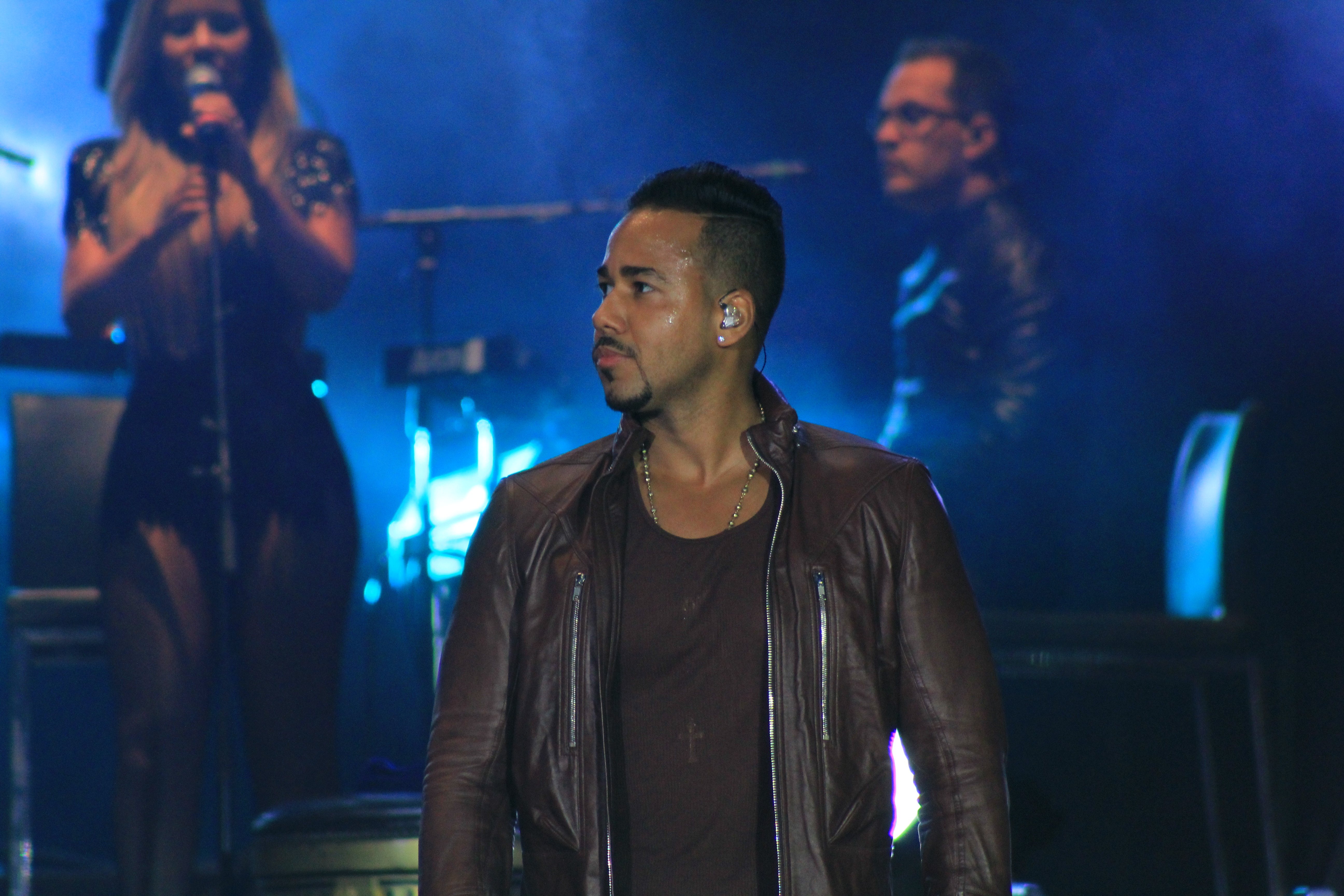
The school of Aventura
Santos calls Aventura his school. It taught him that recorded talent is only half the assignment. A performer distinguishes himself in the room, where the audience can interrupt, object, flirt back or sing louder than the microphones. He learned to turn interaction into an instrument. The quiet boy developed what he calls the “monster” of his stage personality.
That education mattered when the group discussed solo projects in 2008. Santos had not dreamed of leaving. He imagined dying, artistically speaking, inside Aventura. Offers had arrived, but loyalty and fear made solo fame less appealing than outsiders assumed. His line was firm: he would not continue with an incomplete version of the quartet. If the four wanted separate work, he would take the opportunities already waiting.
The decision produced no grand divorce. Aventura remained a living name, returning when the four men were ready. Sometimes the pause lasted two years, sometimes five. Santos built his solo catalogue without pretending his apprenticeship had been a costume he could now discard.
“Obsesión” carries Aventura’s New York bachata far beyond its first audience.
Formula, Vol. 1 begins Santos’s solo recording career.
Two Yankee Stadium shows turn a local origin into a city-sized homecoming.
Formula, Vol. 3 shares the Latin Grammy for Best Merengue/Bachata Album.
The joint tour with Prince Royce carries their new record through arenas and stadiums.
A genre with doors
The solo records widened the guest list. Usher, Drake, Carlos Santana, Rosalía and Justin Timberlake entered Santos’s world. These names made good posters, but the more interesting fact is how he uses them. He does not like the standard transaction in which a guest emails a verse and disappears. He prefers collaborators together in the studio, changing the object rather than decorating it.
As a teenager, Santos told his Aventura bandmates that he would one day record with Timberlake. The prediction took patience. “Sin Fin,” their pop-bachata collaboration, finally appeared on Formula, Vol. 3 in 2022. On the same album, Rosalía met the genre through the flamenco shading of “El Pañuelo.” A year later, the album won a Latin Grammy in a tie with Sergio Vargas’s A Mi Manera.
Reinvention, in Santos’s practice, does not mean evicting the old tenants. He listens widely so bachata does not repeat itself, then brings those colors home. The method resembles New York itself: adjacency creates invention. A Dominican guitar can converse with an R&B singer, a Spanish flamenco voice or an American pop craftsman without surrendering its passport.
“You are happy and you want to listen to bachata; you are sad and bitter and you want to listen to bachata.”Romeo Santos on the genre’s emotional range
Better late, properly
His collaboration with Prince Royce is a miniature of his method. They recorded a song in 2016. It was not right. A second attempt was better, still not right. The third worked, at which point a single track seemed too small for the meeting. The eventual answer required ten months of recording and seven years of intermittent effort. Better Late Than Never arrived in late 2025 with 13 songs and only one outside featured artist, the younger Dominican singer Dalvin La Melodía.
Santos and Royce took care that neither appeared to be visiting the other’s record. Some songs lean toward Royce’s bright guitar language; others bear Santos’s darker dramatic fingerprints. The album became a negotiation between two distinct careers that had long been flattened by fan-made rivalry. Their 2026 Mejor Tarde Que Nunca Tour turned that studio truce into a shared stage across North America, Europe and Latin America.
At a listening event in Madison Square Garden, Santos noticed the chemistry but refused certainty. He does not walk onstage with every turn decided. The audience tells him what it wants. That admission explains more than a set list. His career has moved through a repeated exchange between meticulous private work and unruly public response. He writes, edits, waits. Then the room answers.
The numbers are handsome: chart runs, record titles, a Grammy nomination, a Latin Grammy, Yankee Stadium twice. Yet they are consequences, not character. The more revealing picture is the teenager pressing play on a cassette because the singer happened to share his name. Curiosity led to craft; craft made confidence possible; confidence grew large enough to include a crowd.
There is a useful modesty in this sequence. A genre did not need rescuing, and Santos never worked alone. His achievement was to hear room for his own biography inside bachata, then trust Lenny, Mikey, Henry and later collaborators to bring theirs. The music expanded because the circle did. Even the royal nickname works best with other people in the frame: a king still needs a band, and, more importantly, listeners willing to reply.
Santos is still competing with that first songwriter. The scale has changed, and the tailoring has certainly improved, but the old question survives every reinvention: who wrote the song? For Romeo Santos, the answer has never been a footnote. It is the whole performance.