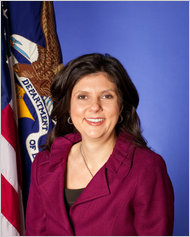
Walk into the household Betsey Stevenson shares with Justin Wolfers and you are looking at a controlled experiment. Two economists. Two kids. No marriage license. A split of earning and parenting they have described publicly and deliberately, because the question of who does the laundry is, to them, a legitimate object of study. Most people leave their work at the office. Stevenson runs her field at the kitchen table.
Her day job is at the University of Michigan, where she is a professor of public policy and economics at the Gerald R. Ford School. Her real subject is the stuff economics spent a century pretending it couldn't touch: marriage, divorce, happiness, who feels secure and who doesn't. She takes the things labeled "soft" and shows they leave hard fingerprints in the data. Then she takes those fingerprints to Washington.
Right now the thing on her mind is artificial intelligence, and not in the way most economists talk about it. The standard panel asks whether the machines take the jobs. Stevenson's 2025 chapter for the NBER volume on transformative AI asks a stranger question: "What Is There to Fear in a Post-AGI World?" Her answer is that the productivity is the easy part. If the machines make everything cheaper and more abundant, the hard work that remains is human - how a society shares the gains, and how people find meaning when the old scaffolding of work falls away.
Increases in income keep making you happier, but they're making you happier at a decreasing rate.
Betsey Stevenson
The regression that picked a fight
For decades, economists repeated the Easterlin Paradox like scripture: past a certain point, getting richer doesn't make a country happier. It was tidy, it was counterintuitive, and it made for good dinner-party talk. In 2008, Stevenson and Wolfers looked at the data and said, with the politeness of people holding a smoking gun, that it wasn't true. Richer people are happier than poorer people. Richer countries are happier than poorer ones. The relationship doesn't flatten out and vanish - it just bends, gently, forever.
What made the finding land wasn't a clever twist. It was the opposite. As Wolfers put it, "the only novelty of our research is we found that the intuitions people had were exactly true." They had taken a famous paradox and replaced it with common sense, backed by better numbers. That is harder than it sounds, and it is the through-line of her career: check the thing everybody already believes.
More money, more happiness - just at a slowing pace
Stylized illustration of the Stevenson-Wolfers finding
Very high incomekeeps rising, slower
From the Wharton classroom to the West Wing
The path there was not quiet academia. Stevenson earned her B.A. in economics and mathematics from Wellesley in 1993, did a stint as a research assistant at the Federal Reserve, and went to Harvard for a Ph.D. she finished in 2001. Her dissertation committee is the kind of detail that makes other economists sit up: Claudia Goldin, who would later win the Nobel; Lawrence Katz; Caroline Hoxby. She trained under Greg Mankiw. The fingerprints of that cohort - careful, empirical, unafraid of the big social questions - are all over her work.
She spent six years as an assistant professor at the Wharton School before Washington called. In 2010, in the long shadow of the Great Recession, she became Chief Economist of the U.S. Department of Labor under Secretary Hilda Solis - the person whose job is to know what the labor market is actually doing while everyone else argues about it. In 2013 President Obama named her to the Council of Economic Advisers, where she stayed through 2015, advising on social policy, the labor market, and trade. When the Biden-Harris transition needed economists in 2020, she volunteered again.
Rich people are happier than poor people, and that's true all the way along the economic distribution.
The Stevenson-Wolfers finding, on NewsHour
The textbook, the podcast, the board seat
Plenty of economists advise presidents. Fewer write the book a whole generation learns from. Stevenson and Wolfers co-authored Principles of Economics, a textbook built on the conviction that the subject should feel like a tool for living, not a wall of graphs. It comes in micro and macro splits, regional adaptations, international translations - the quiet infrastructure of how millions of students first meet the discipline. The same instinct drives Think Like An Economist, the podcast the two co-host, where the recurring lesson is less about supply curves and more about asking a sharper question.
In 2023 she joined the board of directors of Lyft - an economist of labor markets taking a seat at a company built entirely on the question of what work is and who gets paid for it. The same year, Michigan handed her its Presidential Award for Public Engagement, which is the university's way of saying she is unusually good at the part most academics dread: talking to everyone else. She writes for Bloomberg Opinion, turns up on Marketplace, and has a way of making the dismal science sound, against all odds, like good news.
What she's actually after
Across the textbook, the columns, the government posts, and now the AI work, the aspiration is consistent. Stevenson wants the gains of an economy to reach the people in it - and she wants the field to take seriously that "the people in it" have inner lives, not just budget constraints. Her post-AGI argument is the purest version of this: abundance is coming, maybe, but abundance is not the same as flourishing. Someone has to design the bridge between them. She thinks economists should be in that room, and she has spent twenty years earning the seat.
Women, work, and the second shift
Long before AGI was a panel topic, the spine of her published research was the labor market for women and families. She has written about how marriage and divorce have changed shape over generations, how the economics of the household actually function when both partners earn, and what public policy gets wrong when it assumes a family looks the way it did in 1955. The work is empirical and unsentimental, which is exactly why it carries weight in policy fights that usually run on anecdote. When she advises on paid leave, child care, or labor force participation, she is not improvising - she is reporting from a body of evidence she helped build.
It is also why her appointments made sense. A Chief Economist of the Labor Department who already studies how households allocate work is not a generalist parachuted into an unfamiliar brief. She arrived knowing the terrain. The same was true at the Council of Economic Advisers, where social policy and the labor market were precisely her lane. There is a tidy logic to her resume that is easy to miss: the academic and the official are the same person asking the same questions, just in different buildings.
The case for joy
Economics earned its nickname - the dismal science - honestly, and most practitioners wear it with a kind of grim pride. Stevenson and Wolfers have spent years arguing the opposite. In a long conversation with the McKinsey Global Institute they made the case for "bringing the joy" back to the field: not as a marketing slogan, but as a serious claim that subjective well-being belongs inside economic measurement, alongside GDP and unemployment. If you can measure happiness - and they insist you can - then you can ask whether a policy actually improves lives, rather than just moving a number on a spreadsheet. That is a quietly radical reframe, and it is the reason her name keeps showing up wherever economics meets ordinary human experience.
She delivers all of this in plain English, on television, in columns, on a podcast, in a textbook a nervous nineteen-year-old can actually follow. That accessibility is not a side hustle. It is the point. An economist who can advise a president but can't explain the idea to a student has only done half the job. Stevenson does both, which is rare, and she does it without dumbing anything down, which is rarer.