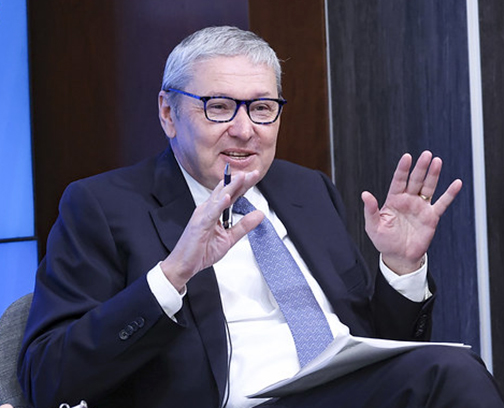
Open almost any introductory economics course in America and the first thing the student meets is not Adam Smith. It is a list. Ten Principles. They are Mankiw's.
Today Greg Mankiw is the Robert M. Beren Professor of Economics at Harvard, still teaching, still blogging, still revising the textbooks that carry his name into a few hundred thousand backpacks every fall. In January 2026 the American Economic Association made him a Distinguished Fellow, the discipline's quiet way of saying you shaped the field. The same month a new edition of his introductory book shipped for the spring semester, because the book never really stops. It just gets a new cover and a fresh set of examples and goes back to work.
What he actually does, day to day, is translation. He takes the part of economics that lives inside equations and the part that lives inside the Federal Reserve and turns it into prose a nineteen-year-old can follow on a Tuesday morning. He has a test for whether a paragraph works. He asks whether his mother would find it interesting, and whether she would understand it. If the answer is no, the paragraph goes back.
Would Mom find it interesting? Would Mom understand this?
- Mankiw, on how he edits a textbookThat instinct is worth a fortune, literally. When he sold Principles of Economics in the mid-1990s, the advance reportedly set a record for a textbook. Publishers do not pay records for clarity they expect to recoup over decades unless they are very sure. They were right. The book has sold more than two million copies and been translated into roughly twenty languages, and according to the Open Syllabus Project, Mankiw is the most frequently assigned author in college economics, anywhere. A generation of people who can explain opportunity cost at a dinner party learned it, without knowing it, from him.
He earned the right to simplify by first doing the hard version. As a graduate student at MIT, advised by Stanley Fischer, he became a central figure in New Keynesian economics, the project of giving Keynes's intuitions a rigorous microeconomic spine. His work on menu costs asked a deceptively small question: why don't prices change instantly when conditions do? The answer, that even tiny costs of reprinting a menu can gum up a whole economy, helped explain why recessions happen and why central banks matter. In 1992, with David Romer and David Weil, he co-wrote a paper on the empirics of economic growth that has since been cited more than twenty-five thousand times. It is one of the most-cited papers in the field.
Then Washington called. From 2003 to 2005 he chaired the President's Council of Economic Advisers under George W. Bush, the economist-in-chief role that puts a professor in front of cameras to defend the indefensible and explain the unpopular. He found out how unforgiving that is in 2004, when he said out loud what nearly every economist believed in private: that outsourcing jobs was, on balance, probably a plus for the economy in the long run. It is textbook trade theory. It was also a political grenade, and it went off. He kept his composure and, notably, did not edit the theory out of the textbook afterward.
People respond to incentives.
- Principle Four, more or less the whole of economicsHe advised Republican candidates for years, most prominently Mitt Romney across two presidential campaigns. And then, in October 2019, he left the party and registered as an Independent, citing his disappointment with how Republicans had responded to Donald Trump. He had already, in 2016, called Trump's hostility to international trade "disqualifying." For a man who once handed out Nixon literature as a kid in New Jersey, the move was its own kind of data point. The economics had not moved. The party had.
The list every freshman meets
His introductory course opens with ten ideas. They are the spine of the whole book, and arguably the most-read sentences in modern economics teaching. A sampling:
Principle six and principle seven sit next to each other on purpose. Mankiw is a market economist who is comfortable saying markets fail, and his favorite tool for fixing them is the most elegant idea in the kit. If an activity imposes a cost on strangers, pollution being the obvious one, then tax the activity by exactly that cost and let people decide for themselves what to do about it. No bans, no mandates, no central planner picking winners. Just a price that tells the truth.
He liked the idea so much he started a club for it. The Pigou Club, named for the economist Arthur Pigou, is an informal roster of economists and policymakers who favor carbon and gasoline taxes. The membership reads like a bipartisan all-star team: George Shultz, Hank Paulson, James Baker III. In 2016 he turned up in Leonardo DiCaprio's climate documentary Before the Flood, calmly making the case that the cleanest way to fight carbon is to charge for it.
Not everyone wants to be charged, or taught. In November 2011, with Occupy Wall Street in full swing, about sixty of the roughly 750 students in his famous Ec10 lecture got up and walked out, accusing the course of teaching only one skewed view of the world and of helping perpetuate inequality. It is the kind of moment that ends careers, or at least ends classes early. Mankiw's response was to write a measured column in The New York Times and then keep teaching. He had been writing for the paper's Sunday business section since 2007 and would continue until 2021, fourteen years of explaining the economy to people who would never take his course.
The Mankiw Tree
A professor's real legacy is his students. His doctoral advisees include:
One went on to chair the Council of Economic Advisers himself.
For all the policy fights, the thing that made Mankiw a household name in the strange small household of economics was a handout. He started a blog in 2006, subtitled "Random Observations for Students of Economics," originally just to give his Ec10 students something to read. It outgrew the class almost immediately. By 2011 a survey of economics professors ranked it the top economics blog going. It is still there, still posting, a steady drip of links, jokes, exam questions and gentle provocations from a man who clearly enjoys the work.
His range is wider than the intro course lets on. There is a second textbook, the intermediate Macroeconomics, that trains the people who go on to run forecasting desks and central-bank research shops. There is a "sticky-information" model of inflation expectations that updated his early menu-cost work for a new generation. And there is a 1989 paper, written with David Weil, that looked at the aging baby boomers and predicted a long slide in housing demand. The forecast was famously early and famously contested, which is its own lesson about economics: the logic can be sound and the timing can still humble you.
He is, in the end, a teacher who happens to be a great economist, rather than the other way around. The dog is named Tobin, almost certainly after the economist James Tobin, which tells you the man does not clock out. He has been doing the same job for forty years: standing between the equations and the rest of us, and making the handoff look easy. It is not easy. It only reads that way, which is the whole trick.