A supplier raises its price. The explanation is inflation. Somewhere inside the buyer’s organization, someone must decide whether that explanation is reasonable. The awkward part is that the supplier knows its business rather well, while the buyer may be responsible for dozens of markets. Beroe Inc has spent two decades working on that imbalance: helping the person across the table ask a better second question.
- Procurement intelligence, AI analysis and specialist research for enterprise buyers.
- A $34 million investment in 2025 helped fund the next stage of expansion.
- New tools connect market evidence to supplier discovery, category strategy and negotiation.
01 / The price behind the price
Consider what happens when a headline inflation number becomes a supplier’s justification. A finished product contains several costs: materials, labor, energy, freight, perhaps a generous margin. Those components rarely move together. The useful question is how much each contributes to this particular purchase. A broad economic index offers context. A cost structure offers something you can discuss across a negotiating table.
That distinction sits at the center of Inflation Watch, Beroe’s cost-intelligence product, developed with Siemens Energy. It combines market movements with cost structures and forecasts so teams can test a supplier’s explanation, model scenarios and prepare budgets. The September 2026 enhancements add AI-assisted cost breakdowns, suggested drivers and confidence scores. Buyers can edit the recommendations. The assumptions remain part of the work.
3× the spend.
The Siemens Energy account makes the proposition concrete. Beroe reports that spend under management grew from $500 million to $1.5 billion without additional headcount. It also reports more than $1 million in savings opportunities identified in one quarter within one raw-material category. These are vendor-published customer results, rather than a promise about every deployment. Their interest lies in the mechanism: reducing the effort needed to examine a purchase.
02 / The research shop learns to listen
Founded in 2006 by Vel Dhinagaravel with North Carolina State University professor Robert Handfield, Beroe began with custom research. Its early service was laborious in the useful sense: specialists investigated supply markets for individual customers. Over time, that expertise became a shared digital product. The company’s history records a shift from generalists to category specialists in 2011.

Then customers supplied a useful correction. In a 2025 interview with AIM Media House, Dhinagaravel described users gravitating toward the company’s early AI assistant instead of the traditional interface. They preferred asking a question to clicking through screens. That behavior encouraged more AI investment. The bottleneck had moved from obtaining research to finding the answer inside it.
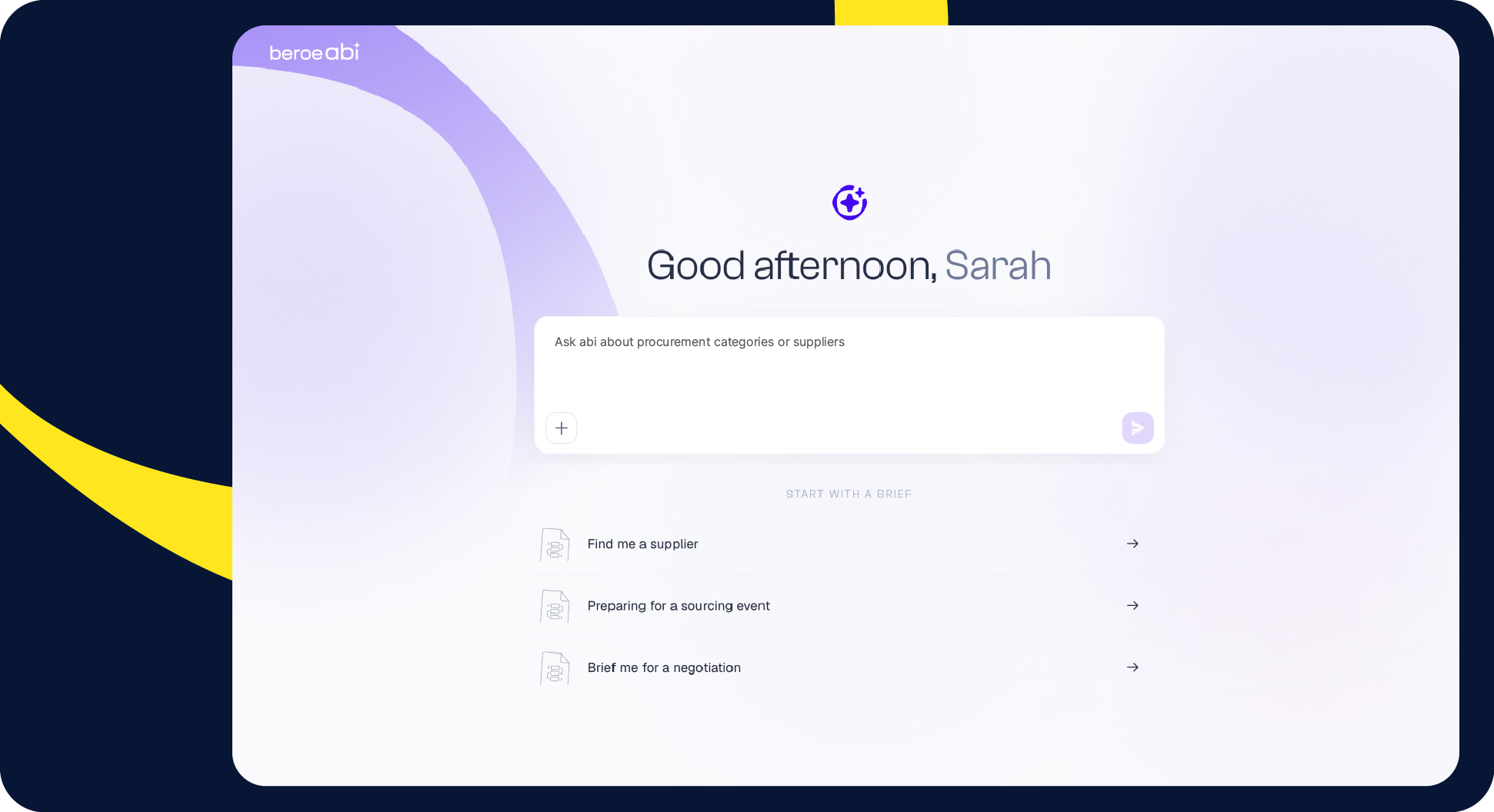
September 2026 brought a rebuilt Beroe abi, replacing the navigation-heavy Live.ai experience with conversation. It draws together category, supplier, commodity, cost, macroeconomic and risk intelligence. Beroe says its foundation includes more than 30 million validated data points. Where its own category coverage ends, users can choose a web search; sources and methodology remain visible. Human specialists are available when an answer needs closer examination.
“The best feature of Beroe would be the people behind the AI, who truly understand the needs of procurement folks like me.”Michael Takyi, BP / customer testimonial published by Beroe
03 / Buying the next move
Finding an answer still leaves a buyer with decisions. Beroe’s 2025 acquisitions help explain its response. Forestreet added AI-powered supplier discovery, extending an existing relationship. The acquisition of nnamu brought game-theory-based competitive negotiation technology. Together, the deals moved Beroe closer to the work that follows a market assessment: identify alternatives, choose an approach and negotiate.
The expansion received $34 million in primary funding in September 2025. Investors included Relativity Resilience Fund, Mukul Agrawal, Ashish Kacholia, Lashit Sanghvi and Alchemy Long Term Ventures Fund. Beroe said the money would support product development and acquisitions. Its commercial offer combines enterprise software and data access with tailored research and analyst support. Customers enter through demo-led sales conversations.
In June 2026, Beroe and Kearney launched MAX. The product combines customer spend, contracts and suppliers with external intelligence and Kearney frameworks, including the Purchasing Chessboard. Its architecture pairs language models with structured rules. The ambition is continuous category strategy: recommendations that change as the relevant markets change, considering cost, risk and environmental, social and governance priorities together.
September’s Bilateral Negotiations launch addressed single-supplier deals. It scores six negotiation approaches and assembles a round-by-round plan, including concessions and exit thresholds. The buyer can modify it throughout. This matters because a sole-source conversation has different constraints from a competitive sourcing event. Software can organize the preparation; commercial judgment still belongs to the person negotiating.
04 / Evidence has to reach the desk
Beroe occupies the intelligence and decision-support part of the procurement market. SpendEdge offers overlapping research and AI-assisted intelligence. Internal analysts and consultants provide other routes. Beroe’s specific combination is category expertise, structured data, custom research and an expanding set of decision tools. Its September 2025 funding announcement reported more than 1,000 enterprise customers, including over 300 Fortune 500 companies.
Distribution is part of the argument. DataHub sends intelligence through APIs, connectors and the Model Context Protocol into existing software and AI workflows. Jaggaer embeds Beroe intelligence in its platform. A category manager should be able to use evidence where the work already happens. Requiring another destination creates another opportunity for useful research to go unread.
The transferable lesson is practical: break the price into components, examine the assumptions and connect the evidence to an actual decision. The limits follow from that method. An inaccurate cost model produces an inaccurate argument. Better information cannot manufacture an alternative to an irreplaceable supplier. Beroe’s own provision for specialist research and editable recommendations acknowledges how much context matters.
There is a fitting detail in the company’s working habits. Beroe introduced a four-day week in 2017; Dhinagaravel has described measuring outcomes rather than hours. The same question runs through its products. How much useful judgment can a team exercise with the time it has? For a buyer facing another inflation explanation, the answer starts with knowing which question to ask next.