The useful thing about a chess clock is its honesty. It does not care how promising the position looked five moves ago. It does not reward the elegance of an explanation. There is the board, there is the remaining time, and there is the next decision. Benji Twerskoi has spent a conspicuous part of his life around that kind of clarity. His public record begins with scholastic chess in Colorado, crosses an education in Rotterdam, and lands in the considerably less photogenic world of marketing operations, where the pieces have names like pipeline, attribution, service, content and reporting.
On paper, these can look like separate lives. Twerskoi is publicly associated with Burwood Group, an information technology consultancy, and with CRM Magnetics, a small firm focused on HubSpot configuration, revenue operations, search and paid acquisition. Away from the dashboards, Denver Chess Club reports record him winning adult tournament sections against fields of experienced players. Yet the two pursuits share an operating grammar: understand the full position, accept responsibility for the move, and avoid confusing activity with progress.
Twerskoi states the principle more plainly on his LinkedIn profile: “I only produce work that I am proud of.” It is a stern little sentence. No committee to blame, no fashionable vocabulary to hide inside. Pride, in this formulation, is not decoration added after the work. It is a test applied while the clock is running.
“I only produce work that I am proud of.”Benji Twerskoi, public LinkedIn profile
The board was there first
Long before the CRM acronyms, there were pawns. A Colorado chess publication lists Benjamin Twerskoi as the second-grade champion at a scholastic event in 2003. Three years later, US Chess records place him in the K-5 section of the 2006 National Elementary Championship, where he scored three points in seven rounds. A 2010 state scholastic recap finds him in the final stages of a crowded seventh-through-ninth-grade division. The record is fragmentary, but its duration matters: this was not an adult hobby acquired for networking photographs. Competitive chess had been part of his world since childhood.
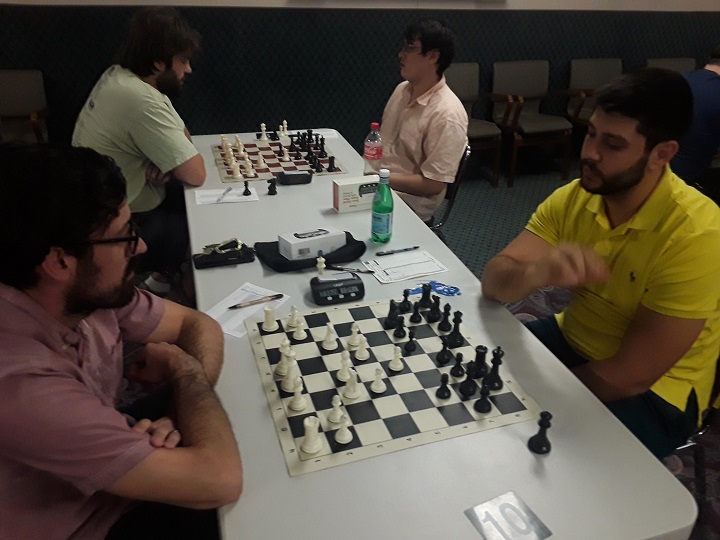
That continuity becomes visible again in Denver in 2022. In July, Twerskoi won the Denver Chess Club’s U1900 section with four victories from four games. Three were upsets, including a first-round win over a notably strong opponent. The following month, at the club’s Thursday venue, he did it again: four games, four wins, two large upsets. A June 2023 report records another shared first place, this time on 3.5 points after a final-round draw.
Upsets are charming because they make a rating look briefly foolish. They are also misunderstood. One surprise can arrive by accident; a cluster of them requires the lower-rated player to keep making useful decisions after the novelty has worn off. Twerskoi’s July run included four separate games. Then August required four more. The romance belongs to the result. The labor belongs to the sequence.
From pieces to pipelines
Twerskoi attended Erasmus University Rotterdam from 2013 to 2017, according to his public profile. The degree is not specified. The geography, however, adds a revealing interval between Colorado childhood tournaments and his later Denver career: four years at a large European university, then professional experience spread across several American cities before his current public association with Burwood Group.
An external Burwood organization chart identifies him as Marketing Operations Manager. That title sounds bureaucratic until one considers the objects being operated. Marketing operations is where a company’s story collides with its machinery. A campaign creates a lead. A lead enters a CRM. Sales changes the record. Service learns something useful. Finance asks which activity produced revenue. Management wants a dashboard before lunch. If those handoffs fail, the company can be busy, expensive and wrong at the same time.
His public posts from the Digitoolix orbit in 2022 circle the mechanics of digital marketing: organic reach, subject lines, advertising strategy and CRM selection. More recently, he has written about HubSpot as a shared platform across marketing, sales, service, content, operations and commerce. The line that matters is operational rather than promotional: “Everyone on your team works from the same source of truth.”
One customer, five connected views
That phrase is fashionable in software, but its practical meaning is severe. A source of truth forces disagreements into the open. Two departments can no longer preserve two flattering versions of the same customer. An integrated system may reduce tab-switching; more importantly, it reduces the number of places where ambiguity can live rent-free.
CRM Magnetics makes that systems interest concrete. Florida records show CRM Magnetics LLC was formed in June 2024 and list Benjamin Twerskoi as an authorized member alongside Nikita Sazonov. The company describes its work in HubSpot configuration, revenue operations, audits, implementations, SEO and paid advertising. Its own five-step model starts with primary KPIs, moves through reporting and process definition, and ends with implementation and repeated optimization. The order is telling. Tools come after the scoreboard and the rules of play.
“Better decisions always start with better data.”Benji Twerskoi, commenting publicly in 2026
The position before the move
The temptation here is to turn every rook into a revenue funnel and every pawn into a prospect. Chess deserves better, and so does operations. The overlap is simpler. Both fields punish local optimization. A chess piece can occupy a beautiful square while the king gets mated. A marketing team can produce a beautiful campaign while the CRM fills with duplicates, the sales handoff stalls, and the report counts applause instead of revenue.
Twerskoi’s public footprint keeps returning to connectedness. His 2026 HubSpot post presents the appeal of an all-in-one platform as an escape from disconnected tools and scattered data. A recent public comment compresses the belief even further: “Better decisions always start with better data.” It is not a dazzling thesis. That is part of its usefulness. Most operating advantages are slightly boring while they are being built.
Chess adds one correction to the data-first maxim. Good information does not move itself. Someone still has to choose, commit and live with the response. Twerskoi’s profile language about ownership supplies that missing human part. Data clarifies the position. Ownership makes the move.
There is also the question of tempo. Companies often buy software because delay feels dangerous. The new platform arrives with a burst of meetings, migrations and freshly colored diagrams. Then the difficult questions return. Which customer action matters? Who owns the follow-up? What happens when two records disagree? CRM Magnetics puts KPI selection and reporting before implementation in its published process. That sequence offers a small but important refusal: speed is only useful after the destination has a name.
Chess players learn the same lesson by losing quickly. A move made with confidence can still waste time if it creates no threat, develops no plan and answers no problem. The clock measures minutes, but tempo measures usefulness. Twerskoi’s consecutive Denver wins are interesting in this light. Each tournament demanded a fresh set of opponents and positions. Whatever worked in July could not simply be copied into August. The repeatable element was not a tactic. It was the discipline of evaluating again.
That is a sturdy model for operations. Reusable templates matter. Automation matters. Yet a system remains healthy only when somebody notices that the position has changed. A lead source shifts. A service question starts appearing in sales calls. A report becomes technically accurate and practically irrelevant. The operator’s job is partly construction and partly attention. Build the board, then keep looking at it.
A second-grade scholastic title in Colorado.
Four years at Erasmus University Rotterdam.
Consecutive perfect Denver Chess Club section scores.
CRM Magnetics LLC is formed, with Twerskoi listed as a member.
Public work continues across Burwood Group, CRM and integrated customer systems.
A career in compound moves
There is an appealing modesty to Twerskoi’s record. The visible accomplishments are specific: a childhood title, eight straight club wins across two monthly sections, a shared first place, a role in marketing operations, membership in a small CRM company. They do not require mythology. Put together, they describe somebody who has repeatedly chosen domains where consequences compound.
A badly configured field in a CRM feels trivial on Tuesday and ruins a quarterly report months later. A loose pawn feels harmless until the endgame. A clean process and a sound move possess the opposite magic: each quietly preserves options for the person who must act next. This may be the most portable lesson in Twerskoi’s story. Good operators do not merely finish their part. They improve the position inherited by everyone downstream.
The public material does not present Twerskoi as a philosopher of systems. It presents him doing systems work, discussing familiar tools and turning up at local chess tables. That ordinariness is valuable. Business culture has no shortage of people announcing transformations from a stage. The database still needs cleaning when the lights go down.
So the memorable image is not a victory pose. It is Twerskoi seated at a folding table in Denver, elbow near the board, looking at a position that will not solve itself. Across town, another board is always waiting: customer records, campaign data, a disputed metric, a handoff with one field missing. The materials change. The obligation does not. Look carefully. Own the move. Leave the position better.