The origin of Because is not a eureka moment in a Palo Alto coffee shop. It is a series of lousy drugstore runs. Alexi Suvacioglu kept looking for products that would help his grandmother, his Nonna, manage bladder leaks. He came home disappointed. Luca Gualco saw his father become reluctant to leave the house because the available protection failed him. The category was large, intimate and strangely indifferent to the people using it.
So in 2017 the two men built Because, a direct-to-consumer personal-care company for older adults. Its first job was prosaic and important: make incontinence underwear that absorbs more, fits more bodies and arrives without announcing itself to the neighborhood. Customers could buy once, subscribe for regular shipments or call a human for help choosing size and absorbency. The company now also sells pads, guards, booster inserts, wipes, skincare and selected wellness products.
The product is physical, but the early advantage was informational. Depend, Poise, TENA and store brands had shelf space. Because had conversations. Every fit question, cancellation, reorder and complaint revealed something the aisle could not. The company says it now serves more than one million people. In 2024, it described analyzing more than 7,000 customer calls a week with software that extracts recurring needs. That is a remarkably modern use for the old-fashioned telephone.

A category designed around inventory, not dignity
Bladder leaks affect more than 25 million Americans, according to Because, yet shopping for protection has historically offered a grim menu: a few bulky packages, fuzzy absorbency language and little guidance. It is also a category in which the buyer and user are often different people. An adult child may be purchasing for a parent. A caregiver may need a product today, not after an online quiz and a shipping window.
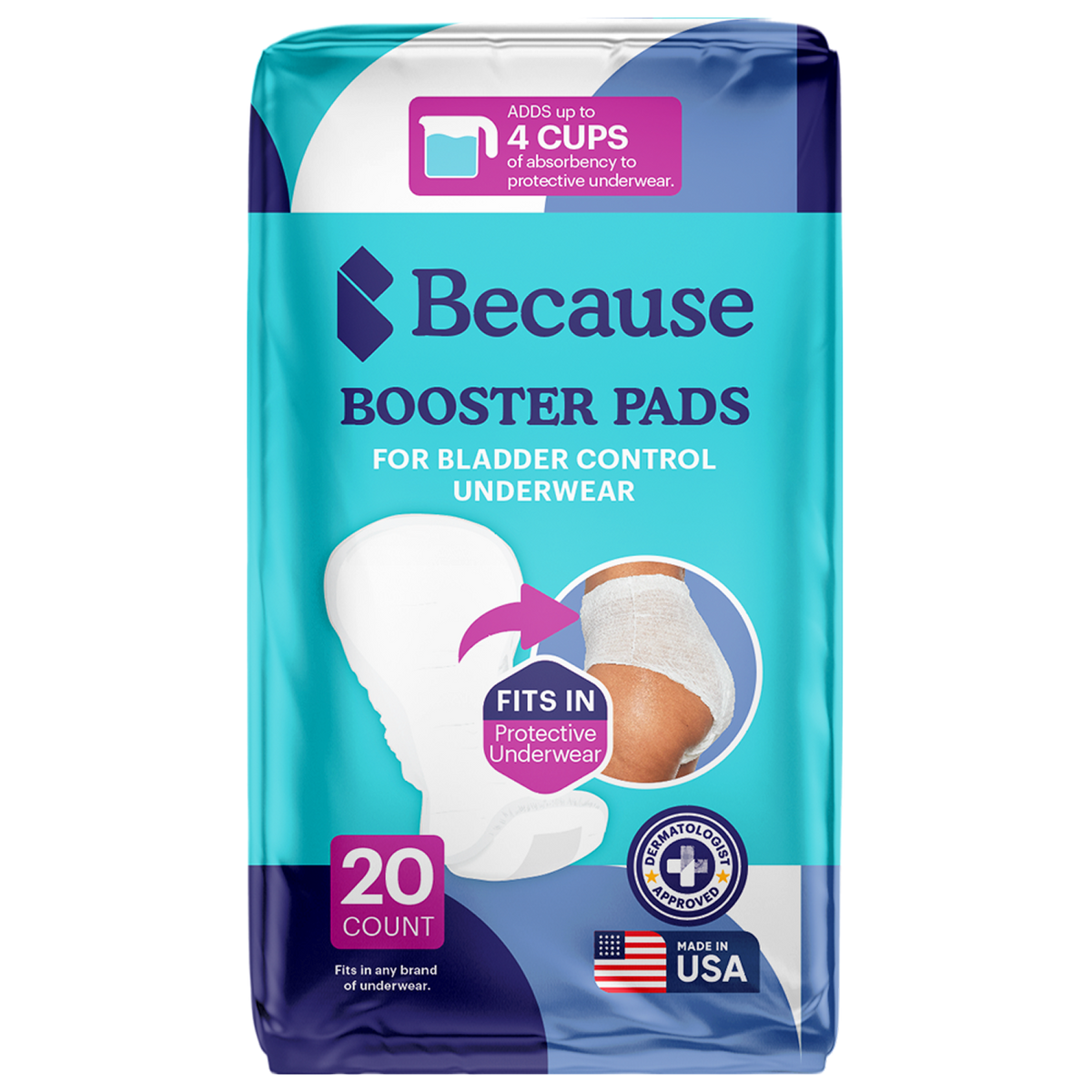
Because treated discretion as part of product performance. Orders arrive in plain boxes. The site explains products in cups of absorbency: overnight underwear at up to six cups, maximum underwear at four, booster pads adding as much as four. Its current starter offer puts a nominal $48 bundle at $9.99 with shipping included. That price is not the business model; it is the cost of reducing uncertainty before a repeat purchase.
The business earns revenue from single purchases and discounted subscriptions on its own site, plus Amazon, B2B relationships and retail wholesale. Because is private and does not disclose revenue or valuation. Two reported venture rounds - $30 million in 2019 and $35 million in 2021 - put its known equity funding around $65 million. A debt-financing event appeared in May 2025 without a public amount.
“Our model is relational and not transactional.”Luca Gualco, co-founder
What failed first was not strategy. It was a pallet.
The company’s early operations were not elegant. In 2019, Suvacioglu told Forbes about accidentally shipping roughly 2,000 pull-ups to one customer. She took the giant delivery in good humor. The anecdote is funny because it is exactly the sort of unglamorous failure a recurring-delivery business must survive: forecasting, pack sizes, address logic and fulfillment controls are as central as the brand campaign.
The first push into physical retail also came with an inconvenient plot twist. Because announced a September 2022 debut at Bed Bath & Beyond and Harmon. The parent retailer filed for bankruptcy the following year and shut its U.S. stores. That does not make Because’s launch a strategic failure, but it made the fragility of a single retail partner impossible to miss.
The more consequential change was philosophical. Digitally native brands once spoke as if leaving the internet meant surrendering margin and customer data. Because’s customers had a less ideological point: sometimes they needed a product immediately, and they wanted to find it where they already bought prescriptions and toothpaste. “Bladder leaks don’t wait,” Suvacioglu said when Walmart began stocking booster pads in 2025.
In April 2026, Walgreens and Target joined Walmart and CVS, completing a four-chain rollout. Select Walgreens stores carried boosters and two sizes of overnight underwear; Target carried boosters and three underwear sizes. The assortment was narrow on purpose. A million online customers had already supplied the company with evidence about which products, sizes and prices merited scarce shelf space. DTC had become the laboratory for retail, not its enemy.
Because sells to the wearer, the caregiver and the clock
This is where Because sits in the market. It is not a medical-device company, although its products are FSA/HSA eligible and developed with clinical advisers. It is not merely an ecommerce shop, because it designs and brands its own core products. And it is no longer merely DTC. It is a consumer-health company using direct relationships to compete with packaged-goods incumbents.
That middle position explains its expertise. Legacy brands know mass manufacturing and shelf mechanics. Specialist care retailers know reimbursement, recurring supply and anxious family buyers. Because has tried to join those skills with consumer-brand presentation: urology input without a clinical waiting room, detailed absorbency without medical jargon, and subscriptions without requiring the customer to become an ecommerce hobbyist. Its competition is therefore broader than the package beside it. A buyer can choose a Depend brief from a pharmacy, a Poise pad from a supermarket, a TENA product online, a specialist seller such as Carewell, or whatever private label is available tonight. Because must be better enough to earn a switch and familiar enough to remain easy.
Its 2023 partnership with A Place for Mom made the plural customer explicit. Families using the senior-living advisory service could receive discounts, a dedicated help line and a free care kit. The person choosing a community for a parent may also be the person figuring out bladder protection that afternoon. Because attached itself to that caregiving journey instead of waiting for a generic search ad to catch it.
The broader assortment - skincare, wipes, supplements and mobility aids at various points - follows the same logic. Trust earned in an embarrassing, high-stakes category can travel. The danger is that it can travel too far. A store that understands one urgent need can become useful; a store that claims to understand every need becomes a mall with a mission statement. Because’s strongest position remains unusually specific: bladder protection designed with older customers, sold through the channel each situation requires.
The moat is not the plain box. It is what customers are willing to say once the box makes them feel understood.YesPress analysis
Do not copy the diaper. Copy the feedback architecture.
The transferable lesson is not “sell an awkward product online.” It is to choose a market where embarrassment, neglect or poor interfaces have suppressed honest feedback. Then create a channel in which customers can explain the whole problem. Because did this with patient phone support, detailed product guidance, subscriptions and repeat orders. AI entered later as a way to summarize conversations, not as a substitute for having them.
A five-part playbook worth borrowing
- Start with a narrow, recurring problem whose existing buying experience is visibly bad.
- Make trial cheap and reversible; use plain language to remove category anxiety.
- Capture reasons, not just clicks: calls, fit questions, returns, reorder timing and caregiver context.
- Turn recurring phrases into product decisions, then test them with the same customers.
- Enter retail with a proven assortment and a reason tied to customer convenience, not founder vanity.
The cost is real. Better absorbency claims require manufacturing and testing. Human support is expensive. Subscriptions create fulfillment obligations. Retail adds inventory, trade terms and less control over presentation. Because also pledges 1% of sales to groups supporting older adults and says it works with U.S. carbon-neutral production facilities. Mission, in this case, appears on the cost side of the ledger as well as the copy.
When the playbook stops working
This model works best when purchases repeat, needs vary by user, the old retail experience lacks guidance and direct conversations produce better decisions. It also benefits from a customer base willing to use the phone and from a product compact enough to ship at consumer-friendly economics.
Good conditions
High repeat use, meaningful fit variation, privacy concerns, weak incumbent guidance and enough margin to fund service.
Bad conditions
One-time purchases, commodity products, low margins, no urgent offline need or feedback that does not improve the item.
It would fail if listening became theater - if call transcripts produced slogans instead of product changes. It would also struggle if retail expansion diluted the subscription relationship without replacing its economics, or if a broad “older adult” label flattened a wildly diverse group into one persona. Age is not a use case. A six-cup overnight need is.
Because’s most interesting achievement is therefore not arriving in four chains. It is preserving a line from an intimate family frustration to a national shelf without pretending the shelf was the enemy. The company started by helping people avoid a disappointing drugstore trip. Nine years later, it has enough information to make that same trip more useful.