A certificate of insurance has an awkward relationship with time. It can be perfectly useful when it arrives and insufficient later. A policy expires. A contractor moves to another project. The required company name changes by a few consequential letters. The PDF stays exactly where somebody filed it, looking reassuringly complete.
BCS has built its business around that moving target. Its certificate-tracking platform collects documents, checks requirements, identifies gaps, and asks for corrections and renewals. Property managers, contractors, procurement departments, and risk teams are buying a continuing process. The interesting question is who keeps that process moving.
- The job: turn insurance paperwork into a current compliance record.
- The choice: run BCS software yourself or add its compliance analysts.
- The lesson: write the rules before automating the chase.
A certificate is a beginning
Consider the distinction between receiving a document and accepting it. A vendor can send a certificate promptly and still miss a required limit or additional insured. BCS gives the submitter feedback during upload, then generates notices identifying what needs fixing. Its product demonstration page describes color-coded checks and configurable requirements for different vendor categories.
The correction request carries a submission link that associates the replacement document with the right record. Renewal notices have their own cadence. An especially revealing detail in the tracking documentation: unread vendor replies pause automation. A confused human has entered the conversation; sending another reminder might make the conversation worse.
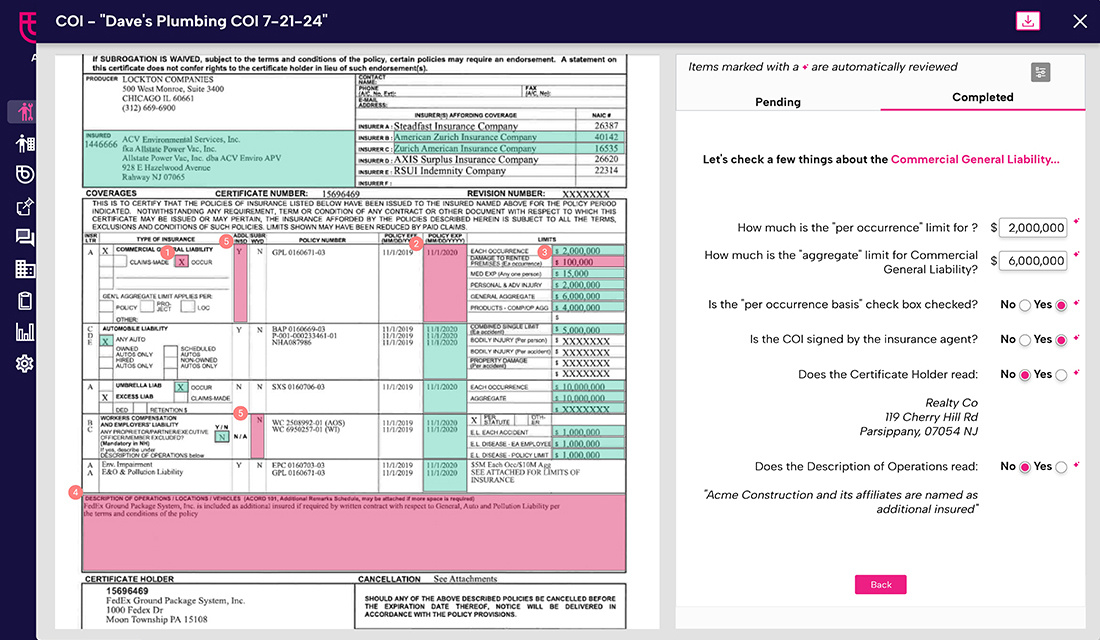
This is where BCS fits in the market: between a shared folder full of certificates and the daily operation of vendor risk management. Its customer applications extend from construction and real estate to hotels, manufacturers, hospitals, and universities. Each organization has outsiders doing work. Each needs a repeatable way to check their paperwork.
The person who keeps calling
Louise Burns launched BCS in 2008. Her earlier work included operations leadership at vendor prequalification business Browz and at Merrill Lynch. That background makes the company’s premise understandable: the administrative process deserves as much attention as the database. Its founding account starts with complaints about the tedious work of managing risk and insurance.

One customer’s account gets unusually close to the problem. Davidson Communities’ controller says the business switched tracking providers after spending too much time chasing certificates and lacking a useful portal for checking compliance. In the published testimonial, the complaint is wonderfully plain: “we were spending a lot of time chasing down COIs”.
“we were spending a lot of time chasing down COIs”Davidson Communities controller / customer testimonial
BCS offers two answers. Self-service customers keep the operational responsibility and use the software. Full-service customers get account management and analysts who contact vendors and insurance agents. The managed offering promises uncapped outreach attempts, including calls, with communication and escalation shaped around the customer’s procedures.
That distinction provides a useful comparison with alternatives such as myCOI, TrustLayer, or Jones. A buyer should ask what happens after a reminder fails. Who answers the vendor? Who calls the agent? When does the unresolved case come back? Feature lists seldom make those responsibilities as visible as a stubborn, unanswered email does.
Teach the machine what counts
BCS’s AI story becomes more interesting when it discusses rules. In an August 2026 technical explanation, CEO David Gubbay describes two reading methods: a deterministic engine and a separate AI vision model. Above them sits a human-authored standard defining acceptable wording, rejection conditions, and customer-specific requirements. This is the company’s description of its architecture.
- 01CollectGive the vendor a direct upload link.
- 02CompareCheck evidence against the agreed rules.
- 03CorrectRequest the particular missing item.
- 04RepeatFollow the next renewal date.
The distinction matters. Reading a limit correctly answers one question. Deciding whether that limit satisfies a particular contract answers another. A system needs the relevant standard before it can make a useful comparison. The portable idea here is simple: preserve an experienced analyst’s reasoning as explicit instructions that somebody else can inspect.
September’s requirement-category redesign makes that idea tangible. Customers can group terms by policy, create custom requirements, and tell RiskBot in plain language what to check. They can also choose whether a newly added requirement applies to existing records. Previously, a change could re-evaluate the entire portfolio overnight. Administrative details have consequences.
The RiskBot Review Agent release adds findings linked to document evidence and optional completion of routine tasks. Review coverage depends on the tier. Questions, clarifications, and waiver requests still go to people. The useful buying question becomes specific: which of our actual terms will this plan review automatically?
Count the obligations
BCS earns money from software and managed services. Its public pricing page lists free tracking for up to 25 vendors, self-service at $0.95 per vendor monthly subject to volume, and full-service from $17.80 per vendor annually with a $10,000 annual minimum. It lists six to eight weeks for full-service implementation.
A practical starting point for trying the workflow. Public pricing page, checked October 2026.
September release notes describe a separate Professional schedule starting at $0.70 per active account monthly, with paid RiskBot review levels. Those figures belong to different published packages. A quote needs to identify the plan, review tier, and billing unit before an annual budget means much.
The billing documentation supplies the easily missed detail: an account is a job or lease requiring distinct insurance evidence. One vendor serving three properties can mean three accounts. The cost follows the obligations being tracked. Count those before counting the suppliers in a spreadsheet.
A useful kind of unfinished
Connections matter too. BCS lists Yardi and MRI integrations; its documented Procore integration maps projects, contacts, and companies into BCS, then returns insurance details and compliance status. Additional services use Experian financial data, Refinitiv regulatory data, and analyst review of health and safety records.
The practical test is to bring a small set of real documents, awkward endorsements included. Define the requirements. Check the feedback. Assign someone to exceptions. Self-service still needs an owner, and terms outside a plan’s automated coverage remain manual. The lesson travels beyond insurance: recurring work becomes manageable when every unresolved item has a next action and somebody responsible for it.