A tax payment arrives. It is counted, deposited, and assigned to a city. Everything appears to have worked. Except, sometimes, it is the wrong city. The mistake is wonderfully ordinary: the money exists, the tax rate exists, the obligation exists. What is missing is the connection between them. Avenu Insights & Analytics has made that kind of missing connection its business.
- Find revenue already owed under existing tax rules.
- Run the paperwork behind records, rentals, courts, and payments.
- Follow the business into Neumo, formed in August 2025.
The company sells software and administrative expertise to state and local governments. Its customers include finance directors, tax administrators, clerks, recorders, and courts. The practical pitch is straightforward: recover money, reduce manual work, and make public services easier to use. The interesting question is how those three activities connect.
A city checks the arithmetic
In a November 2023 report, Santa Rosa’s finance department described its relationship with MuniServices, operating as Avenu. Over the then-current contract, the city had paid approximately $600,000 in fees and reclaimed more than $2.6 million in additional revenue. Staff recommended extending the relationship through September 2026 while retaining existing rates.
The work included identifying sales and use taxes assigned to another jurisdiction or tax pool. Fees depended on the service: a share of recovered revenue or a flat audit fee. The figures imply more than $4.30 recovered for each dollar in fees. They describe one city’s experience, rather than a return every customer should expect.
This is Avenu’s revenue business in miniature. The first failure can be administrative: a reporting error, an incorrect allocation, an obligation missed in a crowded office. The remedy requires people who understand the rules as well as software that can locate the discrepancy. Recoverability also has a clock: statutory time limits constrain which mistakes can be corrected.
The rental listing is only step one
Consider a vacation rental. Finding its online listing does not establish that its owner has the right permit, filed the required return, or paid the correct amount. Each question belongs to a different part of the administrative chain. Avenu | STR, launched in 2024, brings identification, monitoring, registration, and tax remittance into one product.
At launch, Avenu said the system monitored more than 100 websites four times a week. Property owners could use a self-service portal to register, submit documents, and pay. Municipal staff could review compliance and financial reports. Software that discovers a property becomes more useful when the office can act on the discovery.
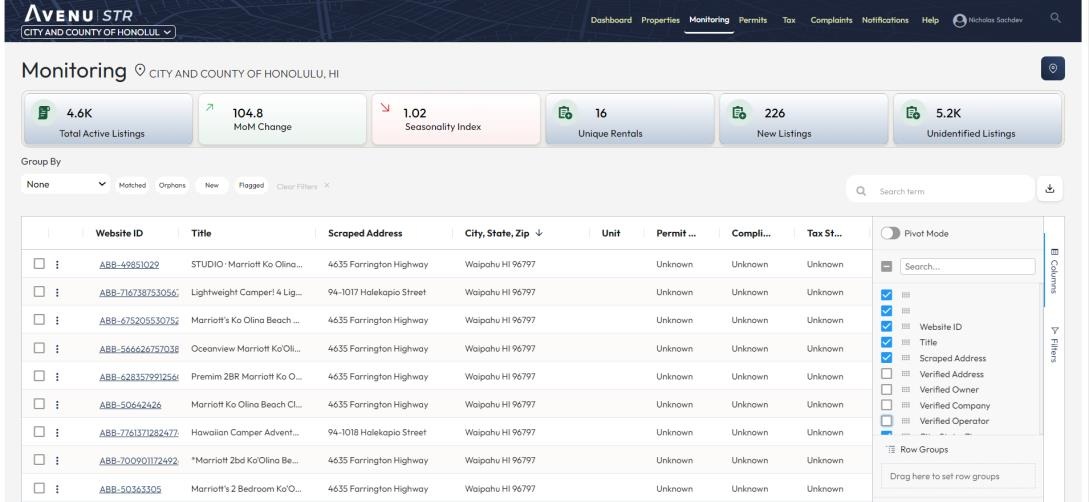
Honolulu gives that chain a real customer. In 2023, Avenu announced its selection to administer the city and county’s transient accommodations tax, including collecting payments and providing live taxpayer support. It also won rental monitoring and compliance work. The service extends beyond handing an agency a login.
The clerk is part of the product
Avenu | Records applies similar thinking to public documents. Its functions include imaging, indexing, cashiering, public search, and payment integration. Digital Processing Services can bring historical books and microfiche into the system. A resident looking for a record needs the search, the document, and the transaction to work together.
Other products occupy neighboring desks. Avenu | Jury handles the sequence from jury pools and summons to check-in and payment. Avenu | Connect, launched in 2023, combined more than 15 applications used by state unclaimed property offices. Here the direction of the money changes: the aim includes returning assets to their rightful owners.
“When governments prosper, communities grow.”Avenu’s stated belief
The business combines software contracts with services such as auditing, administration, hosting, and support. Pricing depends on the assignment and jurisdiction. Eufaula’s 2023 agreement, for example, specifies hourly audit compensation and prohibits contingency fees. A buyer needs to examine the actual scope and fee schedule rather than assume one commercial model covers everything.
A delayed launch belongs in the story
Government software also carries history. An October 2019 Pine County board packet described a Tax/CAMA replacement contracted in 2013 under an earlier owner, with a planned 2016 launch. The project subsequently passed through Xerox and Conduent before reaching Avenu in 2018.
By the report’s date, Pine County said it had paid $50,830 in installments and $36,000 in project management fees, while further deliverables remained unmet. A sixth amendment moved the launch to June 2021, introduced a penalty, and allowed counties to exit. The document does not establish the eventual outcome.
That record gives buyers a concrete lesson: tie payments to accepted deliverables and protect an exit. Pine County staff had also viewed working alternatives from Tyler Technologies and MCIS. In this market, the competition can be a functioning specialist system, an incumbent supplier, or an agency’s existing process. Breadth alone does not settle a procurement.
Three businesses, one new name
Avenu cites a service heritage dating to 1978, but its present identity came later. Government Revenue Solutions adopted the Avenu name in January 2018. Its portfolio grew through acquisitions. It bought Conduent’s local and municipal government software business in 2018, added rental compliance provider Harmari in 2022, and acquired Finvi’s state and local government division and Judicial Innovations in 2024. Courts and payments became a larger part of the offering.
Arlington Capital Partners acquired Avenu from Mill Point Capital in October 2023; terms were undisclosed. In August 2025, Arlington combined Avenu and ITI with its acquisition of GovOS to form Neumo. The combined business reported more than 4,500 government customers across North America. In March 2026, Matt Coury succeeded Paul Colangelo as Neumo CEO; Colangelo remained on the board.
The strategic wager is visible: connect more of the steps between a government obligation and a completed interaction. For a city considering the approach, start with a measurable problem, establish the cost, and check the result. A corrected allocation, a searchable deed, a completed permit: small things, until you are the person waiting for them.