The chart was ordinary. Its consequences were not. During a college internship, Assil Halimi was helping with a conceptual design for electric aircraft propulsion when he encountered a comparison of fuel energy densities. Coal and oil occupied the familiar end of the scale. Uranium appeared orders of magnitude away. A fuel pellet small enough to balance on a fingertip, he later explained, could yield energy comparable to a ton of coal or 150 gallons of oil.
For a student raised in Algeria, where oil and gas are difficult to separate from the national economy, the number carried more than scientific charm. Energy was already a fact of public life. Here was another source with an almost comic concentration of potential, paired with a decidedly uncomic problem: converting that potential into dependable, affordable electricity.
Halimi has been following that mismatch ever since. He studied the physics of reactors, worked around operating nuclear plants, investigated their economics and earned a doctorate at MIT. In 2025, he co-founded Apollo Atomics in Cambridge, Massachusetts. The company is now attempting to turn a familiar pressurized water reactor into something closer to a manufactured product - compact enough to build in a factory and transport rather than assemble as a bespoke megaproject.
“You can build a lot of amazing things, but you have to take costs into account to make sure you’re proposing something feasible that can make it in the real world.”Assil Halimi, on studying economics alongside engineering
01 / Two curricula, one appetiteThe practical romantic
Halimi was born in Algiers and grew up in Cherchell, a coastal town west of the capital. His father is a computer engineer; his mother works as a judge. As a schoolboy, he belonged to an astronomy club and traveled to places with little light pollution to look at the sky. The habit combined wonder with instruments, an arrangement that still suits him.
As a teenager, he enrolled in Algerian and French high-school programs at the same time. The scientific courses overlapped. History and other nonscientific subjects did not, giving him parallel cultural views of the same world. He studied in Arabic and French, sat two baccalaureate examinations and graduated with two diplomas. The inconvenience he remembered was missing parts of the 2014 World Cup.
In France, he entered INSA Lyon for electrical engineering and added a bachelor's program in mathematics and economics. He finished that degree in two years, then wanted electrical and nuclear engineering together. Lyon did not offer the combination, so he moved to Paris for nuclear studies connected with the French Alternative Energies and Atomic Energy Commission and Paris-Saclay. Before starting, he visited Fukushima.
The résumé looks restless, but the governing idea is consistent. A reactor is not a physics paper enlarged until it reaches a grid. It is a financial asset, a construction project, a licensed system and a promise to operate on an inconveniently long clock. Halimi wanted the mathematics of the machine and the economics of whether anyone would build it.
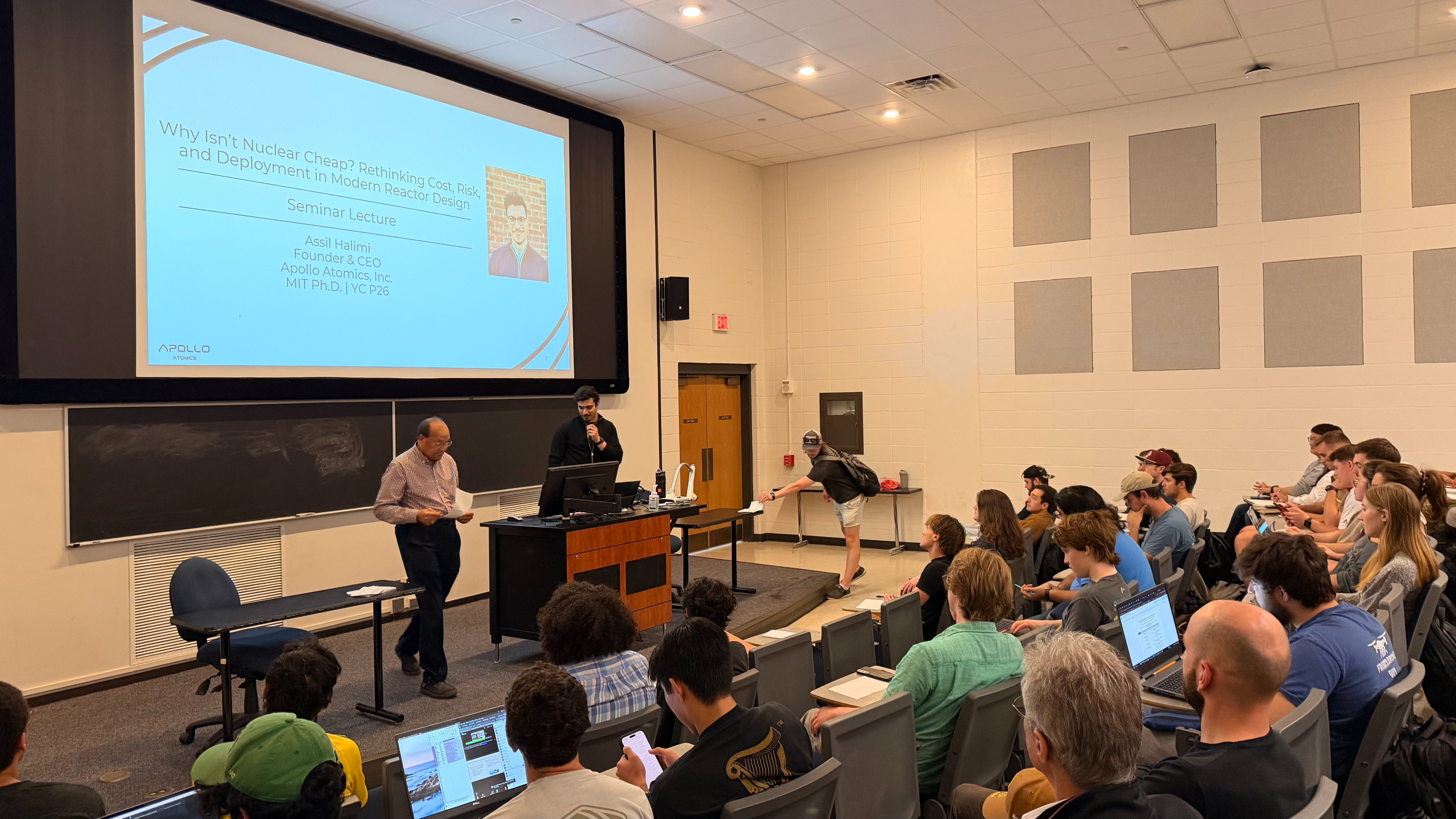
02 / Inside the institutionLearning what cannot be hand-waved
His route to founding passed through the old nuclear world. Halimi worked as a reactor operator with Engie in Belgium and as an advanced reactor designer at EDF. His later collaborations included Westinghouse, NuScale and Rolls-Royce. Those names matter less as prestige than as exposure: utilities, vendors and reactor teams each carry different constraints, and nuclear projects punish anyone who mistakes a constraint for mere stubbornness.
At MIT, under professor Koroush Shirvan, Halimi worked on two connected ways to improve nuclear economics. One concerned high-burnup fuel: keeping fuel in a reactor longer and drawing more energy from it while assessing material degradation, fuel performance and safety. The other concerned small modular reactors. A smaller plant can be constructed faster and repeated in series, but simple shrinkage sacrifices economies of scale. His research asked how design improvements, especially greater power density, might compensate.
His 2021 paper modeled integral pressurized water reactors across a wide range of core power densities. It treated cost as part of design rather than a decorative paragraph added after the equations. Later work covered high-burnup cores, fuel performance, power uprates and long-cycle reactor designs. In 2026, MIT awarded him the Del Favero Thesis Prize for an innovative advance in nuclear engineering. He had also served as co-president of MIT's American Nuclear Society chapter and received the department's student-service award.
There is a gentle irony here. Halimi arrived at entrepreneurship by becoming deeply fluent in an industry known for procedure. His eventual startup thesis did not discard that knowledge. It concentrated the gamble.
03 / The component in the roomA narrower kind of radical
Pressurized water reactors use heat from a primary coolant loop to produce steam in a separate loop, which turns a turbine. The steam generator enabling that exchange is large, complex and traditionally built around tubes. Apollo's proposal is to shrink the channels, pack more heat-transfer surface into a given volume and move far more heat through a smaller component. Halimi compares the logic to transistors on a chip: smaller units allow more working surface inside the same space.
and coolant
generator
factory assembly
The choice is strategic as much as thermal. Many advanced-reactor companies adopt new coolants, fuels or materials, which can demand new supply chains and unfamiliar regulatory work. Apollo says it intends to preserve commercially familiar fuel, water cooling and established suppliers while placing the major design change in the steam generator. In the company's telling, that can reduce the plant footprint, invite factory fabrication and let higher-output systems travel by truck.
Claims about future cost and deployment remain claims. Apollo projects electricity at three cents per kilowatt-hour and commercial deployment in 2028. It reports letters of intent representing 20 gigawatts. These are measures of ambition and market interest, not operating plants. The near-term proof is more prosaic: a one-megawatt demonstrator, long-duration component testing, manufacturing work and continued engagement with the U.S. Nuclear Regulatory Commission.
That distinction between the promise and the next test is where the story becomes useful. Halimi's approach is neither timid nor total reinvention. It is an attempt to choose a limited set of new problems that could unlock a much larger change. In infrastructure, novelty accumulates interest. Every unfamiliar material, supplier and approval path becomes another debt to repay before a customer receives power.
“Nuclear power is safe, sustainable, and reliable; now we need to be on time and on budget.”Assil Halimi
04 / A founder on two clocksWeeks for a startup, decades for a reactor
Apollo joined Y Combinator's Spring 2026 batch. The accelerator's tempo makes an odd companion to nuclear development, and perhaps a productive one. The company transported a working system demonstrator from Texas to California and placed it in a tent near Demo Day, where investors could inspect hardware rather than another rendering. In August, Apollo announced $31 million in seed and equipment financing led on the equity side by FCVC, with participation from Y Combinator and other firms.
Halimi co-founded the company with Drew Walker, its chief operating officer. Walker brought manufacturing and operating experience from electric vehicle ventures, along with prior White House work. Their division of labor reflects the company's central challenge: a reactor design is only one member of an unruly ensemble that includes testing rigs, suppliers, manufacturing systems, permits and customers.
In a long interview, Halimi described learning a different lesson at Y Combinator. The CEO's job, as he paraphrased the advice, is to survive ten or fifteen years. Intensity matters, but the assignment is a marathon. It is a fitting thought for a founder whose product must move quickly through an industry designed to distrust shortcuts.
His public manner mixes technical specificity with an engineer's willingness to admit friction. Asked about design compromises, he answered, “There are so many trade-offs.” It is a plain sentence, almost funny in its refusal to perform certainty. The steam generator may be smaller. The list of obligations is not.
05 / The wagerMake the enormous repeatable
The childhood astronomy survives mostly as a postponed purchase. Halimi sold his equipment when he moved from Europe and once said he hoped to buy new gear. Soccer filled some of the hours outside MIT. These details give the career's scale a useful correction: the founder proposing truck-delivered nuclear plants was also the student who missed football on television because he had chosen two sets of exams.
Apollo's path now depends on evidence. Components must perform for long periods. A design must be manufactured consistently. Regulators must become comfortable with its behavior. Suppliers must arrive on the same schedule. Customers who signed expressions of interest must eventually make harder commitments. Financing must outlast the glamorous announcement.
Halimi's bet is that nuclear power can become more competitive without behaving as though seventy years of operating experience were an embarrassment. Keep the accumulated knowledge. Keep the fuel and coolant that industry understands. Redesign the part that makes the system bulky, then test it until confidence becomes deserved.
The idea began with a tiny pellet and a very large number. A decade later, the question has changed from how much energy fits inside uranium to how much machinery is truly required to use it. Somewhere between those two measurements sits Apollo Atomics - and an engineer trying to make an enormous industry repeat itself.