The laser dot skitters across the canvas. On one side stands a person who may not have held a paintbrush since primary school. On the other, hidden from view, an artist is turning that dot into directions: here, now left, fill this patch, trust me. Around them, a corporate gathering does something corporate gatherings rarely manage. People stop checking their phones. They watch. Then the next reluctant painter steps up.
This is Art of Everyone, a small events company in Bridgeport, Connecticut, built around an appealing reversal. The expert does not make the artwork while the crowd watches. The crowd makes it while the expert conducts. Guests apply paint to fabric or clear plexiglass; the conductor uses laser guidance and spoken cues to keep many untrained hands moving inside a planned composition. At the end, the host owns a commissioned artwork made by the room.
The company calls the method Laser Guided Live Art. That sounds technical. In practice, the important technology is permission. A blank canvas asks a frighteningly broad question - what can you make? A moving dot asks a tiny one - can you put paint here? Most people can.
01 / The useful trickTwo odd ideas become one good product
The documented origin starts with painter Brad Noble, who had been turning over two notions. One was teaching a person to draw by pointing a laser over the person's shoulder. The other was painting from behind fabric and pushing pigment through to the visible side. Separately, each was a technique. Combined, they became an event: the conductor could guide without occupying the participant's space, and the painting could emerge in front of an audience.
Noble tested a version in Barcelona in 2016. In 2017 he co-founded Art of Everyone with James Chantler Brown. The pairing makes almost comic sense. Noble is a figurative oil painter drawn to faces, scale and emerging tools. Brown began as a comic magician, toured 38 countries, consulted on Arrested Development and worked with Steve Martin on the Great Flydini character. Later roles at Universal, Paramount, AOL/HuffPost, YouTube and Google put him inside branded entertainment and audience development.
One founder understood how an image resolves. The other had spent a career thinking about attention, cues and the point at which a spectator volunteers. Art of Everyone sits in the overlap. It is less an art class than a carefully staged transfer of confidence.
“Every child is an artist. We help grown-ups remain artists.”James Chantler Brown, quoted in a 2019 profile
02 / What the buyer buysA painting, a performance and a reason to approach a stranger
Art of Everyone sells custom projects to the people responsible for making gatherings feel consequential: corporate event teams, destination-management companies, conference producers, hotels, associations, leadership groups, festivals, universities, museums, nonprofits and private hosts. Public materials describe experiences running from about 45 minutes to full-day or multi-day immersions. Pricing is not published. Buyers discuss their audience and goals, then receive a proposal.
That quote-based model reflects what is being configured. The team must match an image to a brand or theme, choose fabric or plexiglass, plan participant flow, transport equipment, protect a venue from paint, rehearse the reveal and decide what happens to the completed work. The canvas is only one cost. The real service is choreography under live conditions.
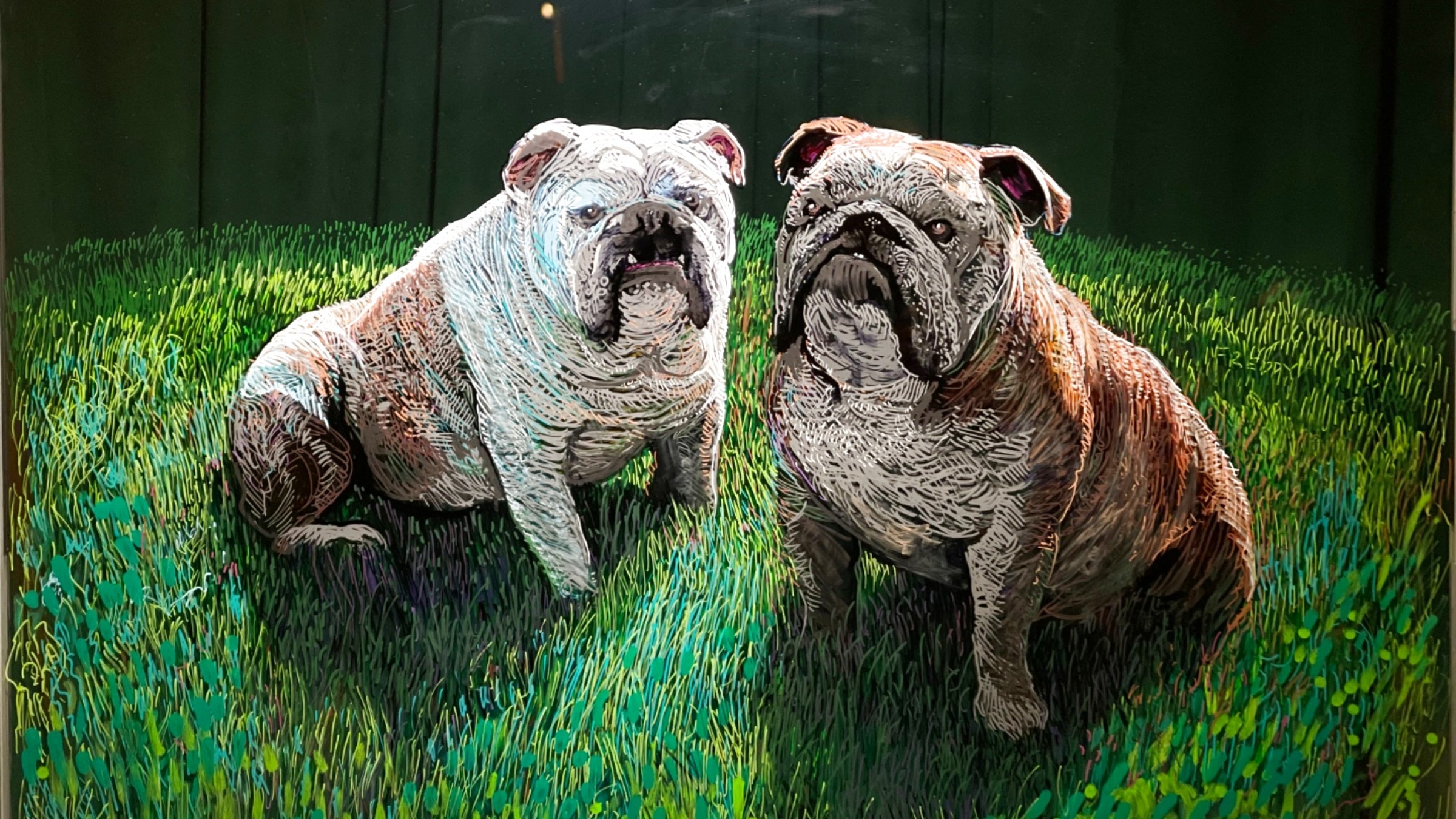
The menu has four useful shapes. Single plexiglass is the base format: one transparent sheet and one final image. Layered plexiglass lets separate groups work on different sheets over hours or days; those sheets are later stacked so fragments resolve into one installation. Classic fabric gives the result a more traditional painting surface. Gallery Wall turns several side-by-side works into either a set or a layered stage reveal.
One clear surface, one guided crowd, one stand-alone commission.
Separate contributions lock together only when the panels meet.
Reverse painting produces the closest thing to a conventional canvas.
Multiple works create a reveal that can become part of the program.
The layered version is the strongest expression of the sales pitch. Each group sees its own incomplete piece. Only assembly reveals the whole. It is teamwork rendered with unusual literalness, but it is also an efficient piece of theater: suspense, movement, a stage moment and a photographable payoff.
03 / Proof in publicFrom The Voice to the back of the BMI stage
The portfolio is a map of places where passive attention is a problem. At Lollapalooza in 2018, festivalgoers added to a mural behind the BMI stage while an artist conductor guided them with a laser. For an NBC The Voice press event, participants worked on portraits of Kelly Clarkson, Adam Levine, Blake Shelton and Jennifer Hudson. A Google team-building setup used four artist conductors and four superhero paintings at once. Another documented format put more than 300 people across four fabric paintings.
The company also lists commissions or collaborations involving Microsoft, Capital One, Yale, Northwell Health, Salesforce, Adobe-related events, Make-A-Wish, YPO and Fairmont. That roster is not evidence that every engagement had the same scale or commercial terms. It does show the format traveling among very different contexts: brand launch, executive room, festival, fundraiser, press junket and hotel opening.
The recurring customer problem is not “we need a painting.” It is “we need people to take part without feeling exposed.” A paint-and-sip class expects each person to own a canvas. A live event painter keeps the audience as spectators. A photo booth produces individual keepsakes. Digital activations offer speed and measurement, but add another screen. Art of Everyone gives each guest a small role inside one shared object.
04 / Behind the canvasA small company has to make a large room feel personal
The core company is lean, but the public roster extends beyond the founders. Artist conductors François Larivière, Hodaya Louis, Caleb Knowdell, Crystal Nobles and Chiara Mecozzi bring different hands to the same basic system. That title - conductor, not instructor - is revealing. An instructor transfers a skill. A conductor coordinates people who are each responsible for a small part of a larger performance.
The job requires more than painting well. A conductor must read hesitation, give directions that survive music and crowd noise, keep a line moving, protect the composition and make a five-minute participant feel useful. At larger activations, several conductors may work simultaneously. The Google example used four, each guiding a superhero image. Consistency matters, but a script cannot do all the work. The experience has to feel human even when the operating plan is exact.
This is where Art of Everyone fits in the experience economy. It is not primarily competing with galleries or selling editions to collectors. It competes for the engagement portion of an event budget, alongside entertainment, team building and branded installations. Its finished work gives it a second identity as a commission studio. That hybrid positioning explains both the appeal and the limit: buyers have to value the live encounter and the object. If either half is irrelevant, a simpler vendor will probably be cheaper.
The competitive edge
The host gets three things in one budget line: an activity, a live performance and a commissioned artifact.
The operational risk
The format needs dwell time, paint-friendly logistics and a final object worth transporting and displaying.
05 / The part worth copyingMake the first move smaller than the fear
Event planners can copy the mechanism without copying the canvas. First, replace an open-ended invitation with one obvious action. “Be creative” is work; “follow this dot” is doable. Second, keep an expert in the feedback loop. The artist conductor does not surrender standards when guests join. The guide absorbs complexity so the participant can act.
Third, make progress visible. A contribution matters more when the person can immediately see it joining other contributions. Fourth, design for accumulation. No guest has to be brilliant because the final value lives in hundreds of small marks. Finally, save a reveal. The moment when transparent layers meet, or the crowd steps back, converts activity into a story people can retell.
This is also what would make the format fail. It is a poor fit for a rushed audience moving past in seconds, a venue that cannot tolerate setup and cleanup, or an organizer seeking a cheap self-serve station. It will frustrate groups that want total artistic control, because the coherent outcome depends on a conductor and a composition planned in advance. And if nobody has a sensible place to hang, store or ship the work, half the proposition disappears.
There is no public funding story, valuation or disclosed revenue to inflate into a startup narrative. LinkedIn describes a partnership with two to ten employees, backed by a roster of artist conductors. That smallness fits the product. Art of Everyone is selling judgment and presence: knowing when to guide, when to step back and how to land a picture while a live audience is making it.
The company’s line is “Simple to join in. Hard to forget.” The first half is the engineering challenge; the second is the commercial promise. Lots of event vendors can occupy a room. Art of Everyone has designed a reason for the room to leave a mark - and a way for the mark to remain after everyone goes home.