Aron Ain had a problem with managers who followed the rules. Recruiters at Kronos were trying to hire experienced people, and those people had perfectly reasonable attachments to their vacations. They had spent years earning time off. A new job meant starting the clock again. The company could offer interesting work and still lose the candidate over a week at the beach.
To a business that sold software for managing working time, this was an awkward little irony. Ain wanted managers to make exceptions. Managers wanted to follow policy. Somewhere between the generous intention and the written rule, the offer was getting stuck. The rule had the advantage of being on paper.
In 2016, Kronos introduced open vacation. Employees covered by the program could arrange time away with their managers rather than work through a fixed annual allowance. The policy attracted attention, as vacation policies tend to do when they include a word like “unlimited.” But the interesting question in Ain’s career is what happens after a chief executive announces that he trusts people. Who gets to test the proposition?
A job that came with a mop
Ain joined Kronos in 1979, the year he graduated from Hamilton College, where he studied economics and government. His older brother Mark had founded the company in 1977. Aron was an early employee, arriving before the organization had enough people to divide every task into a department.
His duties included selling, installing software, answering phones and cleaning bathrooms. In the early days, he walked through Boston looking for businesses willing to try the company’s electronic time clock. It used a microprocessor to record punches and add up working hours. After selling a clock, he also had to help make it work. A satisfied customer could therefore owe something to the same person who had emptied the trash.
The origin is useful because it gives his later ideas a setting. A small company makes authority unusually concrete. The customer needs an answer, the equipment needs attention and somebody has to tidy up. There is little room for an executive theory of whose responsibility a problem ought to be. The problem is there, and so are you.
He had expected a shorter stay. Instead, the work kept changing. Ain moved through nearly every functional area of Kronos and became CEO in 2005, succeeding his brother. By then, he had spent roughly a quarter-century learning the business before receiving its most conspicuous title. His career has the unusual shape of a long apprenticeship inside one continually expanding employer.
The boss gets a report card
One of Ain’s most revealing management decisions concerned the people doing the managing. Kronos introduced its Courage to Lead training program in 2015. Training was a sensible start. It also raised an inconvenient question: how would the company know whether the lessons had changed anybody’s behavior?
A course can certify attendance. The people on a manager’s team experience the results. Kronos began asking them. Introduced in 2016, the Manager Effectiveness Index collected employee assessments of their managers twice a year. Questions covered communication, career development, empowerment and support. The distinction mattered: an employee could like Kronos while having a miserable relationship with the person immediately above them.
For a manager, that separates two flattering ideas. Working at a popular company does not automatically make you a good boss. Nor does delivering a business result explain how your team experienced the delivery. Ain described a performance-review approach that assigned 60 percent to what an employee accomplished and 40 percent to how they accomplished it. Conduct had a place in the arithmetic.
Ain said the managers with stronger effectiveness scores also had stronger engagement and lower turnover. That is his reported finding, rather than proof that one survey explains every departure. Still, the design carries a clear argument about authority. Employees’ experience of a boss deserves a measurement of its own. A manager should have to read it.
Chief people officer David Almeda was central to this work. Ain publicly credited Almeda and the HR team with helping turn employee engagement into a business priority. That detail belongs in the story because a philosophy of sharing credit becomes more convincing when the credit comes with somebody else’s name attached.
Permission needs instructions
Open vacation offered another test. Removing a ceiling sounds simple until someone must schedule a team. Ain’s account included managers worried about extravagant requests and longer-serving employees annoyed that newcomers could receive flexibility they had spent years earning. A benefit can feel like a possession, even when somebody else receiving it takes nothing away from you.
The company kept tracking time away and asked managers to discuss plans with employees. Giving permission did not eliminate the need for coordination. It also did not guarantee that people would actually take a break. A vague promise of freedom can leave an employee guessing what the boss will approve. Scheduling conversations gave that promise a practical form.
The recruiting problem itself was less fashionable than the headlines suggested. Ain explained that experienced candidates, including people in their thirties and forties, were reluctant to surrender established vacation allowances. The policy addressed a specific obstacle to hiring. It makes a useful reminder that an appealing workplace idea can begin with a recruiter losing another candidate.
“Trust is the magic glue”
Aron Ain, speaking at Hamilton College in 2019
There is a pleasing tension here. Kronos helped customers keep track of work, while its own CEO was arguing for more employee discretion. Measurement and trust had to live together. The manager surveys and vacation arrangements show the terms of that coexistence: ask people about their experience, explain the expectations and keep paying attention after the announcement.
The fine art of stopping to chat
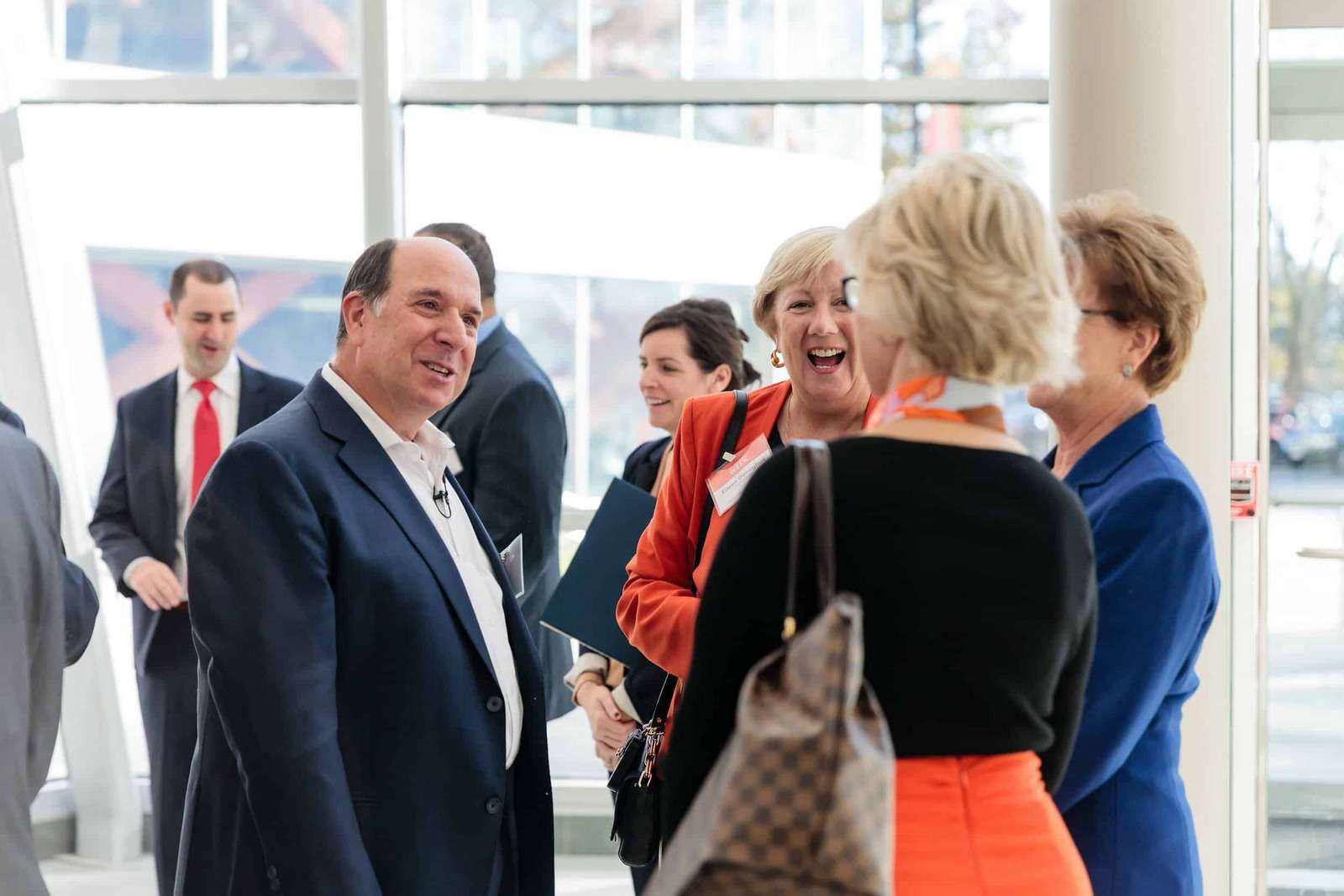
Ain’s account of everyday leadership includes a great deal of talking to people who have no appointment with him. He describes chatting with employees in elevators, candidates waiting in the lobby and visiting vendors. He calls this “the fine art of kibitzing.” It is a wonderfully unsolemn phrase for an activity that can acquire a consulting fee when described less cheerfully.
The casual conversation has a practical advantage. A visitor or junior employee may know something that has not traveled through the management chain. Asking questions creates another route for that information. It also gives employees a chance to encounter a chief executive as a person who is curious about them, rather than a signature at the end of a company announcement.
He credits his parents, Pearl and Jack, with teaching him to value family, service and respect for others. His own description of leadership repeatedly returns to curiosity and setting ego aside. These are personal statements, and their usefulness depends on what a leader does with them. In his case, the recurring acts are rather ordinary: answer, listen, ask another question, remember that the other person has a life.
Leaving without burning the bridge
That life may involve another employer. Ain has argued that a company does not own an employee’s career. Kronos welcomed returning employees, often called boomerangs, and UKG has continued to tell their stories. The idea asks a manager to survive a small injury to pride: somebody can choose to leave without making their years of contribution disappear.
One returning employee, Deepak J., recalled receiving a note from Ain a few weeks after leaving, thanking him for his work. He stayed in touch and returned within 19 months, taking a different role leading marketing in India. The note is the telling detail. Appreciation arrived after the employee had stopped being an immediate organizational asset.
For a company, a departing colleague may later become a customer, a referral or a returning hire. But the human reason for a civil goodbye is sufficient on its own. The business possibilities follow from leaving the relationship intact. A farewell need not contain a miniature trial about loyalty.
Two companies, one unfamiliar name
Ain’s career also contains the less conversational work of changing a large software business. In 2007, he helped negotiate the $1.8 billion sale that took Kronos private under Hellman & Friedman. The company subsequently moved from licensed software toward cloud services. That meant changing how products were delivered and how customers bought them, alongside the work on its internal culture.
In 2020, Kronos and Ultimate Software completed their merger on April 1. Ain became the combined company’s founding CEO and chairman. The new organization adopted the name UKG, short for Ultimate Kronos Group. A new set of initials was the easy part. Two established companies also brought their own practices, loyalties and understandings of what made them good places to work.
Ain had spoken admiringly of Ultimate’s employee and customer loyalty before the companies came together. His stated approach to integration was to learn what each did well. That is a demanding position for a longtime chief executive: experience supplies confidence, but a merger requires room for someone else’s experience too. Keeping the familiar practice simply because it is familiar would defeat the point.
UKG entered Fortune’s 100 Best Companies to Work For list at number six in 2021. The ranking is a dated milestone in the early combined company, rather than a permanent verdict on every employee’s experience. It marks the scale at which Ain’s workplace ideas were being tested. Policies that began inside Kronos now had to travel across a larger organization.
What remains after the CEO title
On July 1, 2022, Ain moved from CEO to executive chair, with Chris Todd succeeding him. Jennifer Morgan became UKG’s CEO in July 2024. Ain also joined Hellman & Friedman in an advisory operating-partner role in 2022 and serves on its CEO Council. After decades inside one business, he gained another setting in which to talk with people running companies.
His book, WorkInspired: How to Build an Organization Where Everyone Loves to Work, published in 2018, collects his management approach. His connections extend into education and community service: he is a Hamilton College trustee, and CJP’s 2026-2027 board roster names him board chair. He and his wife Susan have two children and five grandchildren.
Ain has said he would prefer to be remembered as a husband, father and friend rather than for his executive title. Read alongside his career, that preference explains something about the vacation policy, the friendly farewell and the questions in the elevator. A job can matter enormously while remaining one part of a life. The same applies to the person running the company. Even a chief executive ought to have somewhere else to be.
Keep the conversation going
Read WorkInspired, follow Ain on LinkedIn or X, and explore UKG.