An electricity bill arrives with the confidence of a verdict. There is a number, a due date, and very little invitation to negotiate. Yet for some American households, a portion of that number is a shopping decision they have never made. Arbor has built its business around this peculiar arrangement: a competitive market that many customers experience as a compulsory monthly expense.
- Arbor compares electricity supply plans and handles authorized switches.
- Households pay no service fee; electricity suppliers pay Arbor.
- Your utility keeps delivering power. Eligibility and savings depend on your account.
The company’s offer is pleasantly unheroic. You need no rooftop panels, battery, new meter or weekend project. You give it enough information to understand your electricity account, and permission to arrange a supply plan. The interesting question is how much household effort disappears when software takes responsibility for the dull bit.
The bill has two businesses inside it
Start with a distinction that electricity bills seldom make entertaining. Delivery pays for the system that brings power to your home. Supply pays for the electricity itself. In supported energy-choice markets, a customer can select another supplier while retaining the utility that operates the wires. Arbor works on the supply decision. It cannot bargain away the utility’s delivery charges.
That matters because “a lower rate” and “a lower bill” are different promises. Use more electricity and the bill can rise even on a cheaper supply plan. Delivery costs remain. A fixed supply rate fixes a price per unit, rather than the amount of electricity a family will consume. Air conditioning retains its expensive personality.
The natural customer is a renter or homeowner who pays their own electricity bill in an eligible utility territory. Ownership of the house is beside the point. Control of the account matters. Arbor’s coverage is concentrated in competitive markets in the Northeast and Midwest; an address check is more useful than assuming that everyone in a particular state qualifies.
The chore returns at the end of the contract
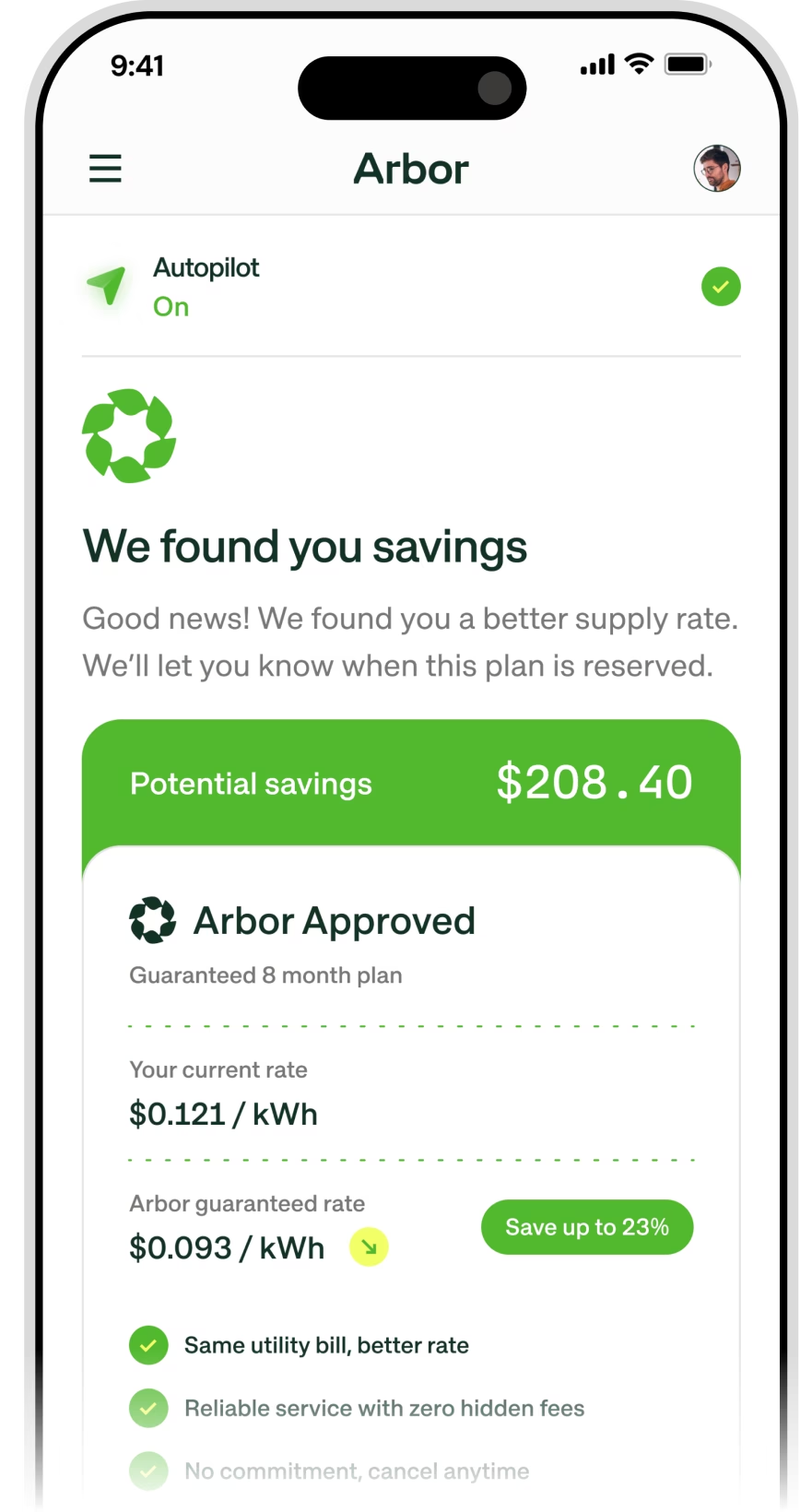
A comparison website can present options. A customer must still choose, enroll and remember when the offer expires. Arbor’s Autopilot takes on that sequence. After examining account information and usage, it looks for a suitable supply plan, submits an authorized enrollment and watches for the next renewal. Its expertise combines electricity brokerage with the management of account data and contract timing.
There is a revealing limit to the automation. Arbor’s FAQ says it does not automatically switch supply rates during an existing term. It begins searching again near expiry. “Continuous monitoring” therefore should not conjure a household hopping between suppliers every afternoon. The product is closer to a diligent contract administrator who remembers the date you were certain you would remember.
Customers can express a preference. Short-term plans, typically one to twelve months, favor more frequent reassessment. Longer plans favor stability, even if the opening rate is slightly higher. This is a choice about exposure to future prices. Arbor also says a particularly attractive short-term opportunity can lead it to depart from a long-term preference. The setting guides its judgment rather than mechanically determining every contract.
The timing deserves its own calendar entry. Arbor says finding a suitable rate can take days or weeks. After submission, the change generally appears within one or two billing cycles. A quick signup is not an immediate discount. Meanwhile, the terms authorize Arbor to sign supplier agreements on the customer’s behalf, with notification and an opportunity to opt out.
Free has a payer
Arbor charges customers no service fee. A supplier pays it when a customer switches to a plan. For a household, that removes the awkward calculation of whether a subscription will eat the savings. For Arbor, it creates a brokerage business whose customer experience happens to look like an app.
“Awareness is the biggest problem.”Andrew Meyer, founder and CEO, speaking to Axios in 2023
The arrangement still calls for a clear-eyed reading. Arbor discloses that it does not have access to every supplier rate and does not guarantee the lowest available price. Its comparison is constrained by its network. The alternatives include shopping supplier offers yourself, using a state comparison service, or staying with the utility’s default supply rate. Arbor sells the convenience of handling the decision repeatedly.
The household FAQ also promises to cover early termination fees on Arbor-secured plans. Businesses have different terms. Arbor for Business offers fixed-rate sourcing, monitoring and advisor support, including multiple locations, but some supplier contracts leave early termination fees with the business. The rate may look familiar; the obligations deserve a fresh reading.
An energy veteran bets on less paperwork
Founder and CEO Andrew Meyer previously co-founded home-battery company Swell Energy and worked on strategy at renewable-energy retailer Inspire. Arbor’s own account dates its founding to 2022. Its stated mission is to make saving on electricity easy. The public product expresses that ambition through price shopping and administration, rather than requiring a household to buy energy equipment first.

In September 2023, Arbor announced a $9 million seed round led by First Round Capital, with Obvious Ventures and Spring Tide participating. Early individual investors included Betterment co-founder Jon Stein and Arcadia CEO Kiran Bhatraju. The launch announcement reported more than 10,000 households and an estimated $5 million in savings. It was an early indication that a modest-looking task could support a consumer technology business.
A March 2026 hiring post describes a larger operation: more than 100,000 homes and businesses served, over $12 million saved and over $20 million raised. Those are company-reported totals. They are neither a prediction for your household nor proof that every customer remains active. The same posting describes a lean team building the data infrastructure behind pricing decisions and customer outcomes.
Borrow the habit, even without the app
The practical lesson is available to anyone with energy choice: identify the supply rate, compare the full contract, and put the expiry date somewhere it will survive your good intentions. Check eligibility before investing time. If your territory does not permit supplier choice, or your current plan is already favorable, there may be nothing useful to switch.
Arbor’s distinction is making that habit somebody’s job. Its usefulness depends on available offers, accurate account information and a customer comfortable granting enrollment authority. The company has chosen an everyday annoyance with a repeat appointment. Electricity continues to arrive as before. The paperwork gets a new keeper.