The work came home in shoeboxes. Ara Mahdessian remembers his parents returning tired and dusty, then carrying on through dinner and afterward. There were receipts to sort, invoices to handle, people to pay. A contractor could finish the physical job and still have an evening’s worth of business waiting. The family had made it to America. The paperwork had apparently been granted permanent residency, too.
Mahdessian was an Armenian child who had come from Iran to the United States with his family. His father became a residential contractor. Years later, armed with a Stanford education, Ara would help build software for precisely the businesses he had watched at close quarters. The remembered detail matters: he had seen what running the company cost after the customer had already said thank you.
That makes his story unusually domestic for a technology founder. The original problem occupied the same hours as family dinner. Solving it meant asking a practical question: how much of the owner’s working day really needed the owner? It is a question that has followed Mahdessian from a small operation in Glendale to the public markets, and now into his argument for artificial intelligence.
A ski trip, with unexpected homework
He met his future co-founder, Vahe Kuzoyan, on a college ski trip connecting Armenian students at Stanford and the University of Southern California. Kuzoyan’s father was a plumber. Both sons knew the routines of a trades business; both had learned enough about software to wonder why those routines demanded so much manual effort. A conversation between people with similar childhoods became the foundation of a partnership.
Mahdessian’s formal qualification was a bachelor’s degree in Management Science and Engineering from Stanford. The destination he chose afterward was Glendale. That decision kept the problem nearby: people he knew were still running contracting businesses, still scheduling work, still chasing the administrative loose ends. College had given him another way to help.
The founding story has several clocks. Corporate filings date his service as CEO and director to June 2007. ServiceTitan’s commercial startup story is often dated to 2012. Between an idea, a company and a product people will pay for sits a less photogenic stretch of work. Here, that stretch included years spent developing software around the operations of a Mr. Rooter business. The founders learned the job while building something to organize it.
A useful measure of how early things still were comes from their first hire, Matt Levitt. He recalled arriving for his 2012 interview in a suit and finding the founders in gym shorts and T-shirts, working from a small room in a father’s office. His wardrobe had arrived at a larger company several years ahead of him. He accepted the job anyway.
- 01The call
- 02The booking
- 03The dispatch
- 04The payment
One business day. Fewer loose ends between its parts.
The investor had questions. Ara had more.
Early ServiceTitan put Mahdessian close to the sale. Up to January 2015, he and one sales representative closed all sales. That is a revealing apprenticeship for a CEO: the person describing the product has to hear, repeatedly, what a prospective customer thinks it ought to do. The feedback arrives without the courtesy of an internal presentation.
By March 2015, the company had 236 paying small-business customers. A financing proposal contemplated an $18 million Series A, including $17 million from Bessemer. Its investment memo also recorded weaknesses: basic sales processes were still taking shape, and the founders needed better tracking of their own operating numbers. Knowing the customer’s business had carried them a considerable distance. Running a larger software company required another education.
Mahdessian treated an investor as someone who might supply it. On his first call with Bessemer’s Byron Deeter, he turned the expected interview around. He asked about hiring, sales strategy and product releases. After roughly 90 minutes, he left for a customer conversation. Deeter remembered being surprised by how little conventional pitching had taken place.
The relationship grew beyond a financing discussion. Before completing the partnership, the founders brought Deeter to Kuzoyan’s father’s plumbing business and spent time together over Armenian barbecue. Later, family gatherings and boardroom conversations overlapped. It is an approach to choosing backers that gives due diligence an unusually sensible test: spend enough time together to discover how you actually talk.
“Grateful for everything, entitled to nothing.”
A motto ServiceTitan adopted from Byron Deeter
The soccer argument before the software pitch
Nina Achadjian, who would become an Index Ventures investor in ServiceTitan, first encountered Mahdessian through college friends. He was making a detailed case for AC Milan winning the 2007 UEFA Champions League. She remembered the depth of his study: matches, players, coaches and the reasons some teams produced results that others could not.
The subject was soccer, but the habit of mind was recognizable. Find the moving parts. Work out which ones matter. Argue the case. Years later, when Achadjian joined Index in 2017 and was asked which company she wanted to back, her answer was ServiceTitan. An old social connection had become a professional conviction.
Soccer also supplies a lighter detail about the culture Mahdessian carries home. The gratitude motto Deeter shared with the company made its way into Ara’s son’s soccer team. A venture investor’s rugby saying had crossed an ocean of sporting preferences. At least the children would know the terms before asking for more playing time.
His own explanation of motivation is less concerned with spectators. In a 2021 conversation with Canva’s Melanie Perkins and Larry Fitzgerald Jr., Mahdessian described three things that mattered to him: helping others succeed, accomplishing difficult things and building a team he wanted to work alongside. Customer success stories supplied daily encouragement. In that telling, the work earns its attraction through the people on either side of the software.
Getting the plumber to the door
Mahdessian has described the customer relationship in equally practical terms. Each contractor had a dedicated success manager, with frequent contact intended to help the business get value from the system. Those conversations also supplied product feedback. For a founder who had spent so much time selling directly, that creates a continuing route back to the people doing the work, even as the organization grows around him.
To understand what Mahdessian sells, start with a familiar household indignity: waiting for someone to arrive. In 2019, he described contractors sending appointment confirmations, technician biographies and links showing a technician’s approach. Staff could recognize a returning caller and see the earlier job before starting the conversation. These are modest conveniences until you remember being told to keep an entire afternoon free.
That emphasis helps explain why a company serving contractors grew into more than a digital appointment book. Marketing, phone calls, field work and payment all affect the same business. A booked appointment can be wasted by a poor handoff. Advertising can produce little if the calls go unanswered. Mahdessian’s account of the product repeatedly returns to the connections between those activities.
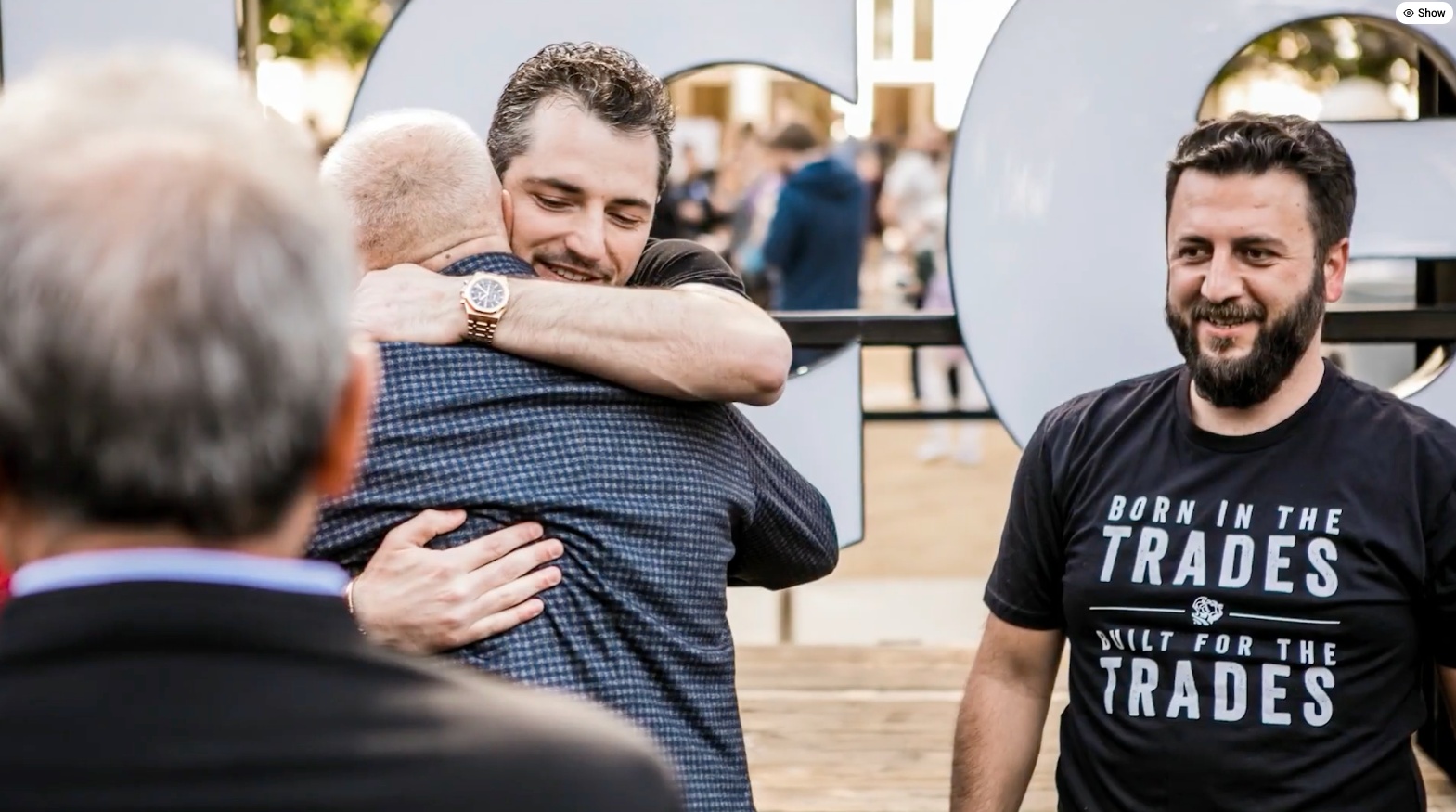
There is a social version of the same idea. Pantheon began as a gathering where customers could learn to use ServiceTitan. It developed into a place for contractors to compare experiences and help one another with operating problems. By 2022, Mahdessian was welcoming more than 2,500 customers to Los Angeles. His mother escorted him onto the stage in an unscripted moment. The family origin story had acquired a live appearance.
By September 2025, more than 4,000 people were gathered for his opening address in Anaheim. He shared messages from customers, including one from Handy Plumbing Man owner Marco Acosta describing how an acquisition had changed his family’s future. Mahdessian paused with emotion. The distance between a financial transaction and the people living with its consequences had become briefly visible on stage.
Wall Street, then another day’s work
ServiceTitan began trading publicly on December 12, 2024. Mahdessian and Kuzoyan appeared together on CNBC that morning, discussing their beginnings, customers and AI. The two sons who had compared their fathers’ working lives now had a stock ticker, TTAN. A symbol is pleasingly short for something that took so long.
The public company carries obligations that an origin story cannot discharge. Investors can read the results. Customers can judge whether the software improves their day. In the quarter ended July 31, 2026, ServiceTitan reported $292.8 million in revenue, up 21% from a year earlier. It also reported a GAAP operating loss of $27.6 million. Growth and profitability remain separate questions.
Quarter ended July 31, 2026. GAAP operating loss: $27.6 million. These are company results, not personal wealth.
Mahdessian’s newer ambition is to make more of the administrative work happen automatically. At Pantheon 2026 in Orlando, he described Max, ServiceTitan’s AI package, as a collection of agents sharing information across demand generation, field work and the office. The objective is coordination: information learned during a customer call should influence the decision about who gets sent to the job.
Max had launched with 50 contractors a year earlier. In his October 2026 keynote, Mahdessian said its customer base would approach 700 by year-end, a projection rather than a completed result. He argued that contractors should lead this technology transition. Whether the software delivers that ambition will be tested in the ordinary particulars: the right appointment, the right technician, the invoice that gets completed.
For all the changes in scale and vocabulary, the argument has a familiar shape. A business owner has more decisions than hours. Some require experience and judgment; others consume an evening through repetition. Mahdessian has spent his working life trying to move that boundary. The destination is easy to picture: a contractor finishes the day’s work and gets to come home with less of it.