The check was supposed to be dead by now. Instead, it keeps turning up at the exact moment nobody wants a history lesson: a law firm closing a property deal, an insurer disbursing a claim, a government office cutting a benefit, a treasurer moving a large sum under a two-signature rule. The paper is not charming. It is accepted, auditable and tangled into decades of procedure. AP Technology built a business by accepting that reality.
From Carlsbad, California, the privately held company makes software that sits between accounting data, human approval, bank requirements and the final payment. Sometimes that payment is still a check. Sometimes it is ACH, a wire, a card or another digital disbursement. The company says customers process more than $140 billion through its products each year. That is a company-reported figure, but it gives the proper scale: this is infrastructure, not a novelty app.
Founder and CEO Richard Love started AP Technology in 1989 after working on an early U.S. Treasury check-printing system and desktop MICR laser printers. MICR is the magnetically readable line of numbers along the bottom of a check - the little row that lets bank machinery know what it is handling. Love's résumé makes the company's present strategy feel less like nostalgia and more like accumulated scar tissue. AP Technology understands where a check jams, where a signature goes missing and where a bank rejects a file because one field arrived in the wrong dialect.
The payment rarely fails first. The handoff does.
A useful way to understand AP Technology is to ignore the check for a moment. The first weak point is usually a handoff. An invoice leaves the accounting system. Someone must approve it. Another person may have to sign above a certain amount. The payment data must match a bank's format. The document needs to emerge at the right printer, perhaps in another city. Finally, the bank needs a reference file so it can question a forged or altered item.
Old systems handle those steps with shared folders, email, spreadsheets, branch visits and a heroic employee who remembers which printer has the MICR toner. AP Technology turns them into permissions, queues, alerts, audit logs and integrations. Its defensible knowledge is not merely how to print a check. It is how to preserve control while a payment passes through several organizations and machines.
The portfolio parcels out that journey. APSecure is the enterprise system for banks, credit unions and large organizations. It supports branch and remote official checks, configurable workflows, API and core-system connections, and multiple payment types. SecureCheck handles business issuance with remote or local printing. SecurePay Advantage automates Positive Pay - sending a list of legitimate checks to the bank so exceptions can be challenged. ezSigner Direct adds encrypted signatures and graphics while a document prints. TruPrint supplies the secure stock and MICR toner.
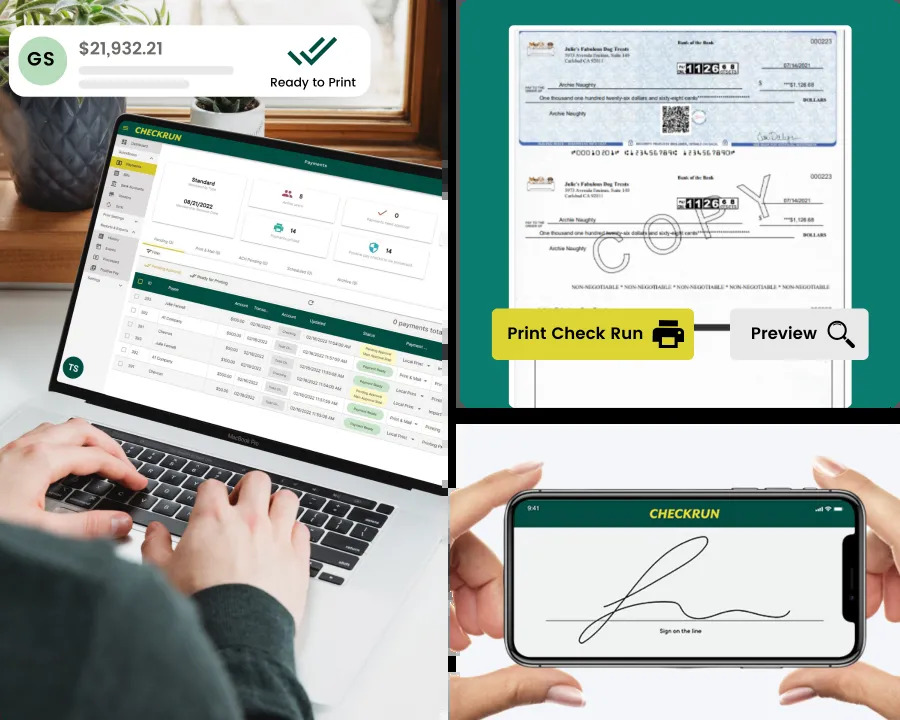
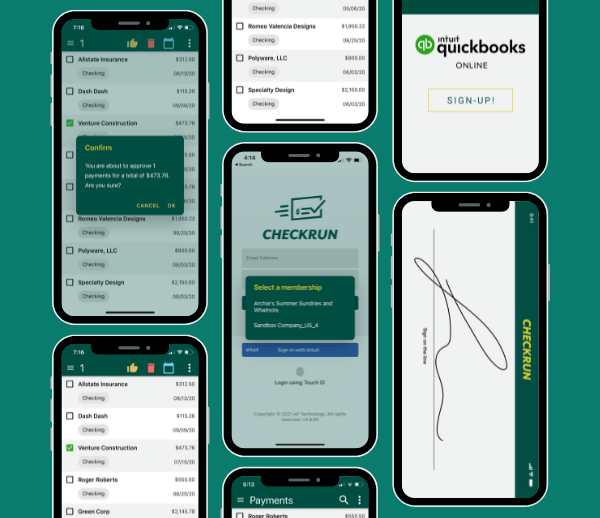
Then there is Checkrun, the cloud service aimed at QuickBooks Online users, accounting firms and smaller businesses. It offers mobile approval, custom workflows, ACH and three ways to deliver a check: print locally, print remotely or let the service print and mail it. The product recognizes a wonderfully mundane truth. “Pay by check” is not one action. It is a chain of decisions about who touches the money, where the paper appears and who gets evidence afterward.
“We consider ourselves a startup with 25 years of experience.”Richard Love, speaking to The Green Sheet in 2015
The contrarian move: migrate gently
The observable strategic shift is practical: start with check expertise, then move the controls to cloud and mobile environments while adding electronic rails. Customers do not have to abandon a familiar payment method on day one. They can automate the approval, signature, fraud file and delivery first.
Greg Wilfahrt, AP Technology's chief mobility and marketing officer, described the posture neatly in a 2023 trade profile: many customers still use traditional checks, so the company serves the current need while easing them into electronic payments “at a manageable pace.” That may be the company's most copyable idea. Enterprise adoption is often easier when the new system respects the old behavior, provides immediate control and leaves a door open to the next method.
The conditions matter. A remote official check is valuable when the recipient requires an official instrument and the customer is far from a branch. It is less compelling when every payee accepts ACH, the organization has already centralized payment controls and physical output adds no benefit. Likewise, Positive Pay helps when a bank supports it and the issued-check data arrives correctly. It is not a substitute for access control, secure stock or reviewing exceptions.
Preserve the customer's accepted output. Automate the approval and evidence around it. Add a clean migration path instead of demanding a leap.
Your operation is fully electronic, existing controls work, or your real bottleneck is invoice capture and procurement rather than issuing payment.
What it costs - and what the price omits
AP Technology does not publish prices for its bank and enterprise systems; configuration, integration, volume and support needs vary. Checkrun is unusually transparent. As of September 2026, its one plan is $50 a month with a 15-day trial, no contract and support for unlimited users and up to 10 bank accounts. There is a $199 implementation fee. Local check printing and ACH file export each cost 35 cents per payment; print-and-mail costs $1.95 per check.
Those numbers are only the visible bill. A buyer should compare them with staff time spent chasing approvals, driving to a branch, reformatting bank files, stuffing envelopes and investigating exceptions. AP Technology says Checkrun can save up to 70 percent of the time used to pay and approve bills, while SecureCheck claims savings of up to 80 percent on payment costs. Treat those as vendor claims, not universal outcomes. The return depends on payment volume, current labor, error rates and how thoroughly a team replaces its manual detours.
Implementation can also bite. A support notice illustrates the unglamorous reality: when a bank changed its ciphers, some SecurePay users needed an updater; another notice detailed renewed certificates and SSL handshake errors. This is what bank-integrated software looks like when the brochure is closed. Banks update security, accounting products move to the cloud, certificates expire and a vendor must keep the bridge standing. A buyer is purchasing maintenance competence as much as features.
A narrow seat in a crowded market
AP Technology is not a consumer wallet, a card terminal company or a full procurement suite. It occupies the issuance layer. Upstream sits QuickBooks, NetSuite, Sage, Acumatica, Microsoft Dynamics or a bank core. Downstream sits a bank network, a printer, a mailed envelope or a digital rail. AP Technology translates and controls what passes between them.
That puts it beside several kinds of competitor. AP automation platforms such as BILL, AvidXchange, Tipalti and Stampli combine invoices, approvals and payments. Bottomline and other payment specialists serve larger institutions. Banks offer their own Positive Pay portals. And the stubborn incumbent is not software at all: an accounting export, a signature stamp, a printer and somebody's car.
The company's difference is depth where others would prefer the paper to vanish. It can discuss a remote cashier's check with a bank, mobile approvals with a law firm, signature overlays with an enterprise and MICR toner with the person standing beside the printer. That range looks eccentric until one realizes all four people are trying to release the same dollar without losing control of it.
From desktop MICR to an API exit ramp
AP Technology's public history reads like a compression of back-office payments. In 2011, an APSecure government brochure described more than $20 billion in electronic payments and 40 million transactions. A 2015 profile reported more than $30 billion annually for roughly 6,000 customers. Today the company reports more than $140 billion. The figures come from AP Technology across different periods and are not audited public disclosures, but the direction matches the expanding product surface.
In 2023, the company joined Jack Henry's Vendor Integration Program to connect APSecure Remote Official Check with the SilverLake core. In 2024 and 2025, it leaned into remote issuance for banks, law firms and real-estate closings. APSecure 5 put checks, ACH, wires, cards and digital payments into one configurable pitch. In 2026, AP Technology refreshed Positive Pay automation, promoted one-pass digital signatures and announced that Peapack Private Bank & Trust was extending real-estate services through remote official-check printing.
The destination is not a world covered in more checks. It is a world where the organization's policy - who can approve, which rail to use, what evidence the bank receives - matters more than the location of a branch or printer. The check survives inside that system because some recipients and situations still demand it. When they stop, the surrounding workflow can choose something else.
The smartest part of AP Technology's strategy is not predicting when checks disappear. It is making that prediction unnecessary.
The lesson hiding in the toner cartridge
What can another company copy? Start with the customer's non-negotiable constraint, however unfashionable. Find the manual handoffs around it. Convert those handoffs into rules, permissions and proof. Price the smaller version plainly. Integrate with the systems already holding the data. Then offer a migration route that does not punish the customer for moving gradually.
It will not work everywhere. Legacy compatibility can become an anchor if maintaining old systems consumes the product roadmap. Remote printing creates hardware, stock and local-security obligations. Banks and regulated buyers demand long sales cycles, technical validation and ongoing support. A workflow that touches money cannot merely be convenient; it must survive audits, certificate renewals, personnel changes and the Friday-afternoon closing that absolutely cannot wait until Monday.
That is why AP Technology is more interesting than its subject matter sounds. For 37 years, it has watched shiny payment methods arrive while the back office kept asking the same unglamorous question: can the right person release the right amount, through the right channel, with evidence afterward? The company's answer is software wrapped around a choice. Sometimes the choice still comes out of a printer.