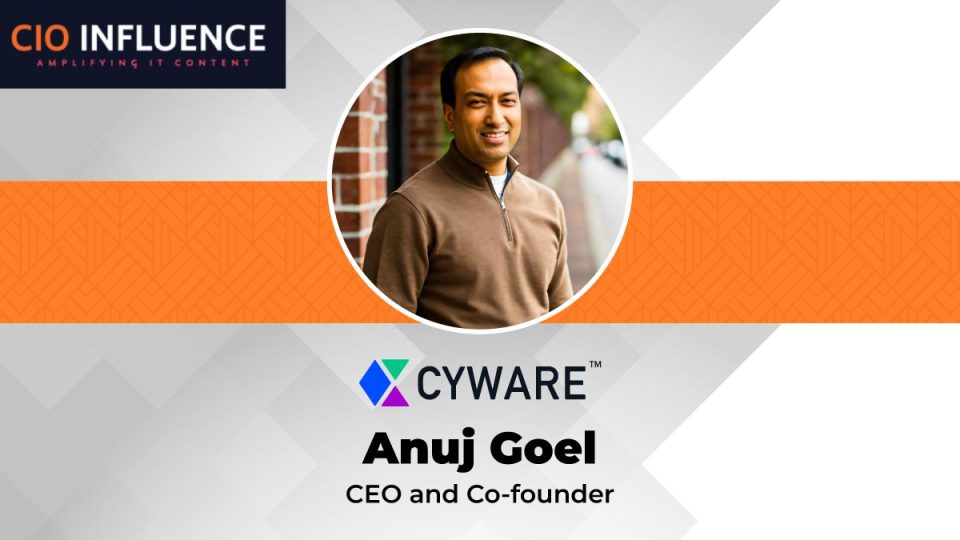
Anuj Goel’s founding insight arrived in a place where information was abundant. At Citi, working his way toward head of global cyber strategy and chief of staff to the CISO, he could see what a large financial institution knew about danger. He could also see how difficult it was to make that knowledge travel. Threat intelligence collected in one corner of the enterprise did not automatically become a decision in another. Tools multiplied. Teams specialized. The handoffs remained stubbornly manual. An alert could be correct, urgent and stranded at the same time.
This was not the romantic version of entrepreneurship, with a sketch on a napkin and a revelation before dessert. It was closer to finding that a grand railway had excellent engines, careful timetables and no track across the final mile. Goel came to believe that cybersecurity had made an expensive habit of knowing things without arranging what should happen next.
He and Akshat Jain founded Cyware in 2016. Jain brought experience building distributed systems at Adobe and Oracle. Goel brought the institutional view: how security strategy behaves when it meets a sprawling organization, competing priorities and a clock that never pauses. Their company would concentrate on connective tissue - threat intelligence, collaboration, orchestration and response assembled into a system that could move.
A childhood curiosity meets an adult bureaucracy
Goel dates his interest in technology to the consumer-computing boom of the 1990s. Virus attacks in the headlines of the early 2000s sharpened the curiosity. He studied computer science at Rensselaer Polytechnic Institute, then completed a doctorate in information engineering there. The combination is telling. Computer science asks what a machine can do. Information engineering keeps asking what happens when information must move through a system full of constraints.
His early academic work included networking and congestion pricing. Later, at Citi, congestion took on an organizational form. Security teams possessed more instruments than a small orchestra, but the score did not always reach every music stand. Threat-intelligence specialists, operations analysts, incident responders and executives could all be working around the same danger from different vantage points.
Goel has described the problem without theatrical fog. Organizations collected large volumes of intelligence, but much of it was neither contextualized nor operationalized in real time. Applying it across different systems demanded manual effort. Collaboration across teams was limited. Delay was not a mysterious technical failure. It was the natural result of asking busy people to carry context by hand.
Cyware’s phrase for its answer was “cyber fusion.” The language borrows from physical fusion centers, where analysts bring different streams of intelligence into one operating picture. In software, the proposition was to let organizations ingest and enrich threat data, share it securely, build workflows around it and coordinate a response without replacing every system already in the room.
The distinction mattered. Cybersecurity buyers are rarely shopping with an empty cart. Their problem is often the opposite. A platform that demands the retirement of an entire tool stack adds another migration to an already crowded day. By 2025, Goel said Cyware offered more than 400 prebuilt integrations across cloud, on-premises and hybrid environments. Four hundred integrations is partly a product metric. It is also an inventory of how complicated modern defense has become.
The company leaves the diagram
Cyware emerged from stealth in 2019. That year, Goel has said, the founding vision came together in a virtual cyber fusion center. The company announced a $3 million seed round in 2020, followed by larger rounds as enterprises and information-sharing communities adopted its products. In June 2023, a $30 million Series C led by Ten Eleven Ventures brought publicly reported funding to $73 million. The investors included companies and funds with their own view of the security market: Zscaler, Advent International, Emerald Development Managers, Prelude and Great Road Holdings.
Growth did not make the underlying idea more complicated. Cyware appeared on Deloitte’s North America Technology Fast 500 in 2024 at No. 447, with 239 percent growth, and again in 2025 at No. 344, with 216 percent growth. Rankings are snapshots, useful but perishable. The more durable fact is that the company found buyers for plumbing. Its customers include enterprises, government agencies and information-sharing organizations such as ISACs and CERTs, groups whose entire purpose depends on trusted information moving among members.
Goel’s interest in collaboration predates the fashionable language around platforms. He served on the executive committee of the Financial Services Sector Coordinating Council and participated in public-private information-sharing initiatives. He has also served as an adviser on cybersecurity and as a mentor in New York City’s Inventors to Founders initiative. The connective theme is difficult to miss: his work repeatedly returns to the problem of turning distributed knowledge into collective behavior.
- Nearly eight years at Citi, culminating in global cyber strategy leadership.
- Cyware is founded with Akshat Jain.
- The virtual cyber fusion center takes shape as Cyware emerges from stealth.
- A $30 million Series C takes reported funding to $73 million.
- Cyware makes consecutive appearances on Deloitte’s Technology Fast 500.
- Goel argues for intelligence that operates more autonomously, under human supervision.
The machine may hurry. The human must answer.
Artificial intelligence has given the old last-mile problem a new wardrobe. Cyware’s recent work describes specialized agents for ingestion, enrichment, correlation, threat hunting, action and sharing. They operate over an orchestration layer and across the company’s integrations. The appeal is easy to understand. If the machine can gather, compare and route routine information, an analyst need not spend a shift serving as a remarkably overqualified courier.
Goel draws a firm line around consequential decisions. He calls Cyware’s approach “human in the loop”: the software can handle repetitive tasks and low-risk actions, but it seeks an analyst’s approval when risk or context demands judgment. His distinction between human-in-the-loop and AI-in-the-loop sounds grammatical until one considers who is in charge of whom.
This is less a concession to nervous customers than a theory of responsibility. Automation is valuable because it can be consistent, tireless and quick. Human judgment is valuable because the world is untidy and someone must remain accountable when the tidy workflow meets an exception. Goel’s five-year view is that agentic AI will manage far more detection, response and sharing with less manual intervention. Yet he continues to put expertise at the center of high-impact choices.
His recent writing pushes the argument further. In 2026 he wrote about the “half-life” of threat intelligence: the larger the haystack becomes, the easier it is for a live needle to hide among expired indicators. He also argued that the AI era moves too quickly for security to keep attaching old controls to each new capability. Both ideas return to the same impatience with accumulation. More data, more tools and more controls do not automatically produce a safer organization. Context and timely action decide whether the collection earns its keep.
A founder who keeps taking notes
For someone building autonomous systems, Goel’s management philosophy is strikingly apprentice-like. He says he has learned by watching mentors and peers, studying how capable people tackle problems and collaborate, then combining those lessons with an individual approach. He urges managers to help others find their own path rather than spend a career imitating someone else’s strategy.
There is a resemblance between that advice and Cyware’s architecture. Do not throw away everything that came before. Learn what each part does well. Preserve judgment where it belongs. Connect the pieces so that the whole can respond with more coherence than any isolated component.
Goel lives in the Charlotte metropolitan area while leading a company headquartered in Jersey City and operating across sectors and geographies. The distance feels apt. His career has been about coordination across distance: between an indicator and an analyst, one company and another, software agents and human supervisors, a warning and the decision it should cause.
Cybersecurity likes the imagery of walls, shields and locks. Goel’s work favors verbs: ingest, enrich, correlate, share, act. A wall stands alone. A verb requires a subject, an object and, often, somebody else. Nearly a decade after Cyware’s founding, his wager remains that defense improves when the right information can find the right participant in time. The last mile is still there. He is simply trying to make it much shorter.