The first thing that fails in enterprise vulnerability management is rarely the scanner. The scanner works with almost comic efficiency. It finds an aging server, a forgotten cloud instance, a container with a bad library, then another, then ten thousand more. Each finding arrives with a severity score and the implied urgency of a fire alarm. The security team is left to discover that every alarm cannot be first.
Hive Pro, founded in 2019 by CEO Anand Choudha and CTO Sarfaraz Kazi, built its company around that jammed work queue. Its flagship, Uni5 Xposure, takes findings from the security products an enterprise already owns, folds in data from its own scanners, removes duplicates, adds threat intelligence and business context, tests whether an attack path is plausible, and sends the resulting work into systems such as Jira and ServiceNow. The sale is not detection. The sale is judgment followed by motion.
The scanner did its job. That was the problem.
Traditional vulnerability management starts with a sensible abstraction: score technical severity, then patch the worst. The abstraction gets brittle inside a real company. A frightening flaw on an isolated test machine may matter less than a merely “high” flaw on a payment system exposed to the internet. One may already be blocked by controls. The other may sit inside an attack campaign that began this morning. A score knows the software weakness. It does not necessarily know the business.
Hive Pro’s response is to normalize the mess before ranking it. Uni5 Xposure can ingest results from products including Tenable, Qualys, Rapid7, CrowdStrike, SentinelOne and Microsoft. It also offers six native scanners spanning code, containers, cloud, web, network and mobile. Asset criticality, network placement, exploit activity, threat-actor behavior and the condition of existing controls then change the order of the queue.
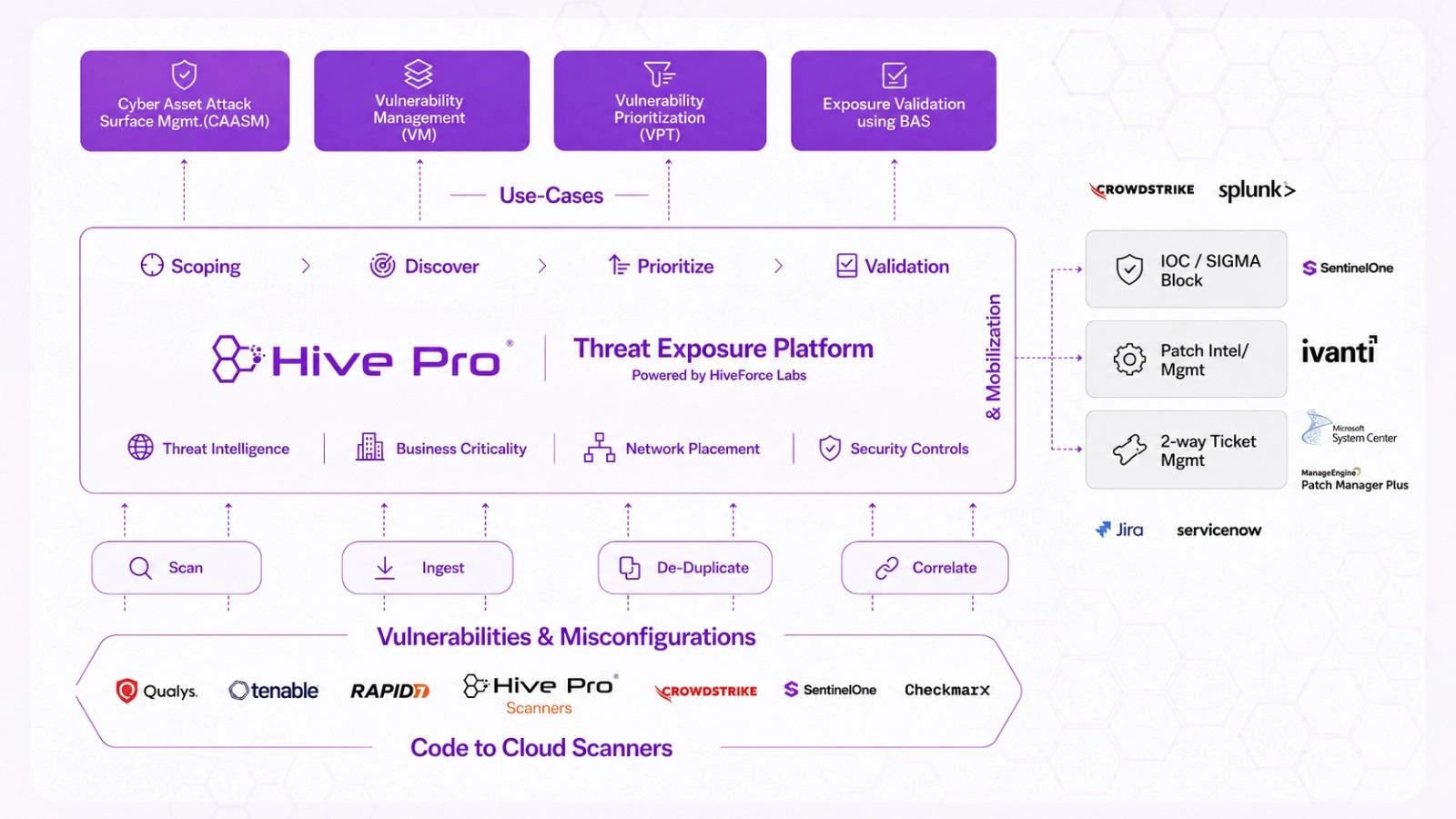
This makes Hive Pro an overlay and, when the customer wants it, a consolidation play. A buyer does not have to fire the incumbent scanner on day one. The platform’s connectors can pull those findings into a common data plane, while the native scanners give the buyer leverage to retire overlapping tools later. For a cautious enterprise, that is a less dramatic migration than a rip-and-replace - and a more plausible one.
“Have been bouncing across Tenable, Qualys, Rapid7, picking the least worst - happy to be breaking the cycle with Hive Pro Platform.”Randy Potts · CISO, Real Time Resolutions
Five verbs make a product
The architecture now maps neatly onto continuous threat exposure management, or CTEM, a Gartner framework that Hive Pro encountered in 2022. The company says the framework described much of what it was already building. The fit gave buyers and vendors a shared vocabulary: scope what matters, discover exposures, prioritize them, validate whether they are usable, and mobilize the fix.
From surface area to closed ticket
Scope
Discover
Prioritize
Validate
Mobilize
Those last two stages carry the interesting weight. Validation asks whether a weakness can survive contact with the actual environment. Hive Pro’s breach-and-attack simulation runs adversarial exercises and maps chained routes toward critical assets. Product leader Amit Mishra has described watching an attacker combine five individually unremarkable actions into a compromise. A point test could mark every control green and still miss the route between them.
Mobilization admits another awkward truth: identifying the right flaw does not patch it. Security has to persuade infrastructure, application or cloud owners to act. Hive Pro can create tickets, assign owners, attach remediation guidance and track closure through the tools those teams already use. That handoff is mundane. It is also where a large portion of security strategy goes to die.
The laboratory is part of the machine
HiveForce Labs, the company’s research group, supplies the live adversary context. It tracks vulnerabilities, exploit activity, attack campaigns and threat-actor behavior, and publishes advisories outside the product. Inside Uni5 Xposure, the same research helps reorder customer risk. A newly weaponized flaw should rise; a severe but unreachable one can wait. The platform is trying to make intelligence operational rather than another PDF in an analyst’s reading pile.
That loop matters most in sprawling, regulated environments. Hive Pro markets to banks, insurers, telecom operators, government bodies and other enterprises where assets span data centers, multiple clouds and code pipelines. Named users include Goosehead Insurance, Real Time Resolutions, Direct Marketing Solutions, ConnexPay and Ujjivan Small Finance Bank. Their common problem is not a lack of security products. It is the cost of making those products agree.
A useful caution: these are company-reported outcomes and benchmarks, not a promise that every deployment will reproduce them. The result depends on data quality, integration coverage, ownership and an IT organization that can act on the tickets.
The channel is part of the product
Hive Pro sells enterprise subscriptions in cloud and on-premises versions through a demo-led process. It also treats distribution as an extension of the software. The company reports more than 150 partners across more than 40 countries, spanning managed security providers, systems integrators, resellers and technology alliances. Service providers can white-label the whole platform or selected capabilities. That matters in markets where a customer buys an operating service, not a login, and expects a local partner to run the exposure program.
The integration roster is equally commercial. AWS, ManageEngine, Ivanti, GitLab, ServiceNow and the incumbent scanner vendors are not decorative logos when the product’s value depends on importing assets and exporting action. Every working connector lowers the adoption cost. Every broken one sends an analyst back to spreadsheets. Hive Pro says the small team behind this work spans 12 countries and prizes ownership, flexible work and short paths from an idea to production. The culture copy sounds like startup copy, but the product architecture makes the preference credible: this is a company choosing to maintain a large number of unglamorous handshakes.
The AI arrives wearing a seatbelt
Hive Pro’s newest interface is Arbis AI, an agentic layer designed to let an analyst question exposure data in ordinary language. Ask for the three fixes with the highest likely risk reduction, and the system is meant to return scoped assets, charts, tables and drill-downs. Underneath are an MCP-compliant tool server, tenant isolation and support for customers that bring their own language model.
The notable choice is restraint. Arbis begins with a read-only Analysis Agent. It can investigate across modules but does not quietly patch production while everyone is at lunch. In a market where “agent” is often code for giving a demo more verbs, Hive Pro is starting with a useful boundary: improve the decision before automating the decision-maker. The company describes this as phase one of a broader multi-agent plan.
That plan follows the company’s history. The 2021 seed round brought a reported $3 million. A second $4 million round in July 2023 funded product work and a larger Herndon, Virginia headquarters. The platform release that autumn pulled the modules into a clearer exposure-management package. External attack-surface management followed in 2024, enhanced attack simulation in 2025, and Arbis in 2026. Each addition moves the product one step farther from counting flaws and one step closer to running the response.
The sale is not a prettier risk score. It is a shorter argument between security and the people who own the fix.
What a buyer can copy without buying
There is a practical operating lesson here even for a team that never signs a Hive Pro contract. First, create one inventory of assets and findings. Second, remove duplicates before analysts spend time ranking anything. Third, weight the list with business importance and observed attacker behavior. Fourth, test the most dangerous-looking paths against real controls. Only then should the workflow create a ticket. Finally, measure closed exposure, not the number of findings placed on a dashboard.
The order matters. Automating a noisy feed simply produces bad tickets faster. Threat intelligence without asset context produces fascinating global news and weak local decisions. Attack simulation without an owner becomes theater. Hive Pro’s contribution is less any single ingredient than the insistence that they belong in one closed loop.
Where the model earns its keep - and where it does not
- Strong fit: many scanners, clouds, business units and remediation owners; a chronic backlog; meaningful regulatory pressure.
- Weak fit: a small environment with one scanner, clear ownership and a queue the current team can already close.
- Failure condition: incomplete asset data or missing integrations. Contextual scoring cannot rescue assets the platform cannot see.
- Human condition: IT teams still need authority and maintenance windows. A well-written ticket is not a deployed patch.
A crowded market, with room above the crowd
Hive Pro competes from several directions at once. Tenable, Qualys and Rapid7 remain entrenched in vulnerability management. Microsoft, CrowdStrike, Palo Alto Networks and Axonius sell broad exposure or attack-surface views. Picus and SafeBreach specialize in validation. Hive Pro’s answer is breadth: native scanning plus third-party ingestion, its own threat research, contextual prioritization, attack simulation and remediation orchestration.
Breadth is useful, but it creates its own test. Every connector must stay current. Every claim of a unified view depends on normalized data. Every automated workflow touches another team’s process. A platform that promises to reduce tool sprawl can become one more tool if adoption stops at the dashboard. The company’s best customer quotes focus on fewer alerts and less manual labor because those are the outcomes that decide whether the layer is infrastructure or ornament.
Hive Pro’s market position, then, is unusually easy to state. It is for the CISO whose scanners already work and whose process still does not. If the company can consistently turn a swollen backlog into a small set of validated, owned and closed exposures, the 1 percent will be more than a slogan. It will be Monday’s work.
Go deeper with Hive Pro