Anthony Hsieh bought a mortgage business, sold it, and entertained the sensible idea of spending more time fishing. Then he built another mortgage business. Then he built loanDepot. In 2022, having taken that company public, he finally stepped away from its daily management to pursue an expedition across the world’s fishing grounds. By July 2025, he was back as chief executive. Retirement, in his case, appears to require a rather generous return policy.
There is a tempting version of this story in which the boats are a reward for the business. Hsieh’s chronology makes that difficult. Fishing came first, before the mortgage companies, before the public listing, before anyone would have thought to describe a fleet as a personal hobby. As a teenager, he worked aboard Southern California sportboats. At 19, he bought a 17-foot Boston Whaler. The larger boats came later. The appetite was already there.
Now based in Miami, the Taiwan-born founder lives between two enterprises that demand an unusual tolerance for uncertainty. One depends on borrowers, interest rates and the machinery of American housing finance. The other sends boats and crews after billfish across distant oceans. Both require people who know what they are doing. Neither offers much consideration for an owner’s preferred timetable.
The family negotiator
Hsieh arrived in the United States as a child and went to school in Los Angeles. Learning English was an immediate assignment. Bugs Bunny helped. Television supplied words and rhythms that a classroom alone could not provide; the business vocabulary would arrive soon enough.
His parents faced language barriers, and he became the family’s representative in major purchases and financial decisions. Cars and homes were matters he encountered through responsibility before they became a profession. The familiar immigrant arrangement put a young person on the adult side of a transaction, translating both language and expectations.
The route into mortgages was less ceremonious than a founder’s biography might suggest. While studying business at California State University, Fullerton, he played baseball and installed stereos. A teammate’s job as a loan officer caught his attention. Hsieh went for an interview and got hired. The industry that would occupy his working life entered through a conversation at a ballgame.
In 1989, he acquired a mortgage brokerage that became LoansDirect.com. He was still in his twenties. That distinction matters less than the position it put him in: he had moved from arranging someone else’s transaction to owning the operation behind it. A commission could reward a good month. Ownership required answering for the months that followed.
Three businesses, one stubborn subject
LoansDirect.com was acquired by E*TRADE. Hsieh went on to establish Home Loan Center in 2002, bringing mortgage products, live interest-rate quotes and offers tailored to borrowers into an online lending business. It merged with LendingTree in 2004, and he continued leading the operation for three more years.
The pattern is striking for its concentration. Selling a business can give a founder permission to become interested in almost anything. Hsieh kept returning to the same difficult transaction: helping a household obtain a loan against a home. The internet changed the point of entry. It did not remove the paperwork, the decisions or the need to get the transaction finished.
loanDepot launched in 2010, after the financial crisis had dismantled familiar mortgage names and shaken confidence in the trade. Hsieh’s founding letter recalled an initial group of 50 employees. Entering that market meant building a lending business while the failures of lending were still very much in view. A recognizable brand and a more manageable customer experience were central to the proposition.
By March 2017, the company was introducing mello, its proprietary digital lending platform, as part of an $80 million technology investment over the previous 18 months. The first iteration combined a consumer portal, mobile tools for loan officers and a digital mortgage application. The ambition reached into the work behind the screen, where information had to move among borrowers and lending professionals.
There was a physical expression of that ambition, too. The mello Innovation Lab was designed for more than 400 technologists, with collaborative space, quiet rooms and a slide. Financial services had discovered a faster way downstairs. Beneath the office theater was a substantial hiring and software effort aimed at changing how loans were produced.
In 2018, mello Home extended the idea into connections between pre-approved buyers and local real estate agents. The company was trying to stay involved through more of the homeownership process. For Hsieh, a mortgage application was becoming one part of a longer customer relationship, with digital tools and local professionals occupying the same plan.
The dinner before the decision
In November 2015, loanDepot was preparing to go public. Hsieh was at Morgan Stanley’s Manhattan offices for a celebratory dinner when he reconsidered. Markets were unsettled. He withdrew the offering on the eve of the planned listing. The evening had acquired a rather awkward new purpose.
The company eventually reached the New York Stock Exchange in February 2021. Between those dates lies an easily missed part of entrepreneurial life: the decision to wait, and then the obligation to keep operating while waiting. A postponed listing does not postpone payroll, product development or competition.
Hsieh’s public explanation of what motivated him has often returned to the borrower. In a 2017 interview, he described opportunity as his source of energy, particularly the ability to help someone buy a first home or a desired home. It was an account of purpose rooted in a specific transaction, one whose significance extends well beyond a lender’s quarterly volume.
That same interview showed how tightly he arranged his day: early news and email, quiet planning time, then getting his children to school before arriving at the office. The schedule was precise. Years before a world tour required an itinerary, he was already giving the morning one.
Bad Company, very familiar company
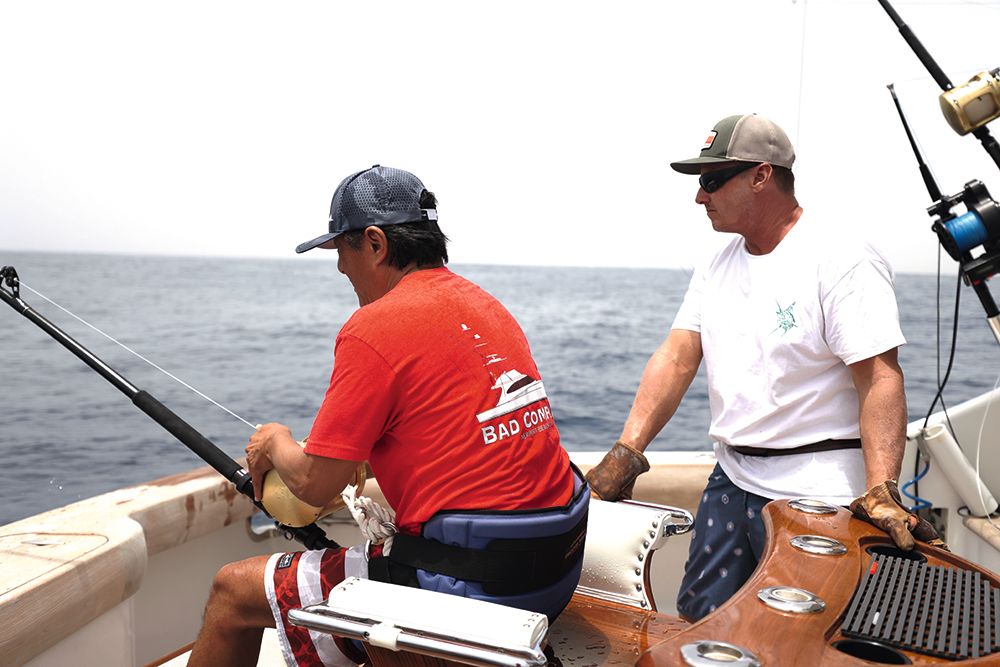
The fishing operation carries the name Bad Company, though its personnel suggest a preference for long acquaintance. Captain Steve Lassley joined Hsieh in 2004. Other mentors and friends came from the California docks where Hsieh had learned the trade. Money could buy a larger boat; it could not instantly supply the judgment of someone who had spent decades finding fish.
The team won a $3.9 million jackpot at the 2006 Bisbee’s Black and Blue tournament. Hsieh and Lassley also developed the sort of companionship that makes long periods of shared concentration possible. Hsieh once called the captain his “fishing wife.” There are less affectionate ways to describe spending that many hours beside another person with binoculars.
Sight-fishing appeals to Hsieh: moving forward, looking for signs, hunting rather than simply waiting. The method involves practiced observation, supported by tools such as sonar and charts. A boat full of equipment still needs someone who can read what is happening around it. His fishing friendships grew around that shared work.
In 2022, Bad Company began its world tour. Madeira, the Azores and Australia’s Great Barrier Reef were among its destinations. The project required support vessels, gameboats, crews and planning across remote locations. A childhood ambition had grown into a transport operation. Even leisure, once expanded to this scale, develops a logistics department.
“The purpose is to fish.”
Anthony Hsieh, on what his boats are for
Hsieh has described preferring functional, reliable vessels to elaborate amenities. The boats enable the fishing; the itinerary follows the fish. That distinction explains why photographs of the fleet, impressive as they are, tell only part of the story. The interesting scene is often on the smaller boat, where the owner is occupied with a line.
The expedition also makes room for research. Hsieh has worked with scientists, including Stanford marine biologist Barbara Block, using satellite tagging to study billfish movements. The trips can collect information about animals that travel far beyond any single fishing ground. Catching and releasing a fish becomes an opportunity to learn where it goes next.
A place on the water for others
In 2018, Hsieh founded War Heroes on Water, an annual sportfishing tournament for veterans. It brought the Southern California boating community into a shared undertaking, with owners donating vessels and crews. Freedom Alliance became a partner in selecting participants.
That work makes use of relationships assembled over years on the docks and offshore. A private interest can remain entirely private. Here, boat owners, captains and anglers made their equipment and time available to people beyond their regular fishing circle. The gathering connects Hsieh’s gratitude toward the United States with an activity he knows closely.
The International Game Fish Association recognized him with its 2024 Gil Keech Heavy Tackle Award. Its account of his fishing career included the world tour, educational videos, seminars and conservation work. The former pier fisherman had become someone whose own experience could be passed along to other anglers.
Back at the desk, with unfinished business
Hsieh returned to an operating role at loanDepot in spring 2025, became interim CEO that June and was appointed permanent CEO on July 28. His stated priorities included profitability, market share and the use of artificial intelligence. The return placed him back inside the everyday business of executing those ambitions.
The 2026 results show progress alongside unfinished work. Second-quarter revenue reached $337 million, up from $286 million in the first quarter. The reported net loss narrowed from $55 million to $7 million. Home equity lending was part of the shift. Those figures describe improvement; they also leave a loss on the page.
A smaller loss. Work still ahead.
Reported quarterly net loss. Lower is better. Figures rounded as presented in company results.
In July, the company announced a Miami corporate center, planned initially for 120 employees. In August, it disclosed an NYSE notice after its average share price fell below the exchange’s $1 threshold. The notice had no immediate effect on trading or operations. The ambition to expand and the pressure of a public listing were present together.
Hsieh’s story has repeatedly returned to that combination of appetite and responsibility. He can assemble an expedition to pursue a fish he has wanted to catch for decades. He can also return to the company he founded when its next chapter remains unsettled. For the former teenage deckhand, there is still work at both ends of the journey.
Follow the work. Follow the boats.
- loanDepot / COMPANY WEBSITE
- Anthony Hsieh on LinkedIn
- Bad Company on Instagram
- Bad Company on Facebook
- Watch: GRANDER, the Bad Company documentary / YOUTUBE
- Bad Company Fishing Adventures / YOUTUBE CHANNEL
- The world tour journal
- The mortgage career and the delayed IPO / FORBES, 2021
- loanDepot’s second-quarter 2026 results
- The August 2026 NYSE price notice
- The 2024 Gil Keech Heavy Tackle Award / IGFA