A chip designer lives in the future, but not the breezy sort promised in keynotes. The future here is a spreadsheet of compromises. A team must decide what software people will want years from now, then turn that guess into silicon while negotiating power, performance, area, cost, and a calendar that refuses to negotiate back. Ann Wu spent nearly five years inside that predicament at Apple. She worked on custom silicon for phones and tablets, then on the M1 and M2 generations. The machines were modern. The process still asked humans to carry astonishing amounts of context.
By the time Wu co-founded Silimate in 2023, she had seen the problem from several useful angles. At Apple, she was a pixel IP design engineer. At Meta, she helped manage work around MTIA, its inference accelerator. At Celestial AI, she moved into product management and strategy for an AI accelerator platform. Engineering taught her how silicon gets made. Program work taught her how many moving pieces must agree. Product work taught her that a technically elegant answer is merely decorative unless somebody can use it.
Silimate grew from a complaint shared with Akash Levy, a fellow Stanford electrical-engineering graduate student who became her co-founder and CTO. Their compact diagnosis was that building chips was painful. The serious version of that diagnosis concerned the long gaps between a failing design, the evidence scattered across logs and waveforms, the root cause, and a fix that did not quietly ruin something else. Traditional electronic design automation, or EDA, has many excellent tools. The troublesome work often lives between them.
01 / The mismatchA year to build for a workload that will not sit still
Software can change before lunch. A chip cannot. A typical development cycle can stretch across 12 to 18 months, and the product may reach production later still. Meanwhile, an AI model that looked important when architects began their work may be replaced by a different model family. The hardware team must aim at a moving target while the cost of changing course rises with every stage.
Wu's proposition is easy to repeat: build better chips faster, with fewer resources. The implementation is less obliging. A useful assistant needs to understand register-transfer-level code, simulation output, hardware intent, and the specific constraints of a customer's design. It must fit beside established tools rather than demand that engineers abandon a production flow they trust. It must also earn confidence in a profession where a plausible answer can be expensive and a subtly wrong answer can be worse.
The loop Silimate wants to compress
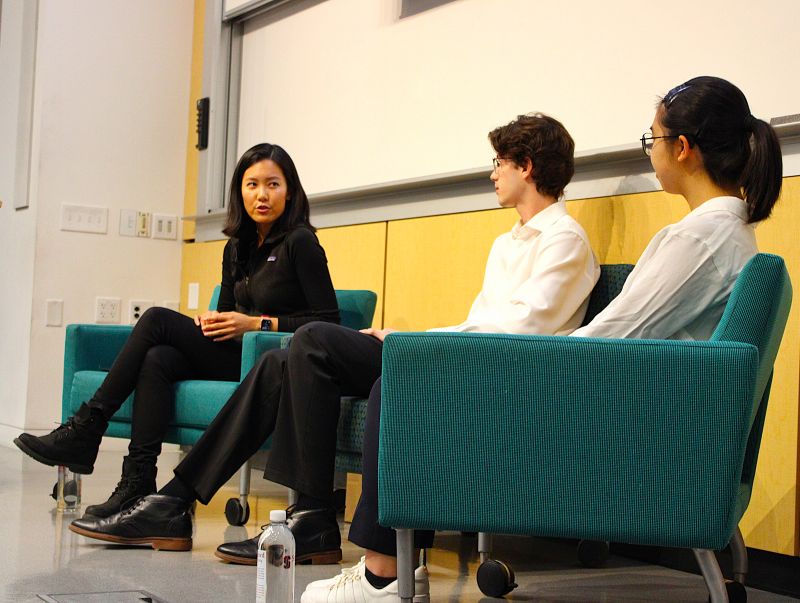
At a Stanford IEEE talk in March 2026, Wu demonstrated the idea through a command-line interface inside VS Code. Silimate examined a processor design with a known bug, traced the failure, created a patch, and summarized its reasoning. The same system can look for changes that improve power, performance, and area, the three-letter triangle known as PPA. Smaller area can reduce manufacturing cost. Lower power can reduce operating cost. Better performance is welcome until it steals too much from the other two.
“You have to know what good looks like.”Ann Wu on engineering judgment in the age of AI
That sentence is the guardrail around Wu's enthusiasm for copilots. Generated code does not relieve an engineer of judgment. It raises the premium on it. Someone must recognize brittle Python, an ugly architecture, or a patch that wins a local metric by borrowing trouble from elsewhere. Silimate still looks for strong programmers. In hardware, Wu argues, the lasting advantage comes from understanding architecture and the physical realities beneath it.
02 / The apprenticeshipFive years close to the metal
Wu's authority on this problem begins with the unglamorous accumulation of design decisions. She earned a bachelor's degree in electrical engineering, with a minor in computer science, from the University of Illinois Urbana-Champaign in 2017. Her public GitHub still contains a student SystemVerilog Tetris project, a tiny artifact from before her work disappeared into products used by millions. Internships at Intel and Apple led to a full-time role at Apple. She later pursued a master's degree at Stanford while continuing to work.
The path also contains a clue about how she likes to operate. At Apple, Wu volunteered in mentoring and outreach, organized mentoring circles, and served as a liaison between Stanford and Apple's silicon engineering group. At Illinois, she later credited classmates, research advisers, upperclassmen, and the engineering community with helping lead her toward that first chip-design job. Her advice to students is practical: contribute to an open-source project, ask the adviser for a research position, and if the answer is no, ask what it would take to become ready.
There is a lighter piece of evidence, too. Wu co-choreographed and directed the opening waltz and polka performances for Stanford's 2020 Viennese Ball. Choreography is an amusingly suitable side craft for someone whose professional life concerns dependent steps, strict timing, and many specialists moving without collision. A waltz is not a chip, mercifully. Yet both expose a weak sequence with ruthless speed.
03 / The customer testWhen users become the sales force
The most revealing Silimate story is not a model benchmark. It is a procurement scramble. In July 2025, Wu wrote about closing a software license with a public, billion-dollar chip company in less than three weeks. The evaluation had created its own pressure: engineers kept asking for access, but the trial license prevented more users from joining. Internal teams scheduled training. A buyer maintained a daily status check with a boss. Silimate stayed in close contact and worked across multiple groups in the company.
Wu's retrospective reduced the episode to three conditions: enthusiastic users, multiple threads within the same enterprise, and a well-defined solution whose value could be quantified. It is a tidy operating lesson. Enterprise sales often looks like persuasion from the vendor's side. Here, the useful force came from engineers who had already decided the tool belonged in their work. Procurement moved because delay had become visible.
By the end of 2025, Silimate said it served more than ten customers, including startups and Fortune 500 companies, and had grown annual recurring revenue more than twentyfold during the year. The company reported its first profitable year with six full-time team members. Its first product, Preqorsor, focused on PPA prediction and optimization. A second product, SMDB, tackled debugging and root-cause analysis. The names are less important than the pairing: improve the design, and explain why it failed.
The team remains in person in Mountain View and advertises values that sound almost severe in their economy: focus on users, work from first principles, build only what matters, iterate quickly, ship quality, and leave ego outside. These are also responses to the market. EDA is dominated by established systems with long histories. A small entrant cannot win by recreating every feature. It must find the expensive gray area, solve it, and connect cleanly to everything around it.
“Walk your own path, and when there's a will there's a way.”Wu's advice to Illinois engineering students
04 / The long betJudgment at machine speed
Wu's ambition has sharpened with the product. Silimate describes a future in which AI-native agents help move a design from specification to freeze-ready RTL in roughly three months instead of the prevailing 12 to 18. It is a target, not a victory lap. The gap includes technical trust, integration, security, and the unruly fact that each serious chip program carries its own constraints.
Still, the direction has a certain inevitability. Demand for specialized silicon keeps rising, software workloads keep evolving, and expert chip designers remain scarce. The question is not whether they should get better tools. It is which tools will preserve the context that makes their judgment valuable.
This is where Wu's career reads less like a sequence of prestigious stops and more like preparation. Apple supplied the craft. Meta supplied the scale of AI infrastructure. Celestial AI supplied the product lens. Stanford supplied a collaborator. Illinois supplied the first community that made the path imaginable. Even the sudden interview at DAC 2024, delivered with about two minutes' notice, fits the pattern: absorb the context, find the clean explanation, keep moving.
Silimate's wager is that chip design does not need less engineering. It needs engineering time pointed at the decisions that deserve it. Let the machine sift the logs, trace the candidate cause, and offer the patch. Let the human decide whether the patch understands the machine being built. Software speed is attractive. Hardware judgment is the part worth keeping.