When Anil Singh left Hanu on December 16, 2022, he chose an unusual place to remember: a windowless office in Princeton’s Carnegie Center. His farewell could have dwelt on the acquisition, the Microsoft partnership or the size of the team. Instead, the room from the beginning supplied the title. A founder with a completed sale behind him was proposing a return to the small, unglamorous business of beginning.
There is something pleasantly awkward about a windowless office as an entrepreneurial keepsake. It offers none of the usual scenery. No skyline to conquer, no horizon to contemplate. You have to bring your own view. For Singh, the room became a way to think about starting again after leaving a company that had occupied so much of his working life.
He did not pretend that this prospect was entirely comfortable. “I am excited and scared at the same time,” he wrote. The admission gives the departure its human scale. An acquisition can settle a company’s ownership without settling its founder’s next purpose. His goodbye ended with a toast to that first office and the possibility of another beginning.
The business course that changed the engineer
Singh’s account of his early life begins in a small Indian village, followed by a move to Lucknow during his teenage years. His parents made education a priority. Much later, describing why he had entered education himself, he traced the family story back another generation: his grandfather, a farmer, had invested in his father’s studies. His father became the first graduate from the village.
That family history gives his current work a personal logic. The opportunity he wants to offer students resembles an opportunity his family had already experienced. A decision about one person’s schooling can alter the choices available to the people who follow. In Singh’s telling, the consequences lasted well beyond a graduation ceremony.
He studied electronics engineering at IIT in Varanasi and began his career as a software engineer. At New York University, he studied information systems, combining computer science with business courses at the Stern School of Business. He expected the technical subjects to hold his attention. The business classes turned out to be the ones he loved.
It is a useful wrinkle in the familiar founder biography. The engineer did not arrive with a lifelong declaration that he would run a company. Education changed what he thought he might do. The unexpected appeal of those business courses gave him confidence to try entrepreneurship. Years later, his explanation for Saras would return to that experience: learning had expanded his own options.
A cloud company with a school inside
Hanu was founded in 2002. Over time, the company developed a concentrated business around Microsoft Azure, helping organizations move to the cloud and manage what they had moved. Singh’s work belonged to the practical side of a technology transition: customers needed people who could make unfamiliar infrastructure useful, dependable and manageable.
The word cloud can make this work sound curiously weightless. Someone still has to understand the applications, the existing systems, the costs and the people expected to use them. Hanu sold expertise for that very earthly work. Its specialization also made the skills of its engineers central to the business. A platform keeps changing; yesterday’s training cannot be the end of the conversation.
Singh identified access to talent as a central obstacle to cloud adoption. Hanu’s answer included its Azure Academy, a mechanism for recruiting people and developing their technical capabilities. Training was part of the operating model. The company needed a way to produce the expertise it promised customers.
That connection became particularly clear when Insight announced its completed acquisition on June 3, 2022. Alongside Hanu’s cloud capabilities, Insight singled out the company’s ability to attract and develop technical skills in India. The academy helped explain what the buyer valued. A company that teaches people to do the work carries something useful beyond its current list of projects.
The Rockstars had rules
Singh called Hanu’s employees “Rockstars,” which adds a certain backstage flourish to the business of enterprise computing. The name also carried an acronym. R stood for respect and appreciation; O for openness and transparency; C for client obsession; K for kaizen, or continuous learning and improvement. The last letter made learning part of the daily vocabulary.
In his writing about company culture, Singh described recognition moving in several directions: from managers to employees, from employees to managers, and between peers. Appreciation was supposed to happen frequently, rather than wait for an appointed day on the corporate calendar. A thank-you loses some of its charm when it requires a quarterly processing window.
He also described a measure called Quality Time with Customers. Leaders were expected to spend time listening to clients and understanding what they hoped to accomplish over the coming months. His stated philosophy joined the employee experience to the customer experience. The people delivering the service needed respect; the people buying it needed attention.
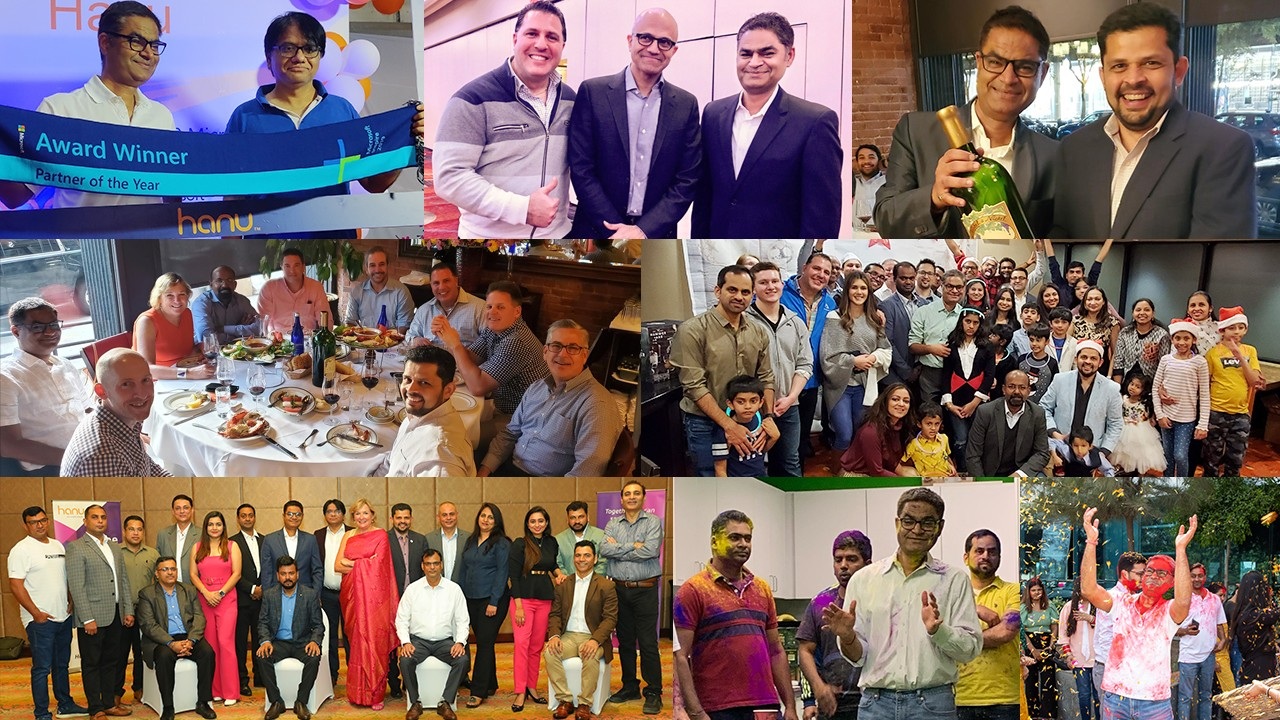
The farewell collage makes an agreeable companion to those operating principles. There are group photographs, celebrations, shared meals and an award banner. Together they give the company a social texture. Enterprise services may be sold in contracts and presentations, but the work leaves people with memories of the colleagues beside them.
Old colleagues, a different classroom
After the exit, Singh built Saras AI Institute, where he is founder and president. Its focus is online education in artificial intelligence. The change in subject is visible enough: Azure services on one side, AI degrees on the other. The continuing interest in how people acquire technical capability is just as visible.
At Saras, one familiar colleague reappears. Amit Kataria, a Hanu leader thanked in Singh’s farewell, is a co-founder and chief operating officer. The founding team also includes Anshuman Singh as chief academic officer, Aman Gupta as chief technology officer and Shailesh Kumar as chief success officer. The venture brings together academic, technology, people and student-support responsibilities.
By July 2024, the institute’s India launch included a student-led AI club initiative across more than 25 engineering institutes. The clubs organized expert sessions, workshops and hackathons. In August, Singh announced that Saras was live and serving students globally, describing associate and bachelor’s degrees alongside personal coaching, leadership development and projects.
The combination reveals the sort of institution he wants to build. Technical material is one component. Guidance, community and the responsible use of technology are also in the proposition. His public explanations repeatedly give education a job beyond delivering information: it should help a learner gain the confidence to act on what they know.
An editorial map of the career, not a scale of financial performance.
An education that leaves something to show
The practical emphasis became explicit in his July 2025 Business Elevated conversation with Pete Codella. Saras used projects in place of traditional exams. Singh also discussed its beginner-oriented Powers of AI course and the institute’s agreement with IIT to advance AI education in India. The invitation extended beyond people already established in the field.
His old campus became part of the new venture’s story. IIT (BHU)’s August 2024 alumni newsletter recorded an AI session led by Singh, identifying him as an electronics alumnus of the 1995 class. Its May 2025 newsletter described an agreement with Saras to promote applied AI learning across disciplines. A former student had returned with an educational organization of his own.
For a student, a project offers a particular kind of evidence. It can be opened, examined, questioned and improved. An exam measures a performance at a chosen moment; a working artifact invites a continuing conversation about decisions and results. Saras has made that preference part of its educational design. Its eventual value will depend on what learners can actually build and explain.
In November 2025, Saras announced a twelve-month online Master of Science in AI Engineering for experienced developers. The launch offered a shorter, stackable development certificate as well. The master’s program was designed around a portfolio and priced at $5,988 in the United States at announcement, with the first cohort scheduled for January 2026.
That offering gives Singh’s ambition a concrete shape: working software professionals, a defined period of study, a stated price and work they can show afterwards. By February 18, 2026, he was discussing Saras in a Nasdaq interview with Kristina Ayanian. In a related public post, he reported 101 learners in the first combined master’s and AI development certificate cohort.
Bring your own horizon
“Be curious and be grateful.”
Anil Singh
Singh has a compact piece of advice for himself and others: “Be curious and be grateful.” In his account of becoming a leader, curiosity required learning to ask questions rather than enter every meeting carrying the answer. That is a fitting discipline for someone now asking students to learn a fast-changing field.
The story has an appealing circularity without requiring a tidy ending. His family invested in education. His own studies helped turn an engineer toward business. Hanu developed a system for teaching technical skills. Saras now places education at the center of the organization itself. Each step changes the setting while keeping the learner in view.
The windowless office remains the useful image. It belongs to a moment when a successful founder allowed himself to sound uncertain, grateful and ready to work again. The next venture gives that uncertainty a direction. After years spent helping companies acquire technical capability, Anil Singh is asking what happens when more people get the chance to acquire it for themselves.
Follow the next chapter
Read, watch and listen to Singh in his own words.