Before Andy Priestley dealt in registrations, alerts and athlete data, he dealt in buckets of cement. Summers in his father's Iowa construction company meant carrying those buckets down steep Lake Panorama lots and insulating attics in the heat. The work was useful, honest and, to a teenager, an excellent advertisement for finding a different summer job. At 16 he found one at Lake Panorama National Golf Course. Yet the construction business left him with more than an aversion to hot attics.
In the early 1990s, his father bought a computer to manage the company's books. Priestley helped set it up, handled accounting in Quicken and QuickBooks through high school and college, and built a computerized invoicing system. He later said those tasks gave him direct experience with cash flow and forecasting that he still used in business. The young man had seen manual labor from both ends: the heavy things people carried and the quiet clerical things a machine could carry for them.
01 / The useful chore
The envelope was the incumbent
When Priestley co-founded My Online Camp in 2006, athletic camps had their own version of the bucket brigade. Forms arrived by mail. Checks needed depositing. Handwriting became a roster. Staff fielded questions, tracked balances and told families when something changed. None of it belonged on a highlight reel. All of it had to work before anyone took the field.
My Online Camp put the event on a website, accepted registrations and payments, and gave coaches and camp managers reporting tools. The company also supplied marketing and administrative help. This was software with its sleeves rolled up. A coach did not need a lecture about digitization; a coach needed the roster to be right on Saturday morning.
Priestley has said that enthusiasm for sports and a love of technology drew him to the opportunity. The combination mattered. Generic registration software could collect a name and a card number. Sports camps had grades, positions, schedules, staff requirements and parents wondering exactly where to be. Vertical software earns its keep in those nouns.
It also depends on knowing where the software company's job ends. Ryzer supplies the website, transaction layer and management tools, while independent directors, schools and organizations own and operate the events. That division sounds like fine print until a schedule shifts or a family asks for a refund. Then it becomes the operating model. Priestley's company built around the organizer rather than pretending to replace one.
An integration announced with ACS Athletics in 2015 makes the founder's logic clearer. Camper information could move from My Online Camp into a college program's recruiting and compliance system, reducing repeated entry and helping coaches work from the same record. The registration was useful on its own. It became more useful when it stopped behaving like an island. Even early in the company's history, the interesting asset was not simply the form. It was the form's ability to travel.
By 2015, the company employed 13 people and said it facilitated hundreds of thousands of registrations a year across roughly 12,000 events and 2,400 organizations. It had also crossed one million registrations in total. The clients ranged from local Iowa high schools to athletic programs at Alabama, Auburn, Baylor, Creighton, Florida State and Iowa State. A form had become a foothold.
02 / The second question
Registration solved what happened after discovery
Customers pointed toward the next product. Coaches told the company they would hold more events if more people knew about them. Parents asked where they could find a camp suited to a child's sport, age and location. One side had supply. The other had intent. Both were already passing through My Online Camp.
“We are essentially playing matchmakers.”Andy Priestley, explaining Ryzer in 2015
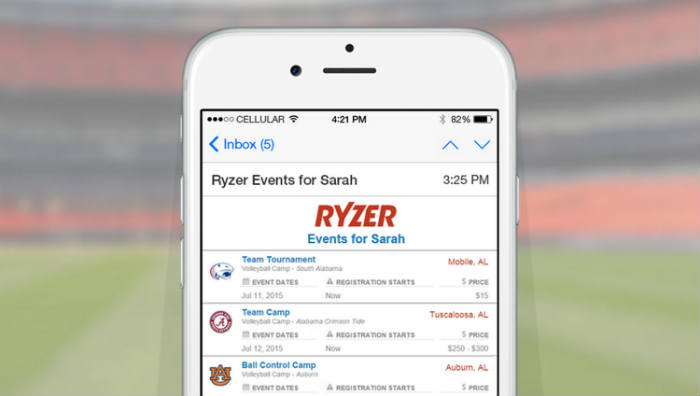
Ryzer launched in March 2015 as the introduction. Families could choose an activity, gender, age group, location and a search radius of up to 200 miles. Matching camps, clinics, tournaments and leagues arrived by email, text message or push notification, either weekly or as soon as they appeared. By June 1, the company reported 76,000 users, more than 86,000 alerts and 6,000 events across 48 states.
The elegant part was what Ryzer did not have to invent. Event organizers were already customers. Families were already registering. The alert system made the existing relationship easier to find. In marketplace language, My Online Camp had assembled supply through workflow software. It had observed demand through transactions. Ryzer connected the two without asking either side to learn an entirely new habit.
A practical idea, formally recorded.
U.S. Patent No. 9,852,194 covers a system that compares a user's criteria with restrictions and details attached to participatory events. It names Andy William Priestley and Matthew Morris Mann as inventors and was granted in December 2017.
The patent describes the unromantic machinery beneath the friendly word “matchmaker”: fields, criteria, dates, locations, costs and notifications. Useful products often look like magic from across the room and like a careful argument between databases up close.
03 / The data learns to travel
A roster becomes a scorecard
Once an event lives in a system, the next interesting moment is no longer the checkout. It is what happens on the field. Ryzer expanded into check-in, performance testing, digital scorecards, leaderboards and athlete profiles. A sprint time or jump measurement did not have to die on a clipboard at the edge of one camp. It could become a verified result, returned to the athlete and presented to coaches.
A 2021 partnership with Tracking Football showed the direction. Ryzer's Go app could record combine testing results; Tracking Football supplied scoring algorithms intended to interpret overall athleticism. Priestley said the combination would help athletes understand their results and showcase them through leaderboards and profiles to college coaches around the country. At the time, Ryzer said its event tools served more than 5,000 operators, while the football partnership covered a substantial network of college and independent events.
This progression explains why a registration company could matter to recruiting. A camper has already done something more revealing than clicking “interested.” The athlete selected a college's event, paid, traveled and performed. The camp captures intent and evidence in the same place. Ryzer spent years making that evidence more portable.
The product surface grew without losing the vocabulary of the original customer. Event staff can use QR codes for check-in. Evaluators can record results in the same mobile system. Scorecards distribute measurements, while leaderboards place verified performance beside a peer group. Athlete showcases give coaches information before the event begins. On Ryzer's current public site, the catalog spans 43 sports and activities. The scale is broad; the language remains stubbornly specific to camps.
Specificity is also a form of trust. An organizer is not purchasing abstract “engagement.” The organizer wants fewer lines at check-in, accurate registrations, timely communication and a useful record when the day is over. A family wants to know that an event matches the athlete in front of them. A coach wants evidence that means the same thing after it leaves the field. Ryzer's expansion kept translating each request into the next piece of infrastructure.
Priestley also discussed the mental side of sport. On a 2022 episode of the FUTRSPRT podcast, the conversation covered Ryzer's measurement of athletic mindset and the changes reshaping college athletics, including name, image and likeness rules and the transfer portal. The product ambition had moved well beyond moving paper forms online. Ryzer was trying to give athletes, families and coaches more structured information about fit and performance.
“Adding Tracking Football's scoring algorithms to our football camp testing results will help athletes better understand their overall athleticism.”Andy Priestley, 2021
04 / The long handoff
Nineteen years near the same customer
In November 2025, college-recruiting technology company Scorability acquired Ryzer. The price was not disclosed. Sports Business Journal reported that the deal combined cash and stock, that Ryzer's brand would remain and that its employees would stay. At the time, Ryzer managed 25,000 sports camps a year for more than 4,000 college programs, reaching roughly 1.2 million high school athletes.
The strategic fit was plain. Scorability helps college coaches evaluate recruits using validated information. Ryzer sits where many potential recruits raise their hands by attending camps. One company worked on the decision; the other had spent nineteen years organizing an important source of the signal.
By then, Ryzer's day-to-day leadership was in other hands. The acquisition reporting identified Michael Kahn and Tim Heath as the company's co-CEOs before the transaction, with Kahn continuing as president of Ryzer and Heath becoming chief financial officer of the combined business. Founders eventually become part of the history they set in motion. Priestley's part is unusually legible because the product kept following the same participant.
First came the person filling out a form. Then the person searching for the right camp. Then the athlete producing a measurement. Finally, the recruit hoping that a coach would see it. Each expansion preserved the context of the step before it.
The transferable lesson is modest enough to miss: begin with the chore. Stay close after it is solved. The second question may be more valuable than the first, but only if the first answer earned you the right to hear it. Priestley's early education in work and software happened inside a construction office. At Ryzer, he applied it to a different kind of building - one form, one alert and one verified result at a time.