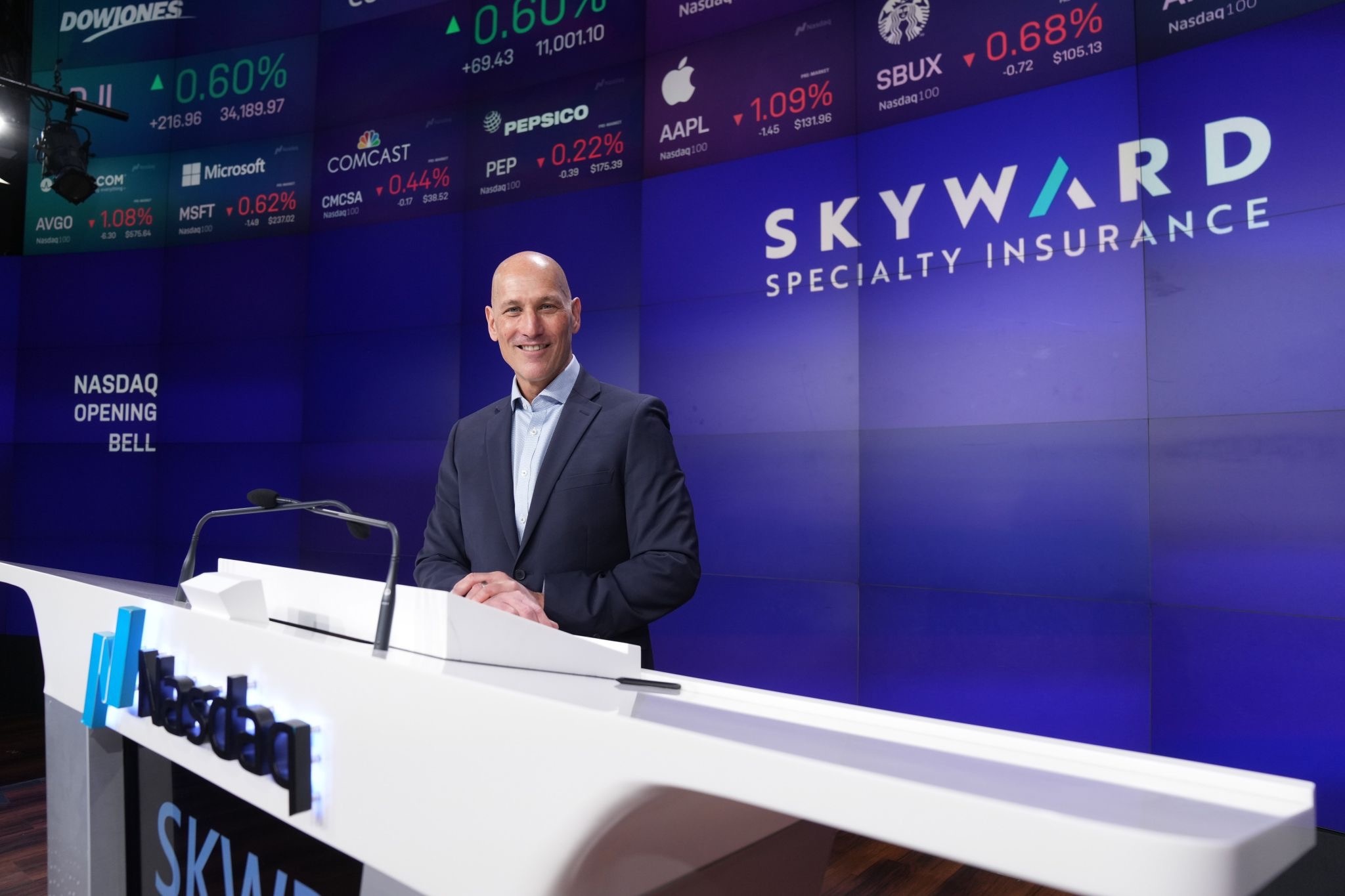
Friday the 13th is an eccentric date for an insurance company to choose for its stock market debut. Andrew Robinson went ahead anyway. On January 13, 2023, he rang Nasdaq's opening bell for Skyward Specialty, a Houston insurer that had spent the previous year waiting for a workable moment to go public. A business devoted to judging risk had finally decided to take one.
The shares were priced at $15. They finished their first trading day at $19.10. The more revealing detail concerned the people watching: every Skyward employee was becoming a shareholder. Robinson had a concern amid the celebration. The company had developed a culture he valued, and public ownership would bring new pressures. He wanted the people who had built the business to keep feeling that it belonged to them.
That combination runs through his public life as an executive: a close interest in the mathematics of an insurance business, coupled with a persistent concern about the people making its decisions. His preferred phrase for the strategy is short enough to fit on a coffee mug: “Rule Our Niche.” The work behind it has taken considerably longer.
A career spent on several sides of the same problem
Robinson's route to Houston passed through consulting, an established insurer, claims management and insurance technology. He holds a Bachelor of Science from Clarkson University. Before joining Hanover, he led the global insurance practice at Diamond, the consultancy later acquired by PwC. Consulting supplied a view across companies; operating them would mean living with the consequences of the advice.
At Hanover, where he spent more than a decade, his responsibilities grew to include specialty insurance, corporate development and enterprise risk. He oversaw U.S. specialty businesses and worked on acquisitions, disposals and integration. In 2017, he briefly served as global chief operating officer at Crawford & Company. The remit covered four businesses, more than 8,000 employees and $1.1 billion in revenue.
Then came Oak HC/FT, where he was an executive in residence and senior adviser. His work included leadership positions at Groundspeed Analytics and Clara Analytics. The sequence helps explain his interests today. He had encountered the insurer buying technology, the investor backing it and the technology company attempting to make it useful. Each has a different definition of a successful meeting.
First, decide what to stop
He became chief executive in May 2020, when the company was still Houston International Insurance Group. The Skyward Specialty name arrived later that year. A new sign was the easy part. The company needed a more convincing answer to a basic question: which business deserved its capital?
The initial work involved closing underwriting divisions and leaving specific classes of business while investing in others. A capital raise and a transaction addressing legacy liabilities helped establish the footing for the operating changes. These were consequential decisions in a business where yesterday's promises can remain on the balance sheet for years. Growth would have to follow a clearer view of what the company could price and manage well.
Robinson describes a selection process with several hurdles. A market must offer the prospect of strong underwriting returns. The company must be able to afford entry. And there must be something durable about its position: knowledge, service or capabilities that give a broker a reason to stay when a rival cuts the price. The slogan is cheerful. The admissions policy is fairly stern.
The useful education of a postponed IPO
The listing did not happen on the first attempt. During the difficult equity markets of 2022, Skyward repeatedly paused its plans. Robinson later described how the delay created time to build relationships with investors. There was an unexpected education in having to explain the company again, listen carefully and return for another conversation.
By the time Skyward reached Nasdaq, those relationships had become part of its preparation. Capital markets are fond of dramatic windows opening; the less cinematic work is knowing who will be standing there when they do. Robinson treated the waiting period as useful work rather than simply lost time.
He was also frank about the trade that followed. Public ownership puts results on display every quarter and makes communicating a long view harder. The IPO supplied flexibility to finance the business, alongside a new timetable of scrutiny. Ringing a bell takes seconds. Learning to operate under that timetable is an ongoing obligation.
A niche still needs other people
Robinson's argument for specialization is rooted in the broker's working day. A broker bringing a complicated account needs an underwriter who understands the details, responds promptly and can construct coverage that fits. A large balance sheet alone does not answer those needs. The relationship gets its value from repeated demonstrations of competence.
In a December 2023 interview, he put the emphasis on distinctive products, knowledgeable people and responsiveness. It is a useful corrective to an industry conversation easily consumed by mergers and market share. An insurer can become larger without becoming more relevant to a particular customer. Robinson's stated test concerns relevance.
That also makes the strategy demanding to replicate. Hiring a team, understanding a trade and earning a broker's trust take time. A niche may look small from a distance while containing a complicated set of commercial relationships. The apparent narrowness is precisely where the work lives. Knowing more about less can be a substantial job.
His children offered their own industry verdict
Robinson has a personal reason to think about insurance's appeal to younger people. In 2023, he explained that both his adult children had started on the carrier side of the industry and subsequently left. One returned to study data science and went on to lead a data team at a media company. The other was working in strategy consulting.
He did not present the departures as a family crisis. He used them to discuss what younger professionals want from work: openness to ideas, room to act and fewer inherited habits. For an insurance executive trying to recruit, there is a certain efficiency in receiving market research at home.
His response reaches beyond adding fashionable software. Experienced insurance workers hold technical knowledge that needs to be captured in forms a new generation can use. Technology can help younger colleagues spend more of their time analysing and deciding, with less spent assembling information. The attraction lies partly in the quality of the working day itself.
The technology has to reach the desk
By 2025, Robinson was describing an organisation where employees were asked to experiment with AI and identify an application within their own jobs. Business leaders also presented implemented innovations twice a year. His own LinkedIn account captures his enthusiasm for these showcases: he watches colleagues demonstrate what they have built and praises the people behind it.
Skyward's tools include SkyBI, for examining business performance, and SkyVUE, which brings information and risk signals into an underwriter's workflow. Their purpose fits his broader approach: make specialised judgement better informed and easier to exercise. A demonstration earns its place when someone can use the result during an actual working day.
In February 2026, he expressed the point succinctly: “When people see ideas move from concept to deployment quickly, belief follows.” It is an operational view of persuasion. Colleagues gain confidence by seeing an idea work. The next experiment then starts with a little less resistance and a little more practical knowledge.
“talent wins.”
Andrew Robinson, September 2025
A bigger company, with the names left on the door
The Apollo acquisition closed on January 1, 2026. Skyward Group became the holding company brand, with Skyward Specialty and Apollo retaining their identities in the market. Robinson became chairman and chief executive of the group. The structure joined a U.S. specialty insurer with a business operating at Lloyd's of London.
Keeping the names was a deliberate choice. Robinson emphasised the credibility and cultures already attached to them. The transaction expanded the organisation without requiring every relationship to begin again under a fresh label. It also raised a practical question for his strategy: how much can two specialist businesses share while preserving the expertise that made each attractive?
One answer appeared in September 2026, when Skyward announced the expansion of Apollo's ibott autonomous vehicle capabilities into the U.S. primary insurance market. The relevant risks extend across fleet operators, vehicle manufacturers and developers of autonomous driving systems. It is a concrete example of the group connecting specialist knowledge with additional market access. Robinson's original preference for complicated corners now reaches businesses changing what happens behind the wheel.
The group's second-quarter 2026 results supplied one check on progress: an 89.5% combined ratio, including catastrophe losses, and diluted operating earnings of $1.30 per share. These are company measures, rather than a verdict on one person's leadership. They matter because Robinson's stated ambition involves profitable underwriting through changing conditions. A strategy eventually has to appear in the accounts.
There is also room for a rugby shirt
In April 2026, Skyward Group became USA Rugby's exclusive insurance partner and front-of-jersey sponsor across its national teams. Robinson connected the sponsorship to talent and execution. By July, the language had become less corporate. On LinkedIn, he celebrated watching the Eagles during the national anthem with Skyward colleagues, then seeing the team beat Portugal 30-29.
It is a small glimpse of the executive away from an earnings table: pleased to see the company's name on a jersey, pleased to share the occasion, and evidently alert to a tight finish. Insurance has its own long contests, although the scoring is considerably harder to explain to a newcomer.
His next task is already visible in the business he now leads. Greater international scope brings more opportunities to connect people and capabilities, along with more chances to lose the specificity he values. Robinson has built his argument around knowing a chosen market closely. The organisation is larger. The questions at the desk remain exacting: do we understand this risk, can we serve this customer, and should we commit our capital?