Andrew Bredenkamp has an excellent test for a company's personality: imagine being trapped beside it at a party. It talks about itself. It keeps talking about itself. Eventually, you find another room. For someone who built a business around teaching organizations how to write, this is a useful admission. Even flawless sentences can make dreadful company.
His career has been spent with the machinery behind those sentences: translation, linguistics, software, the rules that help a sprawling organization sound coherent. Acrolinx, the company he co-founded in Berlin in 2002, brought that machinery into corporate writing. His work with Translators without Borders and CLEAR Global asks a related question with different stakes: who gets to understand the information being produced?
There is a pleasing complication in this story. Bredenkamp likes technology. He says so without embarrassment. Yet the interesting part of his work begins when a machine encounters a person whose language, expectations or circumstances it has failed to understand. A fluent system can still be a poor listener.
A linguist before the label became fashionable
Long before the current enthusiasm for conversational AI, Bredenkamp studied the relationship between language and computation. His education included translation at the University of Westminster, linguistics at UCL and doctoral work at the University of Essex. His public professional profile dates his Essex studies to 1992-1996. This was a route through languages into artificial intelligence, with translation supplying an early reason to care about precision.
A 1996 paper he co-authored with Thierry Declerck, Frederik Fouvry and Bradley Music dealt with identifying word constructs in text. Its examples included dates, numbers and proper names. One problem involved recognizing numbers written out in German. Anyone who has encountered a German number at full conversational speed may feel that the computer deserved a small round of applause.
The work was concrete: take text in different formats, recognize what its pieces are doing, feed that information into grammatical analysis. It is an early glimpse of the practical concerns that would follow him into business. Before software can help a writer, it needs some account of what the writer has put on the page.
At Germany's DFKI, Bredenkamp headed technology transfer for the Language Technology Lab before starting Acrolinx. The job itself sat on a boundary: research on one side, applications beyond the laboratory on the other. Moving between those worlds became a recurring feature of his career.
The company that checked the company's words
He founded Acrolinx with Sabine Lehmann and Hans Uszkoreit in February 2002. The first product, Acrocheck, arrived in 2004. Its purpose belonged to an unglamorous but stubborn category of business problems. Large organizations publish instructions, product descriptions, support material and marketing copy through many people. Their customers experience the resulting vocabulary as if it came from one company.
The customer list expanded across industries. Adobe and Cisco joined in 2008; IBM, Oracle and Caterpillar followed in 2009. Microsoft became a customer in 2015. These were organizations with enough writing to make editorial consistency an operational concern. A troublesome term could travel a considerable distance before anyone caught it.
Berlin, Germany
Translators without Borders
Stays involved on the board
For more inclusive language AI
In July 2017, GENUI backed a majority acquisition and growth investment with a total transaction volume of approximately $60 million. Management increased its shareholding as part of the deal. The figure describes the transaction, rather than a personal payout to Bredenkamp. The distinction matters in a business where a financing headline can acquire an entirely new meaning by lunchtime.
His argument at the time was that companies had made progress distributing content while struggling to create good material at sufficient scale. Acrolinx applied linguistic analysis inside writing tools, giving guidance on clarity, terminology and tone. The ambition was to make standards usable during the act of writing, when changing a sentence is still relatively cheap.
A gadget enthusiast with a party rule
For all that technical preparation, Bredenkamp's explanations often return to ordinary social behavior. In his 2015 conversation about content marketing, the party bore was his example of a brand that cannot stop broadcasting. An engaging company, he argued, needed to listen and offer something another person might actually enjoy hearing.
He also questioned organizations that called their writing a strategy without making deliberate choices about their audience. A company's personality needed to be written down clearly enough for employees, agencies and freelancers to use. Otherwise, a supposedly shared voice depended on everybody guessing the same thing.
“Very simple: I learn by listening.”
Andrew Bredenkamp
Then there is his cheerful confession: “I love gadgets.” He compared his company's technology to a Swiss Army knife for content. The attraction lay in finding further useful things it could do. That combination of curiosity and attention to users gives his technical work a recognizable human center.
His own writing on B2B tone made another unfashionably straightforward observation: a business buyer remains a person. Words accumulate into an impression of a company. Choosing terminology is therefore only part of the job; writers also need to consider the character conveyed by the whole. A purchasing department does not confiscate one's capacity to be bored.
Two audiences, one crowded calendar
By 2016, Bredenkamp was carrying the commercial and nonprofit versions of this argument into different rooms. Adobe invited him to give a keynote at its online DITA World conference about content and customer experience. The subject was joining up communication across the compartments of an organization. Customers, after all, are rarely interested in which internal team owns a sentence.
That October, the Translating Europe Forum listed him for a keynote on the work of Translators without Borders. The program described a community of more than 3,500 professional translators working across 150 languages. Here the task was to connect humanitarian organizations with people who could make information understandable locally. The vocabulary changed between conferences; the need to think about the recipient remained.
His nonprofit involvement had begun well before he left the CEO's office. He was a board member of Translators without Borders from 2010 and took over its chair from Lori Thicke in October 2015. Business and language access were occupying the same years of his life. The latter was already a commitment, rather than a retirement project waiting politely in the corridor.
CLEAR Global now identifies him as board chair. Translators without Borders continues within the wider organization. CLEAR's mission combines getting information to people with making it possible for them to be heard. That second direction is significant: communication has to leave room for an answer.
The optimist who checked the assumptions
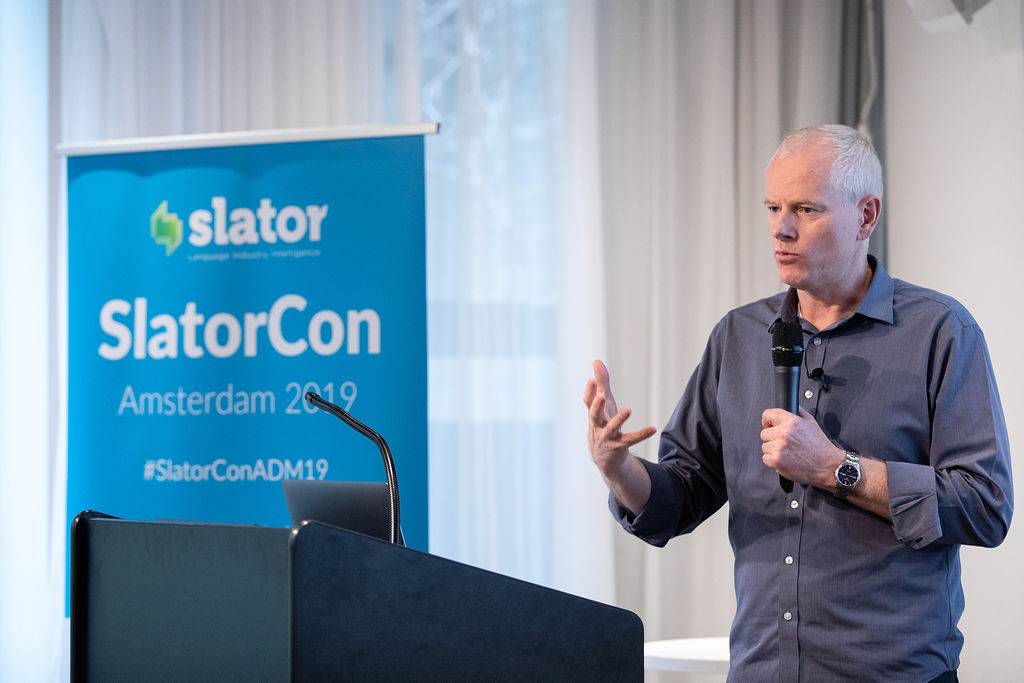
At SlatorCon Amsterdam in 2019, he warned language service businesses to examine the economics of data annotation carefully. Demand for labeled data looked attractive. But the same AI researchers who needed that work were trying to reduce how much of it their systems required. A growing market could still contain an awkward business model.
He discussed the limits of generated text, including the difference between plausible individual sentences and a coherent whole. He also urged language businesses to look beyond the familiar set of well-served languages. Local differences and dialects could matter to companies trying to reach people more effectively.
The skepticism did not amount to a retreat from AI. He described himself as an optimist. His position left space for technical progress while asking what, exactly, a system knew and where its value came from. Years in language technology had given him reasons to question an attractive demonstration without losing interest in the machine.
Leaving the office, keeping the question
At the start of 2020, Bredenkamp announced that Volker Smid would take over as Acrolinx's CEO. He would remain involved in a non-operational capacity as a board member and strategist. His announcement welcomed the new leader and pointed to expanding offices and markets. It read as a handover within an ongoing company.
The business subsequently became Markup AI. Its current leadership belongs to a later chapter: Matt Blumberg joined as CEO in January 2025. Bredenkamp's place in that history is as Acrolinx's co-founder and former chief executive. The original concern with the quality of enterprise writing continues in a company now confronting vastly greater supplies of machine-generated text.
Bredenkamp, meanwhile, has directed more of his work toward impact investing and advising ventures and nonprofits. Precision Development lists him as an advisory group member. Lanfrica lists him among its advisers, identifying him as CLEAR Global's chair and CLEAR Tech's CEO. His professional orbit now includes organizations working on the language gaps that commercial technology has left open.
Who gets a turn to speak?
On March 13, 2026, Bredenkamp joined Daniel Björkegren and Han Sheng Chia in publishing a roadmap for AI across the world's languages. Their argument begins with a gap between a model technically supporting a language and people being able to use it reliably in their own communities. Local context, dialect and patterns of switching between languages complicate any tidy coverage list.
The proposed response includes local participation in collecting and validating data, wider sharing of nonsensitive language resources, and incentives that reward useful contributions. The authors frame the work as a coordination problem as well as a technical one. They present an agenda requiring further design, rather than a finished mechanism.
That is a fitting place to find Bredenkamp after the corporate writing tools and conference stages: still interested in what language technology can do, still asking who judges whether it works. A company can issue a million sentences. A model can produce a million more. Somewhere at the other end is a person deciding whether to stay in the conversation.