The most revealing name in fashion may be the one missing from the garment. Ananta Group is not courting shoppers with billboards or celebrity drops. It works one layer down, where a retailer's sketch becomes a sample, a wash recipe, a production plan and eventually a container full of clothes. From Dhaka, the family-founded group designs, develops and manufactures private-label apparel for brands selling in the United States and Europe. Its own figures are large enough to sound like a consumer empire: more than 34,000 employees and annual turnover above $450 million. Yet the product that Ananta really sells is confidence behind the scenes.
That confidence has to survive a strange collection of tests. Can a factory reproduce an on-trend finish across a million pairs of jeans? Can it build a tailored shoulder and tape-seal a waterproof jacket? Can it make a technical sports bra, source certified yarn and document the chemistry in a wash? Can it hit price and delivery promises while auditors inspect safety, working conditions and environmental systems? Ananta's answer has been to assemble a portfolio of specialist factories instead of remaining only a denim producer.
The factory before the factory
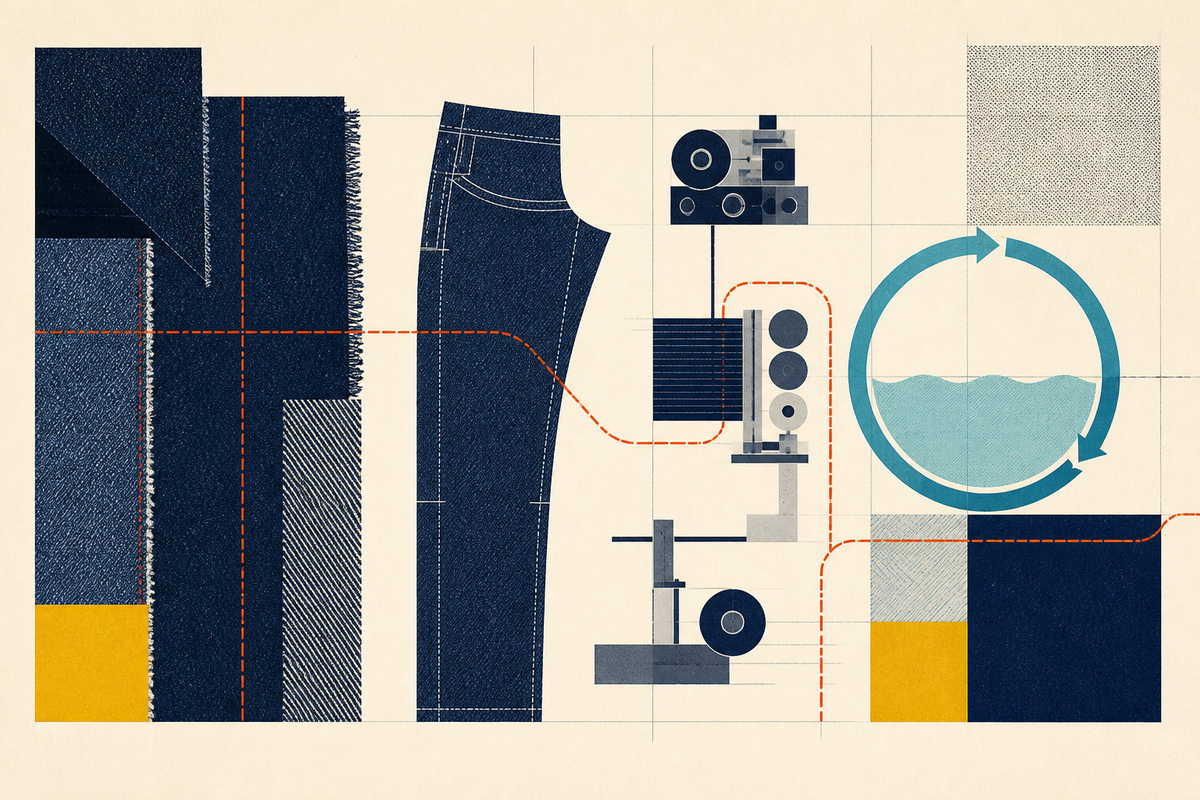
Ananta's process starts well before a cutting blade touches fabric. Its design teams build seasonal trend boards 12 to 15 months in advance, studying consumer buying patterns, runway signals and competitive products. They research fabrics in fashion centers across Europe, Asia and the United States, then translate ideas into customer-specific collections. Tech packs and 3D garment design let teams inspect construction and wash details virtually. That can reduce the time and material spent on physical samples, but its bigger purpose is commercial: give a buyer something concrete to react to before an order is locked.
This changes the pitch from “send us your specification” to “let us help develop the specification.” In a low-margin industry, that is a meaningful move. Sewing capacity can be compared by price. A supplier that recognizes a silhouette, proposes a workable fabric, predicts the cost and knows how to mass-produce the finish is harder to swap out. It also learns earlier what its factory floor may be asked to do next season.
One closet, six factories of thought
The company's range reads like a brisk walk through a department store: denim and casual bottoms, fully fashioned sweaters, tailored suits, technical outerwear, intimates and activewear. These are not merely different patterns on the same sewing line. A suit requires specialized pressing and tailoring. A sweater depends on gauge, yarn and knitting expertise. A waterproof shell can require quilting, down filling, ultrasonic welding and tape-seam sealing. Intimates bring molding, bonding and exacting fit. Activewear adds high-stretch fabrics, laser cutting and support structures.
Ananta acquired part of that knowledge through partnerships. Ananta Huaxiang, established in 2010 with Shanghai Huaxiang Group, brought fully fashioned knitwear capability. Universal Menswear followed in 2011 with Romania's Time Trading SRL, combining local scale with European tailoring experience. DNV Clothing added outerwear, while Z&Z Intimates extended the group into lingerie and performance clothing. The logic is practical: a large retailer can place more of its assortment with one group, while Ananta spreads demand across categories that move on different fashion cycles.
Customers named in company materials or financing disclosures include H&M, Gap and Bestseller, with product initiatives also tied to Levi's, Wrangler and Zara. The relationship is business-to-business: Ananta is paid to develop and manufacture merchandise that reaches stores under someone else's label. Scale matters because orders are large, equipment is expensive and a late shipment can erase the advantage of a low unit price. But category breadth matters because buyers increasingly want fewer handoffs, better traceability and suppliers able to discuss design as fluently as output.
“Our employees are our most significant and essential resources.”Ananta Group
The blue-jeans engineering problem
Denim makes Ananta's operating thesis easiest to see. The group says its three denim factories each have capacity for roughly one million jeans a month, with sampling, sewing, washing and embellishment on site. The difficult bit is often the finish - the fade, whisker, abrasion and hand-feel that make new cloth look lived in. Traditional methods can consume water and chemicals and expose workers to undesirable processes. Ananta uses Jeanologia equipment including laser, ozone and e-Flow systems. Lasers reproduce surface effects without manual scraping or potassium permanganate spray. Ozone can alter color with less water. E-Flow uses nanobubbles to deliver a controlled amount of chemistry to a garment.
No machine makes apparel impact-free. Cotton cultivation, synthetic fibers, heat, transport and the sheer volume of production remain material issues. What the equipment can do is turn environmental performance into a measurable production variable: liters, chemical inputs, energy, discharge and repeatability. Ananta says its Apparels operation recycles about 30 percent of process water through its zero-liquid-discharge plan. Its effluent-treatment plant has a stated capacity of 100 cubic meters an hour, and it meters water and energy across processes. Those details are less photogenic than a green hangtag, which is precisely why they matter.
The wash-floor dashboard
Figures are company-reported snapshots, not a consolidated lifecycle assessment. They describe selected facilities and programs.
The group also points to GOTS, Better Cotton, Organic Cotton Standard and Recycled Claim Standard certifications, plus a LEED Gold factory certified in 2017. These establish frameworks and eligible material claims; they do not answer every question about a garment's footprint. The more interesting competitive point is that compliance, environmental measurement and production engineering are merging. A buyer does not merely ask whether a supplier can make a look. It asks what chemistry made it, where the inputs came from and whether the same result can arrive next quarter with fewer resources.
A family business learns to specialize
Humayun Zahir founded Ananta in 1992, according to the company's timeline and an International Finance Corporation disclosure. Family-business profiles sometimes place the origin in 1991, when the early enterprise included garments, paper and toys. After Humayun's death, his sons Sharif and Asif Zahir took responsibility for the group. The brothers narrowed attention toward apparel, then diversified within it. It is an apparent contradiction that works: specialize in the operating system of garment manufacturing, then apply it to more product categories.
Sharif, now chairman, brought finance and economics training. Asif, now managing director, brought an unusually technical résumé for the sector: computer science at Stanford, product work at Google and an MBA from Harvard. The company still presents itself as a family enterprise, with Qamrun Nahar Zahir serving as director and chairman emeritus. Yet its board and ventures include outside investors and specialists. An IFC package invested in 2013 combined a $6.25 million loan with $2 million in equity, supporting relocation and expansion. At disclosure, a Bangladesh-focused fund managed by Brummer & Partners also held a minority stake.
The culture described by Ananta mixes family language with systems: employee training, audits, inspections, safety programs and channels for workers to raise concerns. In a workforce of this scale, intent has to become routine to be credible. The same is true of product quality. A tailored lapel or bonded seam cannot depend on one gifted operator; knowledge must be translated into equipment, line design, instruction and inspection.
The next moat is the missing mill
Ananta's constraint is also Bangladesh apparel's familiar constraint: much of the fabric and material chain can sit outside the final manufacturer. Imported textiles add lead time, currency exposure and coordination. The group has discussed a large integrated textile and apparel industrial park in the Mirsarai Economic Zone, intended to bring spinning, weaving, knitting, processing and garment production closer together. Its 2023 alliance with textile-technology company NTX sharpens that idea, with plans around lower-impact dyeing and printing, synthetic and man-made fibers, renewable energy, digitalization and closed-loop water management.
If built as described, the project would serve activewear, outerwear and intimates especially well. Those categories rely on technical fabrics that Bangladesh has historically imported more often than basic cotton materials. Local processing could shorten the interval between a buyer spotting demand and a finished order leaving the factory. It could also concentrate risk: capital, energy, water systems and technical execution all become Ananta's problem. Vertical integration offers control only when each vertical works.
Multi-category private label
Design, sampling, manufacturing and finishing across six apparel categories for global retailers.
More textile control
Bring advanced fabric processing closer to garment production to reduce handoffs and lead times.
Where Ananta fits
In the global apparel market, Ananta sits between a commodity contractor and a fully integrated textile conglomerate. Its competitors include Bangladesh groups such as Ha-Meem, DBL, Epyllion and Noman, as well as large suppliers in Vietnam, China, India and Turkey. The alternative for a buyer is not always another group. It may be a network of specialists: one denim mill, one tailor, one activewear factory and a separate design office. Ananta's proposition is that coordinated breadth can beat that patchwork.
Its differentiation is therefore cumulative, not magical. Trend intelligence is useful because factories can execute it. Category factories are useful because buyers can consolidate orders. water-saving machines are useful because impact reporting and repeatable finishes affect purchasing decisions. Partnerships are useful because they fill knowledge gaps faster than learning from scratch. None of those pieces guarantees a durable advantage alone. Together, they make the company more involved in the decisions that happen before a purchase order and harder to remove after one.
That is what people can do with Ananta: a brand can bring a mood board, a target customer and a price architecture, then use the group to research materials, develop a garment, visualize it, sample it and manufacture at scale. The shopper receives none of this as a service. The shopper receives the jeans. Ananta's business is to make the complicated middle disappear - while leaving enough evidence for the buyer to know exactly how it worked.