The first clue is the address. On Cloverleaf Drive in Baldwin Park, east of Los Angeles, sits a company with roughly a dozen employees and a name that says almost nothing. TRLA Group Inc. could be a law firm, a property vehicle or four surnames squeezed into an acronym. Public records occasionally put it in graphic design. The federal government puts it somewhere more tangible: men's and women's performance sports apparel.
That distinction matters because TRLA is a fine example of a business that is easy to misread from its front door. Tex-Ray, the Taiwan-based textile group that owns it, calls TRLA its Los Angeles customer-service office. The Federal Trade Commission's apparel registry goes further, describing activity under the A-Rex Textile name as wholesale, retail, internet and import. One label says conversation; the other says commerce. Put them together and the job comes into focus.
The product is partly a shirt. The rest is coordination.
A performance top begins as a deceptively fussy list of decisions. How quickly should it move sweat? How much ultraviolet protection is enough? Does the fabric need stretch, insulation, abrasion resistance or an antibacterial finish? Who owns the pattern? Which factory can cut it, sew it and deliver it on schedule? The buyer sees a sample. Behind the sample is an argument among chemistry, machinery, labor, freight and price.
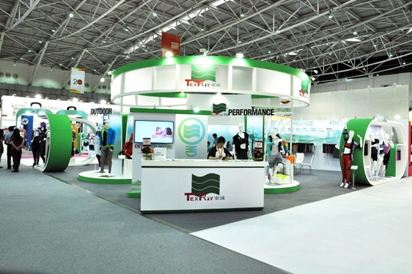
TRLA occupies the useful end of that argument. It gives American buyers a California point of contact while the parent network supplies the technical and manufacturing depth. Tex-Ray markets temperature-regulating T-Cool and T-Hot textiles, solution-dyed Eco-lor fabric, activewear collections and smart garments with embedded sensing. The group says it operates 18 mills and garment factories across three continents and nine countries. TRLA does not need to own every loom in Baldwin Park. Its value is making that distant capacity answer a nearby brief.
The clearest customer evidence comes from ASICS. Its 2020 primary-supplier list named TRLA Group beside tier-one apparel facilities in China, Mexico and Vietnam. An older collegiate licensing disclosure named Tex Ray/TRLA Group as a manufacturer of basic tees and fleece. These are not glamorous artifacts. They are better than glamour: they show the company where it actually lives, inside the paperwork of branded apparel production.
The clever bit is not putting the whole supply chain in California. It is putting the conversation there.The TRLA operating logic
A customer office with factory consequences
This is where TRLA differs from a freelance sourcing agent. An agent can introduce a buyer to a factory. TRLA sits inside a group that develops yarns, fabrics, finishes and finished garments. Vertical integration is an overused phrase, but here it describes a practical compression of handoffs. A cooling treatment that fails a wear test can return to textile development without the buyer rebuilding the supplier map from scratch.
It also explains the company's odd mixture of identities. Marketing service sounds light. Import trading sounds heavy. Both are true because the commercial promise must eventually survive customs, production tolerances and a shipping date. In 2003, a U.S. customs ruling addressed patchwork women's shirts submitted by A-Rex Textile at the same Baldwin Park address. The fabric recipe alone ran through cotton, polyester, acrylic, rayon and silk. Even the humble blouse arrived with a small materials seminar attached.
The brands that disappeared
TRLA did try to make its own names visible. Starting in 2007, it filed apparel marks for Runners Reward and DRI-TEK. The first applications were abandoned. Briz later achieved registration, then was cancelled in 2017; a second Briz application was abandoned in 2018. A later Runners Reward registration lasted until 2019.
Trademark records cannot tell us the mood in the meeting where these ideas were dropped. They can tell us what endured. The consumer-facing names vanished; the customer-service and trading company remained. That is a useful correction to the usual business story. Visibility is not always the prize. Sometimes the durable position is being the translator between a demanding brand and a complicated production system.
What $1.372 million bought
In December 2022, Tex-Ray's board approved the acquisition of 100 percent of TRLA from another group subsidiary, Flynn International, for $1.372 million. This was an internal reorganization, not a venture round or a market valuation. Still, the price gives the otherwise quiet office a rare numerical outline. Tex-Ray chose to hold the American customer-service operation directly.
The move did not change the basic proposition. TRLA remained the close-to-customer edge of a far-flung system. Current group reporting still lists it as wholly owned. California registry data lists the corporation as active. The dramatic event, if one insists on finding one, is continuity.
The copyable move
Put a small, empowered listening post near the customer and connect it to genuine operating depth. Give that office enough technical fluency to translate a buyer's problem before it travels through the factory network.
Where the model earns its keep
This structure works best when the product is technical, the order is large enough to reward coordination, and the buyer values one accountable route into multiple capabilities. It is especially sensible for performance apparel, where fabric behavior and garment construction cannot be separated cleanly.
It works less well for tiny runs, instant trend chasing or buyers who want to manage factories directly. A global network adds options, but also distance, lead time and organizational seams. The local office must know what the distant operation can really deliver. Without that trust and technical command, it becomes an extra layer rather than a useful bridge.
TRLA's modest scale is therefore not a contradiction. It is the design. The office does not have to resemble the industrial system behind it. It has to make that system understandable, responsive and purchasable. The long journey of the T-shirt begins with a short conversation in Baldwin Park.