The trouble with a good jacket is that it can outlive the reason you bought it. The trail mud washes off. The zipper eventually complains. Yet the synthetic fibers can remain, in one form or another, for a very long time. Billy McCall came to this puzzle from the water. A lifelong surfer raised in Northern California, he knew the pleasure of a dawn session and the practical magic of technical clothing. He also knew polymer science. The same materials that made the outdoors more comfortable could shed persistent microfibers into it.
That contradiction became less a guilty thought than an engineering brief. McCall had trained in nanoengineering at the University of California San Diego, earning both bachelor's and master's degrees. His research centered on novel polymer composites, including highly compliant piezoelectric foams. He later joined the 3D-printing company Carbon, where functional polymers had to do more than look clever in a paper. They had to print, perform and answer the needs of industrial partners.
In 2018, he founded Kintra Fibers. The ambition was precise and awkward: build a synthetic textile material from renewable inputs, give it the performance expected of polyester and nylon, and design a more responsible route for its end of life. Fashion enjoys novelty. Manufacturing prefers repeatability. McCall would need both.
“As a lifelong surfer, protecting the oceans is near and dear to me.”Billy McCall, on Kintra's early partnership with PANGAIA
The molecule before the mood board
McCall did not enter fashion through silhouette, trend or celebrity. He arrived at the polymer. Kintra's material is a fiber-grade polybutylene succinate, commonly shortened to PBS. Its inputs are bio-based rather than petroleum-based, and the material is designed to biodegrade under appropriate aerobic conditions. The point is not to make a delicate novelty yarn. It is to make a useful synthetic: soft, stretchy, durable and capable of moving through familiar textile processes.
This distinction matters because the word “sustainable” can become suspiciously roomy. A fiber may begin with a better feedstock but fail in processing. It may compost in one test while being too weak for a garment. It may perform beautifully while demanding a factory full of new machinery. McCall's approach treats those constraints as one problem. Chemistry, hand feel, abrasion, dyeing, extrusion and economics sit at the same table, whether or not they enjoy one another's company.
The practical stroke is compatibility. Kintra designed its resin for existing polyester polymerization and fiber-extrusion infrastructure. A mill should not need to become a shrine to brand-new equipment before trying it. For a founder, this is an exercise in restraint. The molecule may be new; the invitation to the supply chain should feel familiar.
The handoff economy
Two founders, two halves of the headache
In 2019, McCall met Alissa Baier-Lentz. She brought experience from fashion entrepreneurship and the frustration of trying to source materials without accepting a forced choice among performance, price and environmental responsibility. He brought polymer science and an appetite for the molecular end of the supply chain. They joined forces around a shared mission to reduce pollution in apparel.
The pairing explains much of Kintra's character. McCall could speak about monomers, nanocomposites and pressure-sensing foams. Baier-Lentz could speak about what brands, mills and products require. Between them sat the difficult middle: turning a promising resin into yarn, yarn into fabric, fabric into a garment, and a garment into something a buyer might order more than once.
Their progress arrived in deliberately uncinematic units. In 2020, Kintra produced its first spool on lab-scale equipment and closed an initial funding round. In 2021, it opened a dedicated lab and moved into pilot production, proving the resin and yarn in knitted and woven fabric. In 2022, the company launched a consortium with Fashion for Good and brand partners, then closed another funding round led by H&M. Each milestone widened the number of people allowed to say, “Yes, but will it work here?”
Money followed the same industrial logic. Kintra announced an $8 million Series A in April 2023, bringing together fashion, venture and public-sector investors. The round was meant to support manufacturing scale, not merely a larger collection of lab samples. Brand relationships mattered here because a new fiber needs demand while it is still being refined. Mill relationships mattered because demand without production knowledge is wishful arithmetic. The consortium structure put those interests in the room together. Inditex, BESTSELLER and Reformation could define applications. Paradise Textiles could expose the yarn to actual fabric development. Kintra could learn which parts of its technical promise survived contact with commercial requirements. This is how a materials company collects truth: not from a single dazzling demonstration, but from many partners discovering different ways for the same thing to go wrong.
The unglamorous middle
Deep technology has a recurring villain, and it rarely wears a cape. It is the space between “works in the lab” and “arrives on time.” A polymer must be produced consistently. A spinner must turn it into hundreds of fine filaments. A mill must knit or weave it. Dyeing and finishing must not spoil its properties. Brands must agree on specifications, tests and prices. Every handoff can quietly assassinate a beautiful idea.
Kintra has spent years courting these handoffs. A Fashion for Good pilot brought together BESTSELLER, Inditex and Reformation with manufacturing partner Paradise Textiles. The program set out to make selected fabrics, dye and finish them, assess environmental impact and study biodegradation in the finished material. In 2024, the company reported its first garment prototype, more than a ton of resin produced and its first yarn run on commercial equipment. By 2025, it had reached its 75-denier, 72-filament target and reported that research and development on the specification was complete.
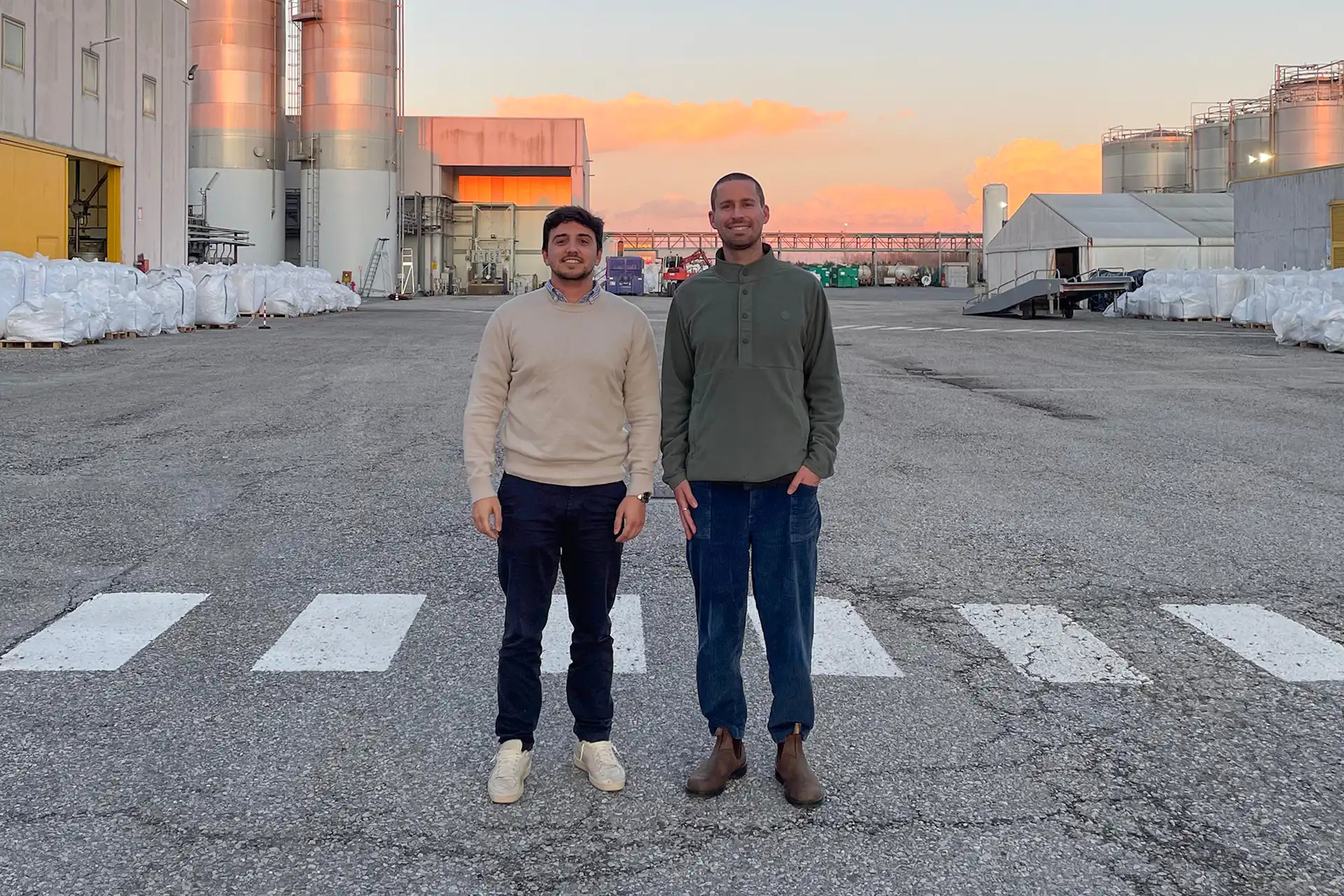
Then came the industrial question at full volume. In March 2026, Kintra and specialty polyester producer Selenis announced a partnership to scale Kintra's patented PBS. Through its Texnascis textile initiative, Selenis would bring polymerization infrastructure, process engineering and production control. Kintra would bring the material and its accumulated textile knowledge. The photograph from the Italian manufacturing site captures the mood nicely: two people in a broad industrial yard, dwarfed by tanks, piping and the capital cost of making chemistry repeat itself.
“Selecting the right industrial manufacturing partner to scale our technology was a top priority.”Billy McCall, March 2026
That sentence reveals McCall's founder style more clearly than any declaration about disruption. The task is selection, control and fit. It is an operator's view of scientific progress. A better material only matters at scale if someone can manufacture it at the required quality and volume. The romance is permitted, but it must wear safety glasses.
Patents, pressure and patience
The intellectual property beneath Kintra also carries McCall's formal name, William McCall. U.S. patents granted in 2024, 2025 and 2026 describe polyester polymer nanocomposites and methods for producing them. The documents are dense with dispersions, monomers, cellulose nanocrystals and polycondensation. Read less ceremonially, they record an effort to tune a biodegradable polyester for strength and processing.
There is a straight line from his university work to this problem, though it bends through several industries. At UC San Diego, McCall helped develop soft composite foams whose electrical response could be adjusted through structure and ingredients. At RoBo 3D and Carbon, he worked where polymer behavior met machines. At Kintra, the object is different but the instinct persists: a material is not merely what it contains. It is what it can survive, what it can become and what the surrounding system can do with it.
The ocean remains the human reason underneath the technical one. During Monaco Ocean Week in 2024, McCall discussed microfiber pollution and the need to combine lower emissions, recyclability and biodegradability. His advice to environmental entrepreneurs came from someone living through the long translation of values into production. Aspiration is useful. Specifications are how aspiration gets a purchase order.
A graceful exit, if the machinery agrees
Kintra's story is still being manufactured. Commercial volumes must be produced. Fabrics must meet brands' needs repeatedly, not just once. Environmental claims must remain tied to defined conditions and third-party assessment. Feedstocks, prices and end-of-life systems will all receive the scrutiny that follows any material hoping to replace an incumbent as cheap and adaptable as polyester.
McCall's useful wager is that responsibility can be designed into both the molecule and the route to market. Start with renewable carbon. Engineer the polymer for textile performance. Fit the installed equipment. Test the yarn in the unruly company of dyes, finishes, looms and washing machines. Plan for what happens after use. None of those steps earns a dramatic costume change. Together, they offer something more durable: a method.
A surfer noticed that the clothing protecting him from the elements could also add to the pollution within them. A nanoengineer decided the contradiction belonged on his workbench. Years later, the answer stands in Brooklyn labs, garment prototypes and an Italian production yard. The thread is no longer hypothetical. Now it has to run.