A refrigerator ought to be an uninteresting purchase. Plug it in, put things inside, forget it exists. Anand Subbaraj’s refrigerator had other plans. Getting it repaired meant repeated calls and six visits from technicians. Each arrival offered another opportunity for the information to catch up with the appliance. Too often, it failed to make the trip.
In his telling, the customer did not know when help would arrive, and the technician lacked the history and parts needed to finish. Subbaraj began examining the connections between the people involved. A repair company could employ capable people and still send them into an avoidable muddle. The missing ingredient was coordination.
That experience sits at the beginning of his explanation of Zuper, the field service software business he now leads as CEO and co-founder. It also supplies a useful way to understand his career. He had worked on data products at Microsoft. Here was data failing a much more domestic examination: could it help somebody fix a refrigerator?
A product career leaves the office
Subbaraj began his career at Tata Consultancy Services in 2001. Microsoft followed, with roughly thirteen years spent in product roles before he joined Zuper as CEO in July 2020. His work included leadership in Azure data services and big data integration. The technical subject changed when he moved into field service; the importance of getting information to the right place did not.
There is a particular appeal in that connection. Data integration can sound like a conversation best left to people with several monitors. In a service business, its consequences turn up at the door. An appointment, an equipment record and a dispatch instruction have to agree closely enough for a person to do useful work.
His early explanation of the opportunity was already broader than replacing a notebook. In 2021, he identified machine learning, remote assistance, customer self-service and connections between business applications as forces shaping service operations. Booking a visit was one part of the problem. Giving everyone a usable view of that visit was another.
The repair story also gives his work an unusual double perspective. He can describe the frustration of the person waiting at home, then consider what the person sent to help was missing. Both deserve a better arrangement. A customer wants certainty; a technician needs preparation. Connecting those needs is a more interesting product challenge than simply adding another screen for each of them to check. The appointment is shared, even when their views of it are different.
This is a demanding audience for software. A dispatcher needs to organize the day. A technician needs a record that makes sense on location. The customer wants an answer more helpful than waiting. Every handoff creates another chance for a detail to disappear. A working product has to survive those handoffs repeatedly, with ordinary people in a hurry.
The workshop that stayed on the calendar
Subbaraj’s management habits have a distinctly practical cast. He has spoken about punctual meetings, material circulated beforehand and notes sent afterward. These are modest rituals for a technology entrepreneur to champion. They also address a familiar workplace mystery: how everyone can attend the same meeting and depart with different assignments.
He has described transparency, accountability and learning as parts of the culture he wants to build. Those words acquire weight through behavior. One of his more revealing examples involved a customer workshop in Texas. A product specialist had to leave for India because of a family emergency. The appointment had been arranged well in advance.
Subbaraj was in another Texas city for a meeting. He decided to prepare overnight and deliver the workshop himself the following morning. In his account, the customer became an advocate for the company. The anecdote is useful because it gives his management philosophy an action and a deadline. An inconvenient commitment stayed on the calendar.
There is also something nicely consistent about a field service executive turning up to do the work. The customer needed somebody prepared to handle a particular job. The CEO happened to be available. Titles did not make the workshop disappear, and they did not deliver it either.
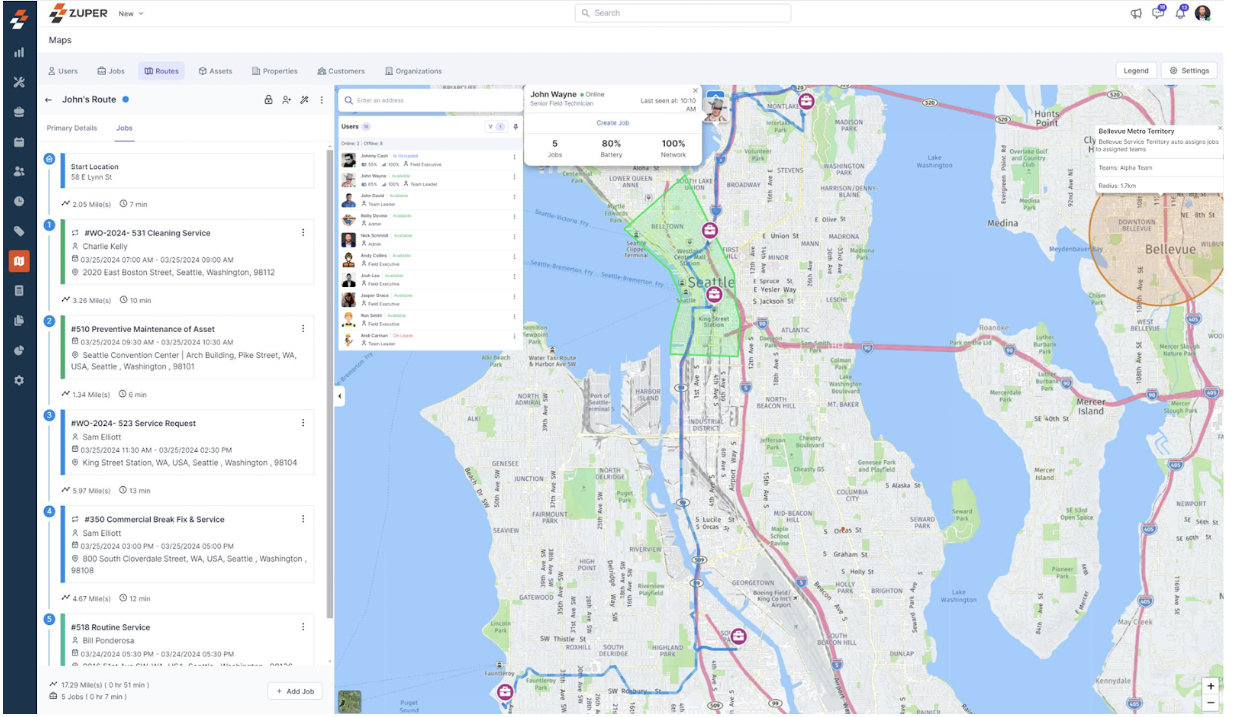
One hundred days closer
By March 2025, Subbaraj had a concrete number to attach to his advice about customers. He said he had spent more than 100 days on the road the previous year. Those visits, he explained, helped shape product development and sales strategy. Listening was something for which he had made room in the calendar.
“Travel, meet them face-to-face, ask the right questions, and truly listen.”
Anand Subbaraj, 2025
He was then a finalist for CEO of the Year at the GeekWire Awards. Zuper had won the previous year’s Next Tech Titan award. Recognition provides a tidy date for a company history. A hundred days of travel suggests the less tidy work happening between those dates: learning how customers actually run their businesses.
The business had already attracted substantial investment. In December 2023, Zuper announced a $32 million Series B led by FUSE. At that point it had 180 employees and offices in Seattle and India. Total funding reported with the round was $46.1 million. Those are company figures, belonging to a particular moment in its development.
Investment led by FUSE, with Zuper operating across Seattle and India.
Investment buys the ability to make more decisions. It also makes the quality of those decisions more consequential. Subbaraj’s insistence on visiting customers offers one answer to the distance that can grow between a software company and the working days it hopes to improve. A meeting with an operator can expose complications a product presentation conveniently leaves out.
His own writing reaches for other ways to explain operating discipline. Among his published article topics is what cricket can teach field service management. It is an apt pairing for someone concerned with timing, coordination and people distributed across a field. The metaphor at least comes with a reasonable expectation that everyone knows where to stand.
The roof changes the requirements
In September 2025, Zuper introduced a platform specifically for roofing businesses. It connected lead intake, inspections, proposals, contracts, scheduling, production and payment. The launch included partnerships with Hover and RepCard, alongside a roofing advisory council chaired by Maven CEO JT Ulyatt.
That council is a revealing addition to the product announcement. A software team can understand workflows in considerable detail and still benefit from people whose businesses depend on them. Bringing operators into discussions about product direction gives Subbaraj’s preference for customer proximity an organizational form. It creates another place for assumptions to encounter experience.
Roofing also makes the physical constraints of software unusually plain. Someone taking notes on a roof has a different relationship with a screen from somebody writing notes at a desk. A useful feature still has to fit the job. Attention is already spoken for, and documentation has to happen somewhere within the day.
Zuper Glass, announced in November 2025, brought that issue into hardware. The glasses connect with the company’s mobile app and support voice-directed photos, video, notes and inspections. The aim is to capture information while the work is happening and sync it with the platform, reducing the need to reconstruct events afterward.
For Subbaraj, this extends a problem he has been describing for years. A record in the office is only useful if the field team can contribute to it. The design question becomes quite specific: how should a person supply that information when their hands and attention are occupied? Voice is the company’s proposed answer.

The work after the answer
In May 2026, the company introduced Zuper Sense. It is designed to examine operational information, flag risks and recommend actions, including handing tasks to specialized agents. The examples are recognizably businesslike: estimates going stale, invoices going unpaid and crew time being used inefficiently.
The proposed change puts more responsibility on the software. Storing a record and suggesting what to do about it are different jobs, each requiring its own test of usefulness. For an owner, the attraction is understandable. A system that helps identify the next task could reduce the work of searching for it.
- 01 Monitor
- 02 Analyze
- 03 Predict
- 04 Recommend
Four product functions, with a practical destination: the next useful action.
September brought an announcement of four additional agents, covering accounts receivable, sales coaching, weather and reputation. Availability varied: the receivables agent was announced as forthcoming, while the sales coach was in beta with selected companies. Behind the names are tasks that occupy real hours in a contractor’s week.
The same announcement framed the work around operators’ requests for completed documentation, followed-up invoices and useful answers in the morning. That specificity is a useful standard for Subbaraj’s ambition. New capabilities need to earn their place in a business that already has customers waiting.
His October 2026 appearance on Build It To Sell It returned to that practical territory, discussing AI in contractor operations. The setting of his work has become more specialized, and the tools more ambitious. The basic question remains easy to recognize: what does the next person need to know before the next job begins?
Subbaraj’s story keeps returning to the distance between a promise and its delivery. A workshop can stay on the calendar. A technician can arrive with a useful history. An office can learn what happened without making another call. These are small events to build a career around, until you are the person waiting for one of them.