The road from San Francisco’s airport to Stanford gave Amr Awadallah an unexpected introduction to his future. He had come from Egypt to study, with a plan to become a professor like his father. Along the way, he saw the headquarters of technology companies he already knew by name. Business suddenly had an address. A company was something people could build, somewhere a person could walk through the door.
Awadallah has described that journey as a change in his sense of possibility. Stanford supplied the next part: entrepreneurship courses, visiting speakers, and explanations of how to start a business and raise money. “It changed me,” he said. The academic destination remained on the map. Another route had become visible.
His career would take him through shopping search, Yahoo’s data systems, Cloudera, Google Cloud and Vectara. The job titles make a respectable procession. The more interesting story sits between them: a researcher’s attention to how things work, followed by a founder’s question about whether anybody else can use them.
The professor who took a different exit
Awadallah arrived in California in 1995. He already had bachelor’s and master’s degrees from Cairo University. Becoming an academic was a concrete ambition, supported by an example at home. His father had earned a doctorate and become a university professor. Education offered a route with recognizable stages and a destination the family understood.
Silicon Valley gave him a competing set of examples. The companies along the road made the prospect of entrepreneurship less abstract; the people speaking at Stanford made it sound achievable. That is a modest kind of revelation, without a dramatic invention or a prophetic business plan. A person notices that something previously distant is within reach.
He left his doctoral work unfinished to start a business and later completed it while working at Yahoo. The arrangement matters. An entrepreneurial detour did not erase the original commitment. His biography carries both the doctorate and the company acquired before he earned it. Even an orderly academic plan can turn out to have rather untidy working hours.
“It changed me.”
Amr Awadallah, on Stanford’s entrepreneurial culture
First, teach a figure to walk
Before he worked on vast quantities of business data, Awadallah investigated a much smaller spectacle: an animated human taking a step. His master’s research examined how to generate convincing walking motion. The problem is deceptively familiar. Everybody recognizes a walk, yet reproducing one on a computer requires attention to movements people usually perform without thinking about them.
The work combined recorded motion with mathematical simulation. His research page describes generating walks from a few specifications, including step length and speed. The objective was to produce natural movement with less manual animation. There is a pleasingly concrete image behind all the equations: a figure that has to make it across a screen without looking peculiar.
His Stanford research moved from figures to servers. Working with Mendel Rosenblum, he studied the vMatrix, an architecture using virtual machines to move internet services among physical computers. Its applications included bringing services closer to users, sharing hardware among services and improving fairness in multiplayer games by reducing differences in network delay.
That last application gives the doctorate an unexpectedly playful edge. A scholarly investigation of internet infrastructure could also concern whether one player enjoyed an advantage because a server was closer. The vMatrix name borrowed from The Matrix. His research site explains the analogy with a smile, and keeps links to humorous game videos alongside the publications. A thesis is allowed a sense of humor, provided the servers behave.
The desks came before the ticker symbol
His first business dealt with another everyday irritation: finding product information and comparing prices online. Yahoo acquired the shopping-search startup in 2000. Awadallah joined the company and spent eight years there, eventually serving as vice president of product intelligence engineering. A search problem had opened the door to a much larger collection of data problems.
At Yahoo, he ran one of the early organizations using Hadoop for analysis and business intelligence. The appeal was practical: working with large amounts of information, keeping it available and finding useful ways to examine it. By 2008, he was an entrepreneur-in-residence at Accel and preparing to take that experience into a new company.
Cloudera brought together Awadallah, Jeff Hammerbacher, Mike Olson and Christophe Bisciglia. It was a meeting of experience from Yahoo, Facebook, database software and Google. Awadallah became its global chief technology officer. For 11 years, his work included helping enterprises ingest data and extract value from it.
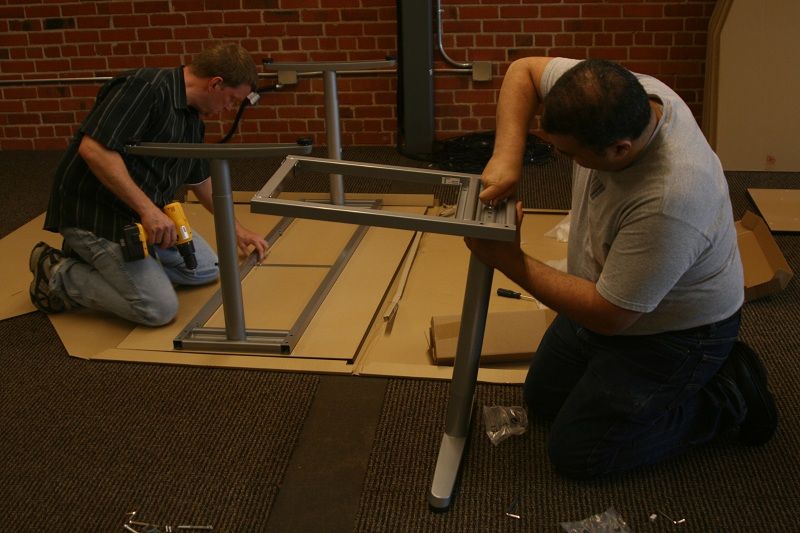
A photograph from the early office offers a useful corrective to the later financial milestones. Awadallah and Olson are assembling desks, kneeling beside an upturned frame. Cardboard covers the floor. It is company building with unusually literal documentation.
Cloudera’s first product plans also needed adjustment. Awadallah recalled that the founders initially intended to offer a cloud service; larger customers wanted software they could run on their own premises. The team changed course. Recognizing a technical opportunity and discovering how customers will buy it are separate pieces of work.
IPO priced at $15 a share; trading began on April 28.
The offering put a public price on years of private work. Cloudera offered 15 million shares at $15 each, a $225 million offering before underwriting costs. Those numbers describe the transaction. They cannot show the customer conversations, technical decisions or office furniture behind it. The desk photograph has the advantage of being comprehensible without a prospectus.
A painful lesson in being heard
Awadallah joined Google Cloud in November 2019 as vice president of developer relations. His tenure ended in July 2021, following employee criticism of an essay in which he described overcoming earlier antisemitic beliefs. He said the essay was intended to encourage understanding. Employees objected to its content, and Google dismissed him.
He subsequently published an account of his intentions and the discussions preceding the essay. It was a difficult public break in a career often summarized through acquisitions and founding roles. The episode also exposes a limit to a technical biography: describing a person’s intended message does not settle the experience of the people receiving it.
The next startup chapter would place him back among engineers, developers and enterprise customers. It would carry familiar concerns about access to information, now complicated by software capable of composing an answer in remarkably convincing prose.
Give the answer something to stand on
Vectara launched its neural-search service publicly in October 2022. Awadallah co-founded it with Amin Ahmad and Tallat Shafaat. The initial ambition was to let developers add sophisticated search to applications without assembling a specialist machine learning team. A user could ask a question in ordinary language; the system would search for meaning beyond a matching string of words.
In his launch writing, Awadallah emphasized a familiar imbalance: advanced AI was already present in major services, while many developers could not easily put it into their own products. Vectara packaged the search pipeline behind APIs. The appeal lay in narrowing the distance between a technical capability and an application someone could actually build.
His later interviews returned to the ordinary developer, including people working outside Silicon Valley. That emphasis is revealing in someone with a Stanford doctorate and experience at large technology companies. Expertise can create a useful product, but it can also hide the amount of expertise the product demands from its users.
- 01RetrieveFind relevant material
- 02RankOrder useful passages
- 03GenerateWrite from that context
- 04CheckEvaluate factual support
A simplified view of retrieval augmented generation and Vectara’s consistency evaluation.
As generative AI became part of the offering, another problem demanded attention. A language model can produce an answer with fluent sentences and unsupported details. In his conversation with Matt Turck, Awadallah explained an approach that first retrieves relevant facts, ranks them and supplies them to a model that summarizes them into a response. The answer has a reading assignment.
Vectara called its approach grounded generation, part of the broader practice known as retrieval augmented generation, or RAG. Grounding gives a model relevant material to work from. It also creates a task for the builder: checking whether the resulting answer stays faithful to that material.
In November 2023, Vectara released a hallucination evaluation model and a public leaderboard. The evaluation examined document summaries for information unsupported by the original text. It was a defined test, with a model acting as judge and its own classification limits. That specificity matters. A result on summarization describes that task; a dependable business application requires attention to the whole process.
The company also developed citations and monitoring features so users could inspect answers. In July 2024, it announced a $25 million Series A, bringing disclosed funding to $53.5 million, alongside its Mockingbird language model. The product work increasingly concerned the relationship between generating text and being able to account for it. An impressive answer still has to survive a reader’s follow-up.
The next question belongs to somebody else
On December 22, 2025, Awadallah announced that he would step away from the CEO role after four years. Shafaat, his co-founder and the company’s chief architect, would take over. Awadallah thanked the team, described the transition as planned with the board, and expressed support for the company’s future. Vectara now lists Shafaat as CEO.
He also asked his network for advice about the emotional side of letting go. It is an unusually direct question after a career spent answering technical and commercial ones. A founder can arrange a succession and still need help adjusting to it. Ownership of an idea and responsibility for running its company do not always keep the same calendar.
His public activity continued. In 2026, he published writing applying computational methods to religious texts. September reporting identified him as a board member of Synapse Analytics, an Egyptian-founded AI business he had backed. These are separate activities, rather than an announced replacement for his former CEO job.
The student arriving from Cairo had expected to return to a professor’s life. He instead built businesses around changing ways to search, store and interpret information, while completing the education he had begun. Now one company continues under another leader, and his own next chapter remains his to choose. The road from the airport has acquired quite a few exits.