The most revealing word in Amit Bhardwaj’s professional biography may be the least glamorous one: operations. Artificial intelligence gets the keynote. Cybersecurity gets the war-room metaphor. Cloud gets a diagram full of arrows. Operations gets Monday morning, when the new system must open on time, the access controls must behave, the help desk must answer, and the people doing the work must not need a second career in troubleshooting.
Bhardwaj is the chief executive of Elevance Systems, a healthcare-focused IT managed-services company based in Cupertino. His remit is the company’s overall vision and strategy. His experience, 27 years of it, crosses information technology, human resources, business development, and operations. Put those four disciplines around one table and you get a useful sketch of modern transformation: the thing to build, the people who will use it, the reason anyone will pay for it, and the daily discipline required to keep it alive.
That breadth explains why Elevance Systems does not present technology as a single immaculate object. Its work covers assessment, data, AI and automation, applications, cybersecurity, cloud, infrastructure, workforce, and ongoing support. It is a catalog of dependencies. The point is not that every client needs every service. The point is that none of these services lives alone for very long.
The middle is where the product becomes real
There is a popular version of digital transformation in which an organization buys a clever tool and crosses a finish line. The managed-services version begins at that finish line. Who migrates the data? Who trains the staff? Who watches the network? Who updates the application? Who notices the quiet warning at 2:13 a.m.? Who decides whether an AI-assisted workflow belongs in the real operating environment rather than a polished demonstration?
Bhardwaj’s company sits in this useful middle. It joins strategy to implementation and implementation to maintenance. The work is less cinematic than invention and more consequential than a slide deck. It requires a leader to hold two ideas at once: technology should change what is possible, and the change must still survive contact with calendars, permissions, budgets, regulations, staffing plans, and old systems with surprisingly good lawyers.
That is why a portfolio spanning AI, data, security, infrastructure, applications, and workforce support makes strategic sense. A cloud migration changes the security boundary. A new application changes training and support. Automation changes roles and escalation paths. Better data changes what teams can measure, which changes what leaders ask them to improve. Each upgrade tugs on the rest of the organization like a thread in a rather expensive sweater.
The practical transformation loop
Bhardwaj’s range also matters here. An executive formed only in technology might overvalue elegance. One formed only in sales might overvalue novelty. Operations teaches respect for repeatability. Human resources teaches that systems are inhabited by people, not “users” rendered as tidy icons. Business development teaches that value must be visible to the buyer. The job is to let each perspective correct the excesses of the others.
02 / A six-month chapterAn acquisition without the costume change
In the third quarter of 2024, Elevance Systems began the process of acquiring R4 Solutions, a healthcare IT services organization. The work took six months. The deal was signed at the end of April 2025 and announced on May 1. Bhardwaj remained chief executive of the combined company.
The announcement contained a line that sounds modest but carries the weight of an operating philosophy: beyond the name change, customers should not expect major changes in the services they received. Acquisitions are usually narrated with trumpets. Here the promise was closer to a well-managed house move: the address book remains intact, the lights work, and nobody discovers the servers in a box marked “miscellaneous.”
Continuity is not inertia. It is a constraint that forces precision. A company can expand its service offerings, combine teams, and change its identity while protecting the daily experience of customers. That requires decisions about systems, responsibilities, communication, and delivery to be made before the new logo is asked to perform miracles.
The acquisition broadened the platform around a consistent idea: healthcare organizations need technology partners that can do more than install. They need collaborators capable of staying with the system through migration, implementation, risk mitigation, infrastructure support, and the ordinary run of service delivery. The combined organization kept Bhardwaj in the role that connects those pieces.
03 / The operating mapOne strategy, many stubbornly connected systems
The phrase “AI-enabled” can stretch until it means almost nothing. Elevance Systems gives it a more bounded home. AI and automation sit beside data architecture, application management, cybersecurity, infrastructure, cloud transformation, assessment, training, and staffing. That placement is revealing. Intelligence is treated as part of an operating environment, not a decorative layer placed over it.
The Elevance operating stack
In that model, the interesting question is not whether a tool can generate an impressive answer. It is whether the answer arrives inside the right workflow, with the right permissions, on dependable infrastructure, supported by people who know what happens when it is wrong. The final mile is full of judgment. It tends to resist slogans.
This makes the CEO less a solitary visionary than a systems integrator. Bhardwaj’s public role is to set vision and strategy, but the strategy itself is expressed through interdependence. Data quality affects automation. Security affects access. Training affects adoption. Staffing affects response time. Infrastructure affects everything while receiving thanks from almost no one, which is perhaps how infrastructure knows it is doing well.
The company’s language returns frequently to outcomes, productivity, and cost. Those are operator’s measures. They keep the conversation close to what changes after the project team packs up. Did work become easier to complete? Did the system remain available? Did support improve? Did the organization gain room to focus on its own priorities? The questions are plain on purpose.
04 / Recognition and rangeThe award is a snapshot; the range is the story
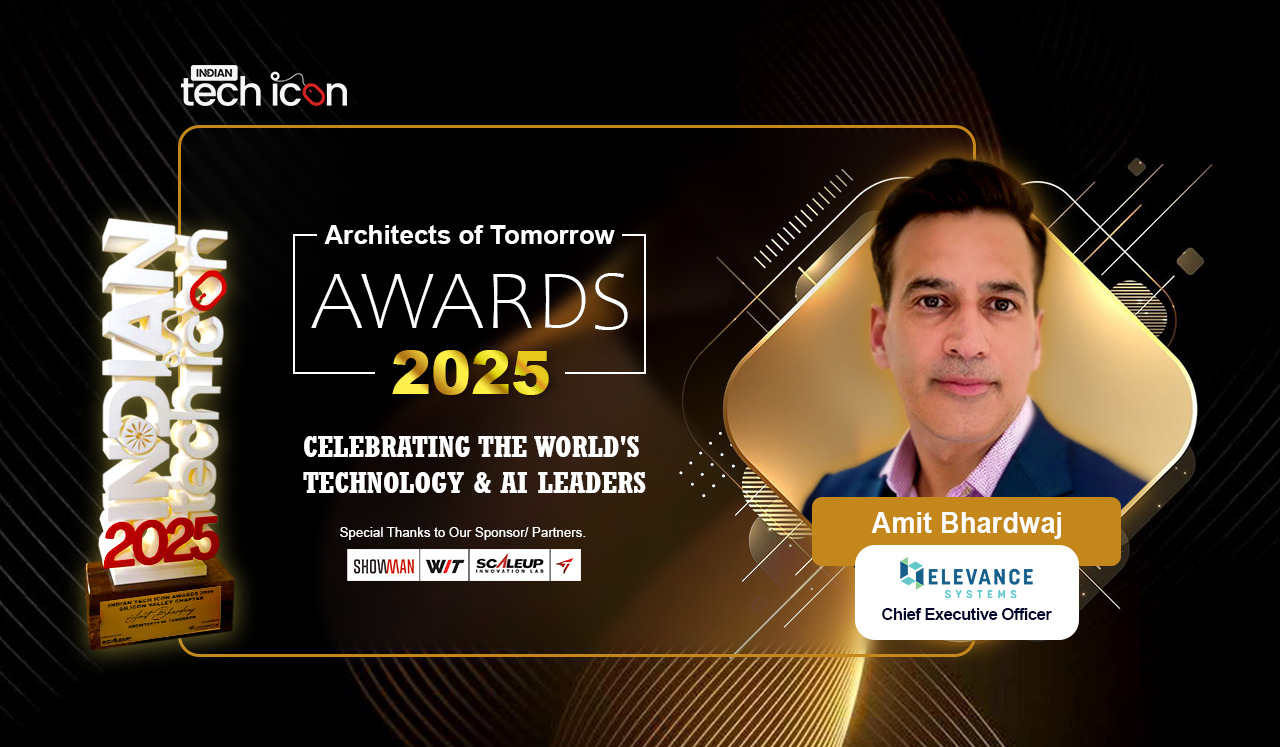
In September 2025, Bhardwaj was recognized with an Architects of Tomorrow Award from Indian Tech Icons’ Silicon Valley Chapter. The announcement emphasized technology leadership, innovation in healthcare IT, a customer-first approach, and a focus on delivery. Awards turn long work into a date, a title, and a photograph. They are tidy in a way careers are not.
The more instructive detail is the sequence. The award followed the acquisition year. It arrived after a six-month transaction that expanded the company while promising continuity. The public honor captured an image of leadership; the preceding work showed its operating conditions.
Bhardwaj’s professional range offers a counterpoint to the cult of narrow expertise. Depth remains essential, but a CEO is often responsible for the borders between areas of depth. IT must meet people operations. Delivery must meet business development. Strategy must meet the stubborn clock of execution. A leader who has worked across those territories can recognize when a brilliant local decision creates an expensive problem next door.
05 / The trail beyond the officeA long-route temperament
Away from work, Bhardwaj is described as a seasoned outdoorsman who enjoys hiking and travel. It is a small fact, but an apt one. A trail is a system disguised as scenery. It has an objective, dependencies, changing conditions, and a ruthless opinion about footwear. Progress is visible, but rarely instantaneous.
The comparison should not be pushed too far. Corporate metaphors already have enough oxygen. Still, the patience of the long route fits a career measured in 27 years and a strategy built from connected services rather than a single revelation. The work asks for a destination and attention to the next practical step.
For Bhardwaj, the current route runs through a broad managed-services business with teams and service offices across several regions. The company’s challenge is to make a complex portfolio feel coherent to the organizations relying on it. The CEO’s challenge is to keep the vision large enough to guide that portfolio and specific enough to survive Monday morning.
06 / The quiet betMake the future dependable
There is an unfashionable confidence in building for continuity. It does not reject novelty. It asks novelty to do the paperwork, pass the security review, meet the existing workflow, and remain useful after the demo tab closes. In healthcare IT, that discipline is not the enemy of ambition. It is the condition that lets ambition enter the building.
Bhardwaj’s public story is therefore less about a single product than a way of arranging work. Assess before building. Connect before declaring victory. Secure the environment. Train the people. Operate the result. Improve it. Then repeat, because systems age and organizations change and someone will always discover one more spreadsheet under a desk.
The bet behind Elevance Systems is that technology creates value when the joins are managed as carefully as the parts. The bet behind Bhardwaj’s leadership is that experience across technology, people, growth, and operations can make those joins visible. AI may get the headline. Dependability gets the renewal.