The bug did not look like a company. It looked like a table that had forgotten which numbers belonged to which rows. Aman Mishra was the first full-time engineer at a San Francisco startup building AI copilots for large enterprises. The product could answer questions over internal knowledge, but first it had to ingest the knowledge: policy documents, financial files and filings, often dense with boxes, footnotes and layouts designed for human eyes. Clean PDFs behaved. The documents people actually used did not.
Mishra has described watching that startup grow from three people to more than 20 engineers and move from proof of concept to production at Fortune 500 companies. Yet errors remained at the ingestion layer. A capable model could reason only over what the pipeline handed it, and a pipeline that flattened a table might preserve every character while losing the relationship that made those characters useful. Expensive intelligence was being served scrambled evidence.
He carried that irritation into Unsiloed AI, the company he co-founded in 2025 with Adnan Abbas. Its proposition is compact enough to fit in an API description: turn PDFs, presentations, images, scans and spreadsheets into structured Markdown or JSON. The engineering beneath it is less compact. Layout, hierarchy, reading order and confidence have to survive the trip. A right-aligned number may be a total. An indent may mark a subordinate clause. A footnote can change the number above it. Typography, in this business, is data wearing a suit.
A systems engineer collects messy systems
Mishra introduced himself in a 2022 student interview as being from Kolkata. At the time he was an undergraduate in Industrial and Systems Engineering at IIT Kharagpur, a discipline concerned with how complicated operations fit together. He had already become curious about startups after an early internship and spent his second year reading Paul Graham’s essays and other Y Combinator material. The fascination was not entirely theoretical. From his dorm room, he launched a peer-to-peer rental platform that reached thousands of orders within two months.
His route into software was practical and slightly bruising. To win an internship at Honeywell, he passed a timed coding test, a technical interview and an HR round. His weak point, he later told younger students, was explaining his solution clearly. He asked seniors and friends to run mock interviews until the explanation improved. His advice was to prepare in a group, know every line on the résumé and accept rejection as part of the process. The final flourish was charmingly direct: “Just Keep Calm and Keep Coding.”
After IIT Kharagpur, Mishra worked on ultra-low-latency trading systems at the hedge fund Teesta Investment, building systems that moved billions across markets. Trading infrastructure is allergic to ambiguity: speed matters, but deterministic behavior matters beside it. Then came the enterprise copilot startup, where the origin of uncertainty moved from market latency to documents. The recurring taste was for software whose errors become operational, not merely cosmetic.
Third time, with more company
Mishra and Abbas were batchmates at IIT Kharagpur, but brought different experience to the same problem. Abbas had worked on autonomous navigation at Mercedes-Benz and on multimodal models. Mishra had the trading systems and enterprise application history. Together they applied to Y Combinator three times within eight months. Between interviews, Mishra wrote, they kept “building, breaking, iterating and selling.” The phrase is more revealing than the eventual acceptance. Persistence without new evidence is stubbornness. Their version produced a changing product and a thickening file of customer conversations.
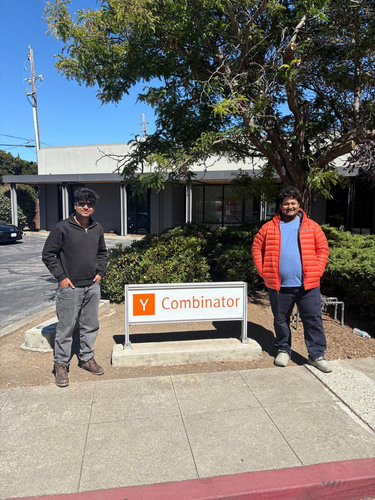
Unsiloed entered YC’s Fall 2025 batch. Mishra recalled first encountering YC as a student, then arriving after the third interview. He thanked the people at Entrepreneur First and friends who had helped from “Day -1.” Co-founder mythology often edits out the near-misses. Mishra left the count in. It gives the acceptance a useful denominator.
YC also changed the pace. “YC compresses months of growth into weeks,” he said after the batch. His explanation was less about prestige than tempo: founders leave with a revised idea of how fast “fast” can be. That pace soon became literal diary management.
The day with forty demos
After Unsiloed’s YC launch, inbound requests came from five continents. At the peak, Mishra says he took more than 40 demos in a single day, using 15-minute slots. The callers ranged from early startups to established enterprises and came from the United States, India, Europe, the Middle East, Australia and South Africa. Their industries differed. Their complaint translated neatly: complex documents would not reliably become structured data.
Before that launch, the founders had already held more than 250 conversations with teams. In the later YC launch description, the count had passed 300. The number matters less as founder aerobics than as category research. When buyers with different job titles and different files describe the same patched-together workflow, a product starts to resemble infrastructure.
The company’s system combines vision models with OCR-based methods. Documents are segmented into text, tables, images and plots. Two parallel representations preserve content and layout, after which a domain-aware decoder produces a requested schema. The company says it can attach confidence scores to extracted items and deploy in private environments. These are not decorative technical choices. They address the moment when a neat prototype meets a thousand-page filing with merged cells, split rows and one consequential footnote.
Accuracy meets its awkward follow-up
By 2026, Mishra’s public writing had shifted from explaining the category to interrogating its operating details. In one essay, he recounted presenting benchmark results to the CEO of a mortgage servicing firm in New York. The executive interrupted with a sharper question: even if the system were 95 or 97 percent accurate, how could his team know which results did not require review? If they had to check everything, the automation had merely acquired a software bill.
That encounter sharpened Mishra’s argument for calibrated confidence scores. A model can be accurate in aggregate and operationally unhelpful if it is confidently wrong at unpredictable moments. The useful threshold is not the prettiest percentage on a sales slide. It is the point at which a team trusts selected outputs to pass straight through and routes doubtful fields to a person.
That focus also explains Mishra’s fondness for financial documents. A rent roll, bank statement or regulatory filing is not difficult because the alphabet changes. It is difficult because relationships do. A number detached from its row can travel quietly into a ledger or analysis. The eventual error looks like bad judgment, though it began as bad reading.
An essay he published in January 2026 offered a playful mental model: documents are visual programs. Titles create hierarchy, tables encode relationships, and alignment carries logic. Humans execute these programs almost unconsciously. Conventional text pipelines erase part of the instruction set before an AI sees it. The ambition, as Mishra frames it, is to make documents computable rather than merely readable.
The loop around the model
Mishra’s latest writing broadens the same instinct beyond documents. He argues that AI teams often treat the base model as the ceiling of their product, then wait for the next release. The less glamorous leverage sits in the loop around it: prepare cleaner context, define an actual stopping condition, use smaller models for smaller jobs, notice repeated tool calls and keep verification separate from execution. The underlying model may stay fixed while quality rises and cost falls.
It is a systems engineer’s answer to a model-obsessed moment. Inputs, controls and feedback rarely earn launch-day glamour, but they determine whether the clever component survives contact with work. Mishra learned that in trading systems, encountered it again in enterprise copilots and made it the center of Unsiloed.
The company’s stated mission has expanded from becoming the default platform for unstructured financial data to serving as a general document interface for AI agents. The language is ambitious, but the work remains pleasingly specific: keep the table whole, keep the clause beneath its heading, flag the doubtful number, show where it came from.
There is a personality visible in that sequence. An internship recommendation praised Mishra for taking ownership across engineering and operations. His student advice favored practice with friends over solitary heroics. His YC story preserved the two failed attempts. His sales story counted the conversations. He appears drawn to measurable effort and willing to publish the unflattering denominator.
Artificial intelligence is full of impressive answers. Mishra is building around a quieter question: what, exactly, did the machine read? In a market racing toward agents that act on our behalf, that may be the fine print worth slowing down for.