A perfectly good sofa can become a remarkably bad problem. It occupies the living room quite happily until somebody has to leave. Then it requires a buyer, a vehicle, a free afternoon and several people whose friendship can withstand a staircase. Alpay Koralturk had been through enough New York moves to recognize the pattern. In 2014, newly married and furnishing an apartment with his wife, he encountered it again. This was his seventh move in the city. Surely buying secondhand could be easier than this.
The couple wanted to furnish thoughtfully. The process rewarded them with inconvenience. The distance between a promising listing and an actual piece of furniture in their home was full of arrangements that could unravel. Koralturk would spend the next decade trying to close that distance. His company eventually took the name Kaiyo, selling used furniture while taking charge of the labor that made the transaction possible.
There is a pleasing domestic scale to the beginning. Before the financing rounds and the California expansion, two people needed somewhere to sit. Koralturk’s response was to build a business around the work everyone else wanted somebody else to do.
An education in changing direction
He had grown up in Turkey and attended Robert College in Istanbul. From there he went to Wesleyan University in Connecticut, studying mathematics, economics and computer science. He graduated in 2008. The combination suggests a person comfortable with both numbers and systems, although his subsequent career would take a less orderly route than a university course catalogue.
J.P. Morgan came first. He worked on derivative products, beginning his career in 2008, a difficult year to arrive in finance. After two years on Wall Street, he wanted work he found more fulfilling. Money alone was an insufficient reason to remain. That dissatisfaction belongs in the story because it helps explain the successive changes of industry that followed.
He worked in strategy at the fashion commerce company Moda Operandi and co-founded the mobile game studio Gram Games in 2012. His listed tenure as its co-founder and CEO ran until 2014. Zynga acquired Gram Games for $250 million in 2018. The acquisition came later than his operating tenure; keeping those dates in order makes his career more intelligible than treating every milestone as simultaneous.
Furniture was another turn, but his earlier experience had practical uses. Pricing, demand, consumer behavior and software would all matter to the business he was assembling. A game lives on a screen. A wardrobe has rather more demanding requirements for transport.
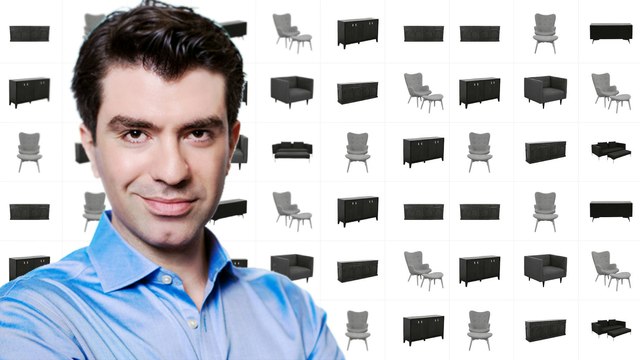
The habit before the business
Koralturk’s environmental interests predated the apartment search. School friends later reminded him that, as a teenager in Istanbul, he had collected recyclable litter from the street. Recycling bins were scarce. He had forgotten the episode; his friends had retained the picture of a boy picking things up around town. It is a useful detail because it gives his later mission a history outside a company presentation.
Asked to describe his work in three words, he chose “Environmental, passion, legacy.” The words were earnest. The problem he pursued was practical. A person can believe in reuse and still give up when it requires renting a truck or negotiating with strangers. Koralturk wanted the service to absorb those complications so that the customer’s good intentions had a chance of surviving moving day.
A rental company learns to sell
The venture was founded in 2014. Its early service, Furnishare, launched in 2015 with a rental model. Customers could choose professionally cleaned furniture on a monthly subscription, with delivery included. A 2016 account described a package of three pieces. Ownership, in that version of the idea, was something the customer could avoid.
Furnishare went through several iterations. By 2019, Koralturk had turned the lessons into Kaiyo, a marketplace for resale. The change gave the original problem a different answer: help existing furniture find another owner, and make the exchange manageable. A useful frustration had lasted longer than the first business model built to address it.
The new identity was developed with Pentagram, including partner Natasha Jen. The March 2019 announcement placed lasting design and accessibility at its center. It was a deliberate attempt to give used furniture an appealing presentation. People buying a secondhand table could care about its appearance just as much as its price. The website had to make room for both.
One object. Several jobs.
- 01CollectPick up accepted furniture
- 02PrepareClean, photograph, store
- 03ResellPrice and list the piece
- 04DeliverMove it to its next home
The customer who brought a checkbook
In 2021, the company’s next financing conversation began through a customer. Liza Benson, a partner at Moderne Ventures, had used Kaiyo and liked the experience. Koralturk said the business was not looking to raise money at the time. Her interest led to conversations and a $5 million Series A involving Moderne Ventures, Lerer Hippeau and Max Ventures.
A furniture transaction makes a fairly unforgiving product demonstration. The collection happens or it does not. The item arrives or it does not. Benson had experienced the service before hearing the investment case. That is a particularly concrete way for a founder’s proposition to reach a potential backer.
Expansion followed. Philadelphia had joined the service area in 2020; Washington, D.C., followed in 2021. In March 2022, Kaiyo announced a $36 million Series B led by Edison Partners. The financing combined equity and debt. California was the next major destination, with investment also intended for hiring, marketing and the existing markets.
Equity and debt announced in Kaiyo’s Series B, led by Edison Partners.
Koralturk’s ambition was broader than a particular city. He compared furniture with cars: expensive purchases that depreciate but can retain years of use. Used vehicles had an established resale culture. Furniture, he argued, had much more room to circulate. In 2022 he said nearly 70 percent of Kaiyo’s sellers had never sold furniture before. That was the behavior he wanted the service to encourage.
The sofa still has to fit through the door
Kaiyo’s promise meant taking custody of the awkward object. Accepted furniture was collected, cleaned, photographed and stored before delivery to a buyer. Inventory selection mattered. The business had to judge which pieces people would actually want, rather than fill a warehouse with things that merely deserved another chance.
Pricing software helped make those judgments. The company used data about brands, condition and demand, adjusting prices as the market changed. In January 2022, its Instant Offer feature added another possibility: sellers could accept an upfront payment after collection and acceptance instead of waiting for the item to resell. Certainty about payment was part of the convenience being offered.
The physical operation grew from modest beginnings. Kaiyo’s first storage arrangement consisted of three separate rented units in New Jersey, roughly 900 square feet in all, opening onto a parking lot used for processing. By July 2023, its warehouse footprint was roughly half a million square feet. Those two measurements convey the change more plainly than a string of growth adjectives could.
They also make the undertaking visible. Every additional warehouse meant more room to hold furniture, and more of the business tied to places, people and transport. A tidy digital shop window depended on a much less tidy chain of physical tasks. The customer was being spared work; the company was inheriting it.
“Cash is king.”
Alpay Koralturk, advising other founders in 2021
There was a larger aspiration behind the deliveries. In 2023, Koralturk described wanting the company to leave a legacy beyond its sales. He hoped people who thought more carefully about furnishing their homes would extend that attention to their neighborhoods and communities. It was an expansive ambition to attach to a furniture transaction, but consistent with his decision to leave finance in search of more satisfying work.
The ambition also gave him a reason to care about the experience of ordinary buyers. His audience included people trying to make a home on a budget. A good secondhand purchase could bring them access to a piece they would otherwise pass over at full price. For Koralturk, the bargain and the environmental intention could coexist in the same living room. The service was meant to make that combination feel easy.
April comes before August
Koralturk left Kaiyo in April 2024. In his departure announcement, he named early investor, executive and friend Haluk Emiroglu as the person taking over. He thanked the team and the people who had supported him. He also acknowledged how thoroughly the job had spread through family life: nights, weekends, holidays, and the hours when he was nominally away from work.
Later that summer, the business entered a different chapter. In August, Kaiyo’s wind-down was reported amid complaints from sellers waiting for payment. Company correspondence said operations would continue only to the end of that month. The difficulties affected people who had entrusted their furniture to the service. Those unpaid proceeds belong in any account of what happened to the company.
The chronology matters equally. Koralturk’s departure preceded the reported wind-down by several months. His tenure, the handover and the subsequent closure are separate events. Taken together, they leave a more complicated history than the expansion announcements suggested. Making resale convenient had won customers and investment; operating the service also required carrying its substantial physical costs.
His stated next step at departure was time with his family before deciding on another venture. After a career spent moving between industries, he was choosing a pause. The apartment problem had occupied a decade. For the moment, his announcement ended somewhere smaller than another market: a plan to join his four-year-old at the playground.