A bus stop is an unusually literal place to start thinking about connections. In 2016, Alim Khamitov was describing a proposed terminal for Almaty: a small machine where passengers could check bus times, work out a route, charge a phone, and pay for services. Wi-Fi was part of the plan. He put the likely cost at 300,000 to 400,000 tenge. Permission from the city would determine what happened next.
He said the idea had emerged while he was teaching at an international IT university. The problem was everyday and recognisable: people waiting beside a road needed better information. No grand theory was required. There was a passenger, a destination, and something missing between them.
Years later, as CEO of MOST Ventures and co-founder of MOST Holding, Khamitov works with a different set of travellers. Central Asian technology founders want to reach customers and investors beyond their immediate surroundings. They need directions, introductions, and sometimes money. His career has come to revolve around the distance between having talent and knowing where to take it.
An address for ambition
Khamitov comes from Almaty. His education took him to Indiana University and the Kelley School of Business, giving him experience of both computing and business. Back in Kazakhstan, he ran an outsourcing company and tried projects in transport and commerce. Then participation in an American accelerator prompted a larger question: why was comparable support so scarce around the founders he knew at home?
He chose to concentrate on the surroundings in which companies get built. In his account, he left his earlier businesses to focus on MOST. The choice has a particular entrepreneurial logic. You can keep attempting individual projects, or you can work on a recurring difficulty shared by the people attempting them. He chose the latter, with all the extra meetings that implies.
MOST already had a history. It began in 2011 as a club for young entrepreneurs; Khamitov joined the team in 2015. Pavel Koktyshev and Mirat Akhmetsadykov belong in that wider story. The community became an incubator and, eventually, a broader collection of investment and support activities. The sequence matters. People were gathering before there was a fund to pitch.
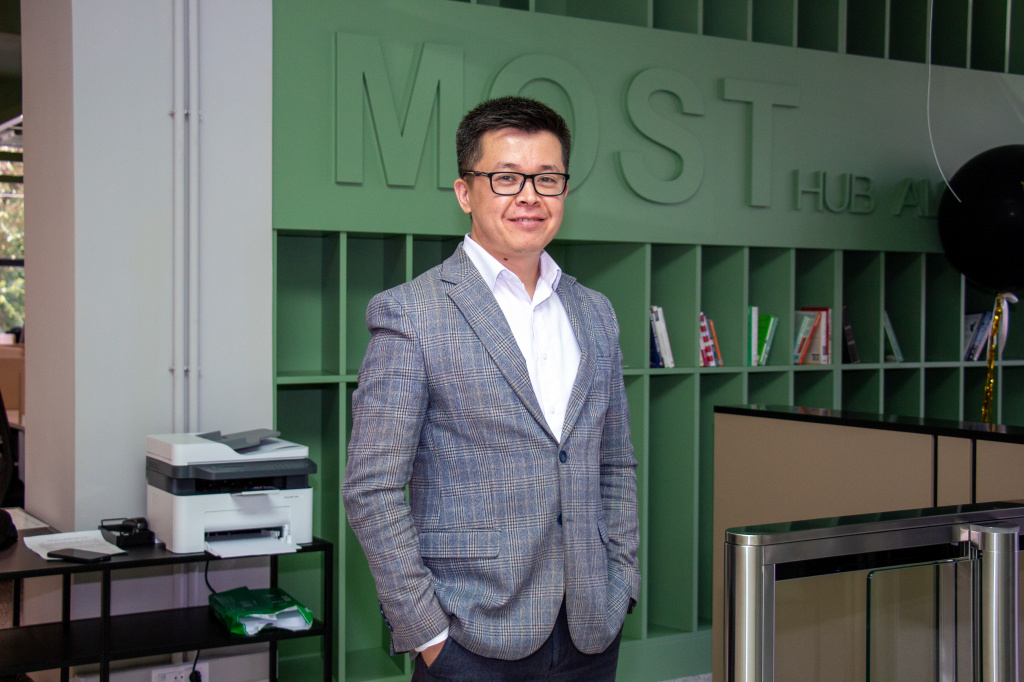
The later fund gave the community another instrument. MOST announced Fund I in December 2020 with a $10 million target. Formal responsibilities followed: the financial regulator’s register lists Khamitov as a director of MOST Investment Limited from March 2021, and CEO and director of the fund company from August that year. Community work had acquired the paperwork of capital management.
Teaching runs through the transition. In December 2020, Uzbekistan’s IT Park announced a webinar in which Khamitov would explain business angels and how to begin investing. The audience for that lesson was the other side of the startup table. Building support for founders also meant helping prospective investors understand what they were entering. An entrepreneur can learn to pitch more clearly; the person listening still needs to understand the proposition. Khamitov was spending time on both halves of that conversation.
The arithmetic of showing up
For someone who allocates money, Khamitov has an unusually explicit explanation of why he attends events. In 2023, he described the benefits of meetings even when venture investing was not their subject. Perhaps only one or two people out of thirty would become useful investment contacts. That was a reason to keep going.
His argument was about the number and quality of opportunities reaching an investor. Consider two fund managers selecting three promising deals. One has seen twenty proposals; the other, sixty. Khamitov used that comparison to explain why a growing network of trusted relationships matters. The arithmetic is simple enough. The difficult part is earning a place in the conversations that produce the proposals.
There is a pleasing indignity to this aspect of finance. Before someone can be selective about deals, they must be willing to put on a name badge. Khamitov’s reasoning gives the apparently social part of the job a business purpose: more useful contacts can mean better opportunities for everyone connected through them.
“Freedom of action is important for me in my work.”
Alim Khamitov, 2022
The social effort has a personal dimension. He once considered himself an introvert, then concluded that building something substantial required deliberately finding partners. He describes honesty and openness as values, calls himself a perfectionist, and favours autonomy in management. He also swims with performance targets. Even the ocean, apparently, can expect a review meeting.
America has more than one front door
In September and October 2022, Khamitov and colleagues from MOST and UMAY Angels spent nearly a month in the United States. They visited Texas, California, and New York, meeting investors, accelerators, startups, and corporate representatives. They were exploring connections for Central Asian companies entering the American market.
The geographical breadth was deliberate. Khamitov thought founders should examine costs, infrastructure, potential customers, and the shape of the local community before choosing where to arrive. Silicon Valley was an important destination, but the itinerary also included places such as San Antonio and San Marcos. The country deserved more careful consideration than a single pin on a map.
His advice started before departure: do the homework on the market. He had encountered founders who raised money at home, moved to America, and struggled because they lacked a clear action plan. He saw possibilities in Texas; other businesses might have better reasons to choose New York. An address should follow the company’s needs. A famous postcode cannot do customer research.
The cheque needs a job
By December 2024, Khamitov reported that MOST had invested about $1.5 million in eleven startups during the year, typically writing cheques of $100,000 to $200,000. He also described a shortage of larger financing for companies ready to expand. Early support was useful; businesses could still outgrow the amounts local investors could provide.
His assessment of founders was changing alongside the market. He put the typical age of founders receiving MOST investment at roughly thirty-seven to forty. This was his observation about the portfolio, rather than a census of Kazakhstan’s entrepreneurs. It suggested a professional world extending beyond student pitch competitions, with experience and previous responsibilities arriving at the table.
His investment questions remained quite concrete: what does the team know, does the product matter, how large is the market, can it travel, and what evidence of demand already exists? He described a preference for people prepared to stay with an idea for years. Enthusiasm is a useful beginning. It becomes more informative when accompanied by customers and persistence.
The same discipline applies to fundraising. Khamitov asks what an injection of money will actually change: which product will exist afterward, which results the company expects, which measurements will show progress. It is a question capable of making a polished pitch briefly uncomfortable. A precise answer gives both parties something to discuss after the presentation closes.
When the program meets its pupils
In 2025, the MOST Accelerator Fund put investment and acceleration into the same program. Its first selection brought ten teams out of roughly four hundred applicants. By October, Khamitov was discussing what happened after selection: some teams accelerated, some waited for funding, and some paused before finding momentum again.
There were practical frictions. A summer launch collided with travel schedules. Some founders needed to adjust to working independently without constant supervision. The program also gave the investor time to observe decisions as they happened. A pitch can explain a team’s intentions; a working relationship reveals how the team responds when those intentions meet a difficult week.
Khamitov described releasing investments in stages, assessing how founders prioritised work and used limited resources. His account made the program sound like something still being revised through experience. For an investor asking entrepreneurs to learn quickly, that is a useful standard to apply to the investor’s own machinery.

The wider MOST operation gives that supervision a physical and social setting. Its current activities include Investment Readiness Accelerator programs, office communities, investor education, and gatherings where companies can meet potential partners. These services have different immediate uses. Together, they make it possible for a founder to remain in contact with a network through several stages of a company’s life. For Khamitov, whose original question concerned missing support, the accumulation is part of the answer. Each new activity has to earn its place by helping someone take a next step.
A route that runs both ways
Fund I’s 2025 account included exits involving CTOgram and GoChat. By December, Qazaqstan Venture Group had signed a term sheet for an investment of up to $3 million from Alem Ventures Fund into MOST Accelerator Fund. Agreed terms are a distinct milestone from money fully paid in, but they show the institutional relationships being assembled around the model.
In 2026, Khamitov outlined plans to invest in at least ten companies. He described a mandate covering Central Asian founders wherever they operate, alongside international companies looking to expand into the region. Proposed cheques for more developed teams ranged from $250,000 to $1 million. These were intentions for the next stage of work, with execution still required.
That two-way movement gives his career its shape. An entrepreneur leaves Almaty, learns something useful elsewhere, and returns with a question. Years of teaching, introductions, programs, and investments follow. The destination keeps widening; the practical task remains recognisable. Someone has a company worth building and needs to know how to get from here to there.